Physicists have demonstrated that the universe cannot be a simulation because a complete and consistent theory of everything cannot be achieved through computation alone, requiring a non-algorithmic understanding that surpasses current mathematical frameworks, thus ruling out the universe being a simulation.
Physicists have demonstrated that the universe cannot be a simulation because a complete and consistent theory of everything cannot be derived from computation alone, requiring a non-algorithmic understanding that goes beyond current mathematical frameworks, thus ruling out the universe being a simulation.
Originally Published 4 months ago — by Hacker News
The article discusses the rise and fall of the contrarian physics podcast subculture, focusing on figures like Sabine Hossenfelder and Eric Weinstein, highlighting issues of scientific integrity, social media influence, and the challenges of public understanding of complex scientific debates. It critiques how controversy and social media can distort scientific discourse, emphasizing the importance of peer-reviewed research and accountability in science communication.
Dr. Gunther Kletetschka proposes a revolutionary theory that the universe is built on three dimensions of time rather than space, with space emerging as a secondary effect, potentially unifying quantum mechanics and gravity and predicting particle masses accurately.
Physicists from Aalto University have proposed a new framework suggesting that gravity emerges from hidden spacetime symmetries, potentially uniting it with the Standard Model forces and advancing the quest for a Theory of Everything. The theory introduces the spacetime dimension field, offering a promising, renormalizable approach to quantum gravity that aligns with Einstein's relativity at classical scales, though further development and experimental validation are needed.
Scientists have developed a new approach to unify quantum mechanics and gravity by reformulating Einstein's equations using fields, potentially paving the way for a testable theory of quantum gravity that could challenge Einstein's current understanding of the universe.
The pursuit of a "theory of everything" in physics, which aims to unify quantum mechanics and general relativity, is being hindered by a fear of failure. Historical examples, such as the ridicule faced by Albert Einstein and Arthur Eddington, have created a daunting legacy that discourages young physicists from tackling this monumental challenge. The current academic and funding environment further exacerbates the issue, making it difficult for new researchers to pursue this ambitious goal.
The pursuit of a "theory of everything" to unify quantum mechanics and general relativity has been hampered by a fear of failure, as evidenced by the ridicule faced by past physicists like Einstein and Eddington. This fear, combined with challenges in funding and career progression, discourages young scientists from tackling this monumental problem, potentially requiring collaboration from established physicists who can afford the risk.
Kent Yagi, a physicist at the University of Virginia, is leading innovative research using artificial intelligence to bridge the gap between Einstein's theory of general relativity and quantum mechanics, aiming to offer new insights into gravity and the universe's fundamental forces. His work, supported by a prestigious CAREER grant from the National Science Foundation, focuses on studying massive gravitational waves to test Einstein's theories and probe the fundamental laws of nuclear physics. The grant will also fund educational outreach projects to inspire the next generation of scientists.
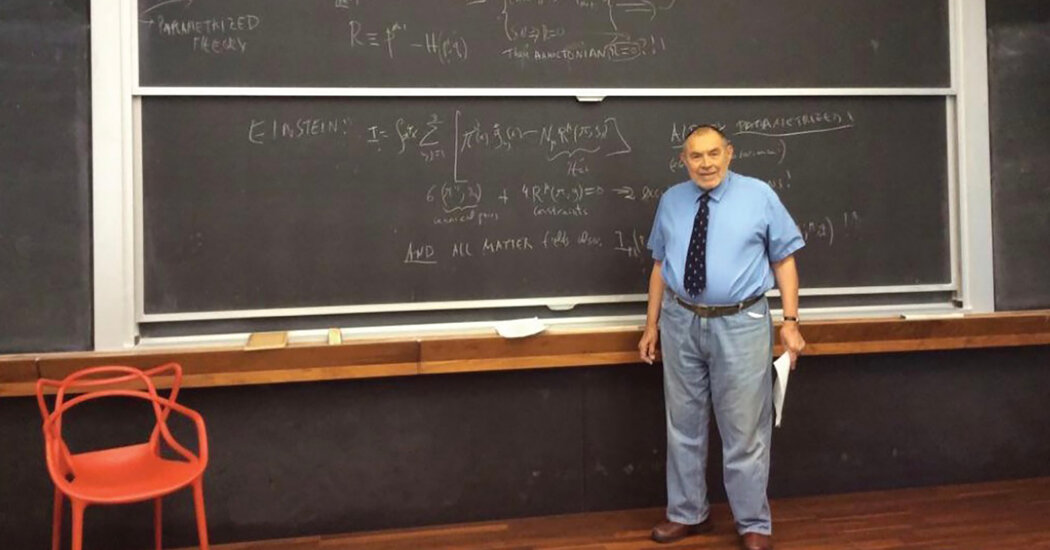
Stanley Deser, a theoretical physicist who contributed to the understanding of gravity and its role in shaping the universe, has died at the age of 92. Deser was one of the pioneers of supergravity, which expanded the idea of supersymmetry to include gravity. He also helped develop the ADM formalism, which laid the foundation for work toward a quantum theory of gravity. Deser's work sought to bridge the gap between quantum mechanics and general relativity, two theories that have yet to be unified into a theory of everything.