UCL scientists found that human skulls evolved faster than those of other apes, with significant changes in face shape and brain size driven by cognitive and social factors, as revealed through 3D skull modeling and comparative analysis.
Self-reported memory and thinking difficulties among U.S. adults, especially those aged 18-39, have increased significantly over the past decade, with higher rates among lower-income, less-educated, and minority groups, prompting calls for further research into social and economic causes.
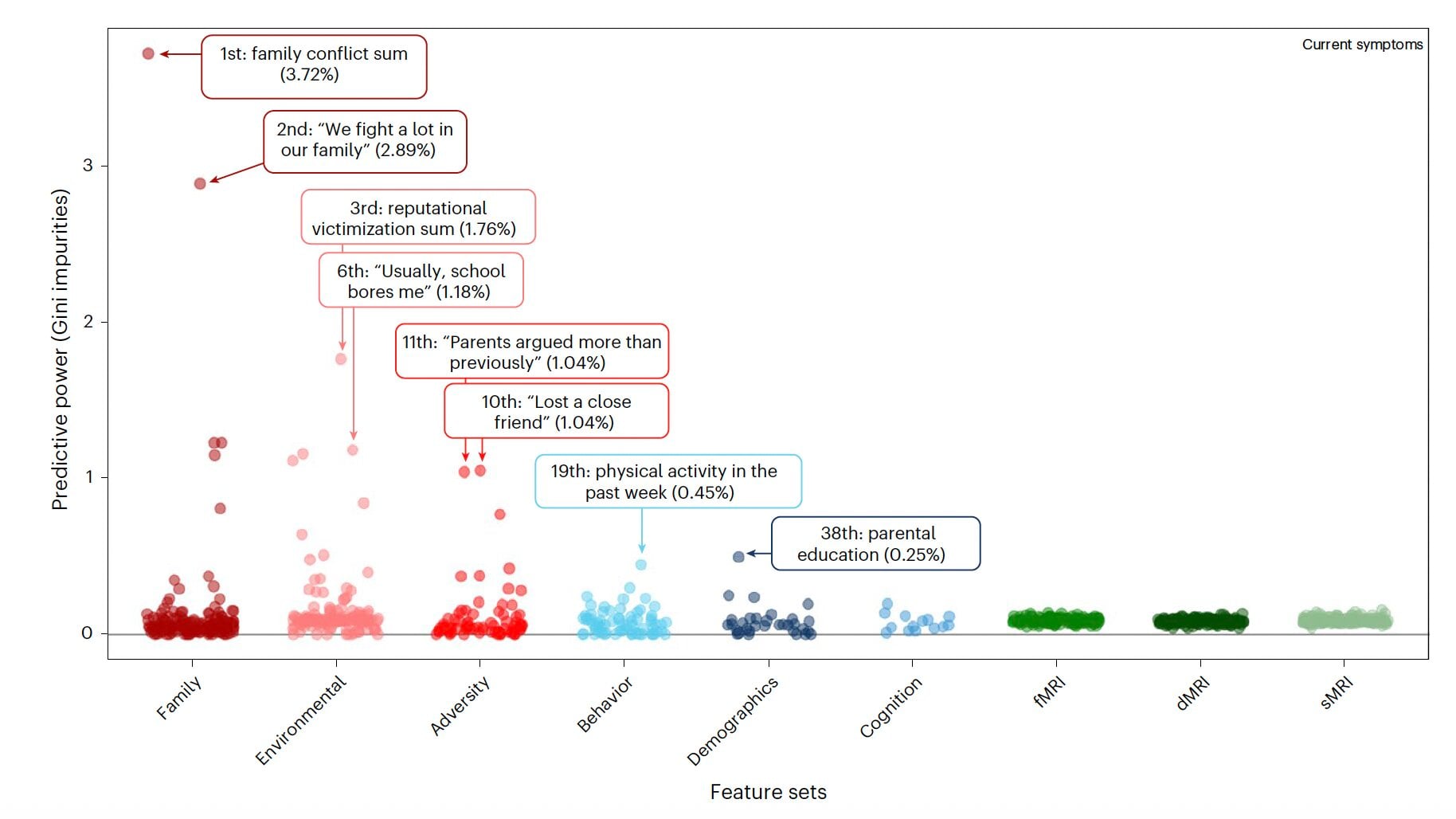
A study using data mining techniques on the ABCD dataset found that family conflicts and peer victimization are the strongest predictors of mental health issues in teenagers, with social factors outweighing brain imaging data in predictive power, highlighting the importance of social environment in adolescent mental health.
A decade-long study reveals a significant rise in self-reported memory and thinking problems among U.S. adults, especially those under 40, with social and economic disadvantages playing a key role, raising concerns about a potential brain fog epidemic.
New research reveals that the mental health benefits of exercise are more complex than previously thought, with factors like context, type of activity, and placebo effects playing significant roles. Leisure activities like sports and gym workouts are linked to better mental health, but work-related or household chores may not provide the same benefits and can sometimes be detrimental. The study emphasizes that social and economic factors are more influential in addressing mental health issues than exercise alone, and highlights disparities in who benefits from physical activity.
The process of evaluating patients for organ transplants involves not only medical criteria but also social factors such as support network strength, financial resources, and caregiver availability, leading to variability in the evaluation process across different transplant centers. Critics argue that these social factors disproportionately impact patients, particularly those of low socioeconomic status, and may exacerbate structural disparities in access to transplants. Efforts are being made to create a more data-driven and equitable approach to transplant listing through initiatives like the Consortium for the Holistic Assessment of Risk in Transplant.
Lisa Barnes, a Black female cognitive neuropsychologist, has been running the Minority Aging Research Study since 2004, one of the largest studies of Alzheimer’s focused exclusively on Black people. Barnes has created a brain bank used by other researchers to understand the illness in this population. Her work has raised critical questions about how the disease differs in Black populations, why cognitive testing relied on to clinically diagnose dementia may fail Black patients, and whether the disease progresses differently in them. Barnes' research has shown that Alzheimer's does not progress the same way for all people and that social factors associated with racial categories, such as wealth, education, discrimination, and access to health care, play a significant role.
A study published in The Lancet found that COVID-19 infection and death rates varied greatly between US states due to a combination of social and economic factors, including poverty, lack of access to quality healthcare, and low levels of interpersonal trust. States with higher poverty and lower educational attainment saw disproportionately higher rates of COVID infections and deaths. The study also found that protective measures like mask mandates and mobility restrictions were effective in reducing infection rates, but only vaccine coverage had a strong association with state-by-state variation in COVID death rates.