Tag

Particle Accelerator

All articles tagged with #particle accelerator

Ancient Archimedes Writings Unveiled After Centuries

Originally Published 21 days ago — by GreekReporter.com

Featured image for Ancient Archimedes Writings Unveiled After Centuries
Source: GreekReporter.com

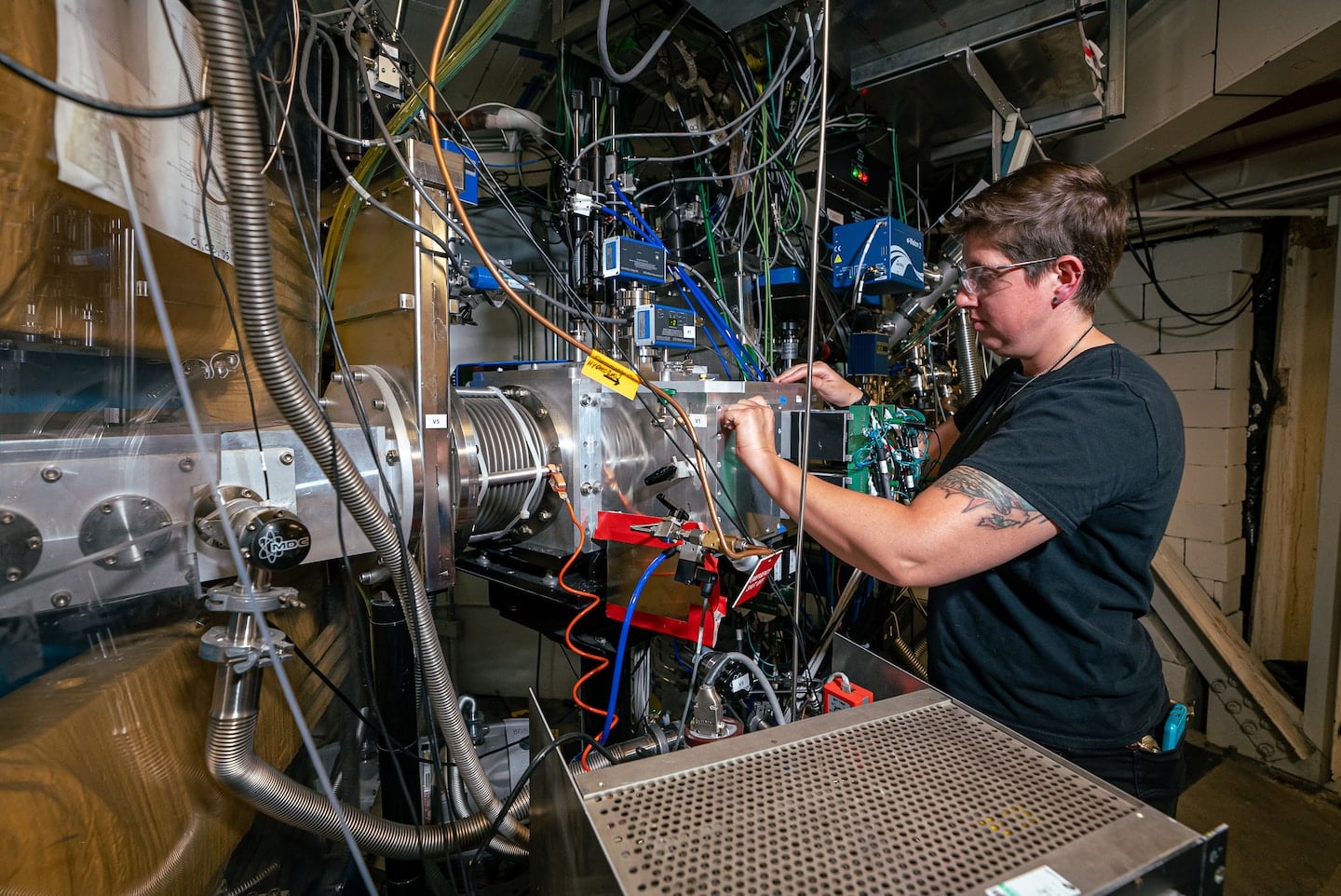
Scientists used advanced X-ray techniques at the Stanford Linear Accelerator to uncover lost writings of Archimedes hidden beneath a medieval prayer book, revealing key theories on mechanics and buoyancy that had been concealed for centuries, with further deciphering expected to take years.

Evaluating Performance of the Continuous Electron Beam Accelerator

Originally Published 1 year ago — by Phys.org

Featured image for Evaluating Performance of the Continuous Electron Beam Accelerator
Source: Phys.org

A new study published in Physical Review Accelerators and Beams re-benchmarks the Continuous Electron Beam Accelerator Facility (CEBAF) at Jefferson Lab, detailing its original and upgraded capabilities. Led by Geoffrey Krafft, the paper captures CEBAF's evolution from its initial 4 GeV design to its current 12 GeV capacity, following a $338 million upgrade. The facility, crucial for nuclear physics research, now serves over 1,650 physicists worldwide and highlights future enhancements like machine learning and new photon sources.

"CERN's Ambitious Experiments During Solar Eclipses Raise Speculation"

Originally Published 1 year ago — by The Debrief

Featured image for "CERN's Ambitious Experiments During Solar Eclipses Raise Speculation"
Source: The Debrief

NASA and CERN are preparing for unique scientific investigations during the upcoming total solar eclipse on April 8. NASA will launch three sounding rockets and high-altitude planes to study the effects of the eclipse on Earth's upper atmosphere and ionospheric disturbances. Meanwhile, CERN's Large Hadron Collider will conduct experiments to potentially find evidence of invisible particles, coinciding with the eclipse due to regular running. The rare celestial event presents an exceptional opportunity for scientists to gain new insights into various phenomena.

"Unveiling the Ghostly Presence at the World's Leading Particle Accelerator"

Originally Published 1 year ago — by AOL

Featured image for "Unveiling the Ghostly Presence at the World's Leading Particle Accelerator"
Source: AOL

Physicists at CERN and Goethe University Frankfurt have discovered a resonant "ghost" affecting particle behavior inside the Super Proton Synchrotron (SPS) using a 4D mathematical model. This ghost, caused by resonance, leads to beam degradation and poses a significant challenge for maintaining beam particles in accelerators. By studying and modeling this phenomenon, researchers aim to develop strategies to mitigate its effects and prevent the creation of similar "ghosts" in future particle accelerators.

"Discovery of a Haunting Presence at the World's Leading Particle Accelerator"

Originally Published 1 year ago — by Yahoo Life

Featured image for "Discovery of a Haunting Presence at the World's Leading Particle Accelerator"
Source: Yahoo Life

Physicists at CERN and Goethe University Frankfurt have discovered a resonant "ghost" affecting particle behavior inside the Super Proton Synchotron (SPS) using a 4D mathematical model. This ghost, caused by resonance, leads to beam degradation and poses challenges for particle accelerators and nuclear fusion research. By studying and modeling this phenomenon, researchers aim to develop strategies to mitigate its effects and prevent the creation of similar "magnet ghosts" in future particle accelerators.

"CERN's Quest: Supercharging Particle Accelerator to Hunt Ghost Particles"

Originally Published 1 year ago — by Daily Mail

Featured image for "CERN's Quest: Supercharging Particle Accelerator to Hunt Ghost Particles"
Source: Daily Mail

CERN has restarted the Large Hadron Collider (LHC) to search for invisible particles, particularly dark matter, by smashing protons together at nearly the speed of light. The experiment is set to take place on April 8, coinciding with the Great North American Solar Eclipse. The LHC aims to test predictions of different particle physics, including measuring the properties of the Higgs boson. Scientists hope to gain insights into the formation and ultimate fate of the universe through this experiment.

"Scientists Successfully Capture 4D 'Ghost' in CERN Accelerator"

Originally Published 1 year ago — by ScienceAlert

Featured image for "Scientists Successfully Capture 4D 'Ghost' in CERN Accelerator"
Source: ScienceAlert

Physicists at CERN have successfully measured and quantified a 4D resonance structure in the Super Proton Synchrotron particle accelerator, which can cause beam degradation and hinder particle research. This structure, resulting from a phenomenon known as resonance, requires four states to represent and affects the path of particles in the accelerator. By carefully measuring particle positions, the researchers were able to map the resonance and demonstrate how individual particles behave within it. Understanding this phenomenon could lead to new ways to mitigate beam degradation and achieve high-fidelity beams for future particle acceleration experiments.

"Chinese Observatory's Breakthrough: Unveiling the Origin of Ultra-High Energy Cosmic Rays"

Originally Published 1 year ago — by South China Morning Post

Featured image for "Chinese Observatory's Breakthrough: Unveiling the Origin of Ultra-High Energy Cosmic Rays"
Source: South China Morning Post

Chinese scientists at the Lhaaso Observatory in southwestern China have identified a bubblelike structure in the Cygnus constellation, around 10 million times larger than our solar system, as a super cosmic ray accelerator within the Milky Way. This discovery challenges previous theories about the origin and source of cosmic rays, shedding light on how ultra-high energy gamma rays may have originated. The structure, observed by the Large High Altitude Air Shower Observatory, contains multiple photons exceeding 1 PeV, and is believed to be powered by a massive star cluster called Cygnus OB2. The findings could potentially solve the century-long enigma of the origin of cosmic rays.

"Europe's Ambitious Plan for a Massive Next-Generation Particle Collider"

Originally Published 1 year ago — by Big Think

Featured image for "Europe's Ambitious Plan for a Massive Next-Generation Particle Collider"
Source: Big Think

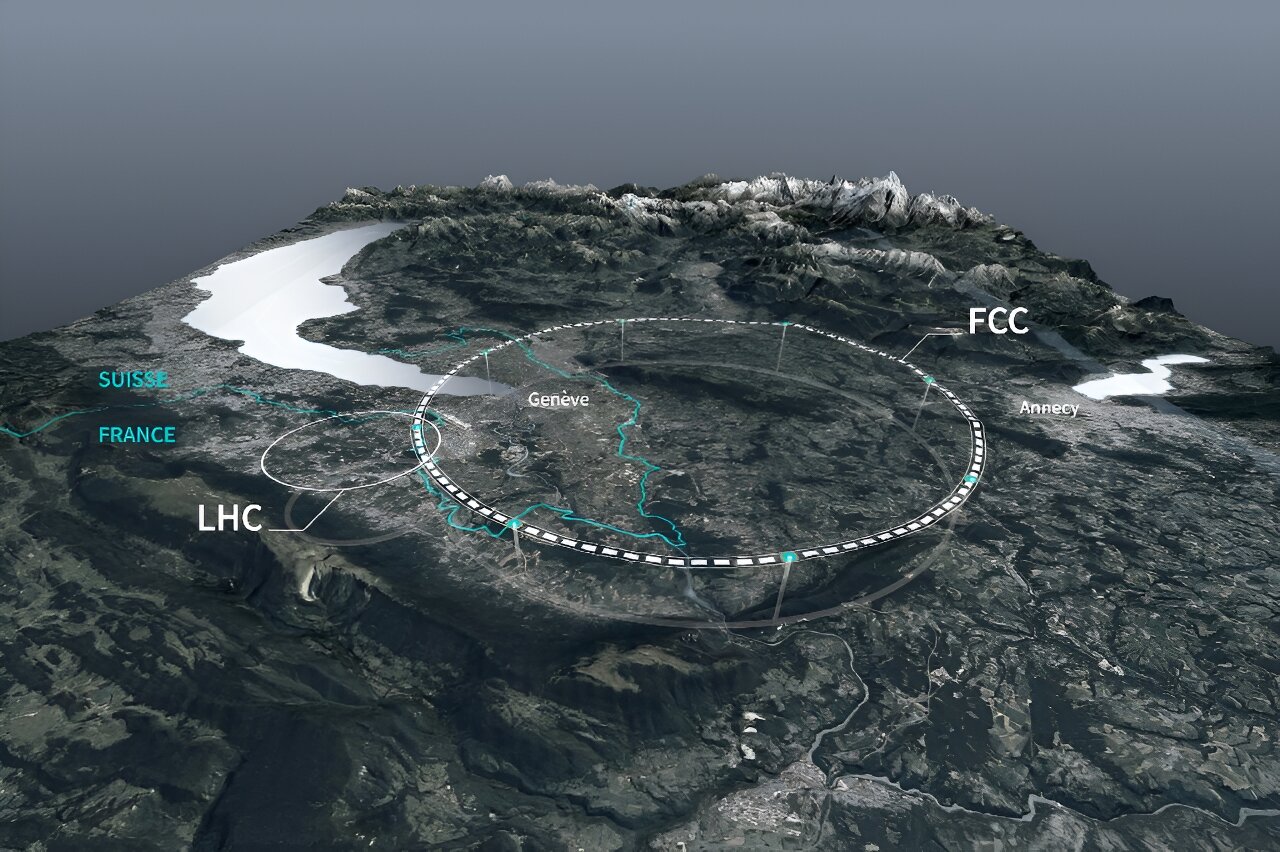
CERN is proposing to build the Future Circular Collider (FCC), a particle accelerator three times longer than the Large Hadron Collider (LHC) in a 27-kilometer tunnel near Geneva. The FCC aims to address fundamental questions about dark matter and antimatter by smashing subatomic particles together at 100 teraelectronvolts, surpassing the LHC's energy level. The project, estimated to cost $21.5 billion, has sparked debate among scientists about its potential to generate new insights. If approved, the FCC could be operational by the 2040s, coinciding with the end of the LHC's useful life.

"Proposed €20bn Next-Generation Particle-Smasher to Uncover Universe's Secrets"

Originally Published 1 year ago — by IFLScience

Featured image for "Proposed €20bn Next-Generation Particle-Smasher to Uncover Universe's Secrets"
Source: IFLScience

CERN is proposing to build the Future Circular Collider (FCC), a particle accelerator three times the size of the Large Hadron Collider (LHC) to explore energies beyond the LHC's capabilities and hunt for evidence of dark matter and dark energy. The proposed 90-kilometer-long collider aims to start smashing electrons in the 2040s and protons in the 2070s, with a price tag of $17.2 billion. Critics argue that the project is a gamble and that the funds could be better spent elsewhere, but the decision ultimately rests on the countries that fund CERN.

"Europe's Ambitious Plan: Building a €20 Billion Particle Collider to Uncover Universe's Secrets"

Originally Published 1 year ago — by Slashdot

Featured image for "Europe's Ambitious Plan: Building a €20 Billion Particle Collider to Uncover Universe's Secrets"
Source: Slashdot

Cern has proposed plans for a $21.5 billion Future Circular Collider (FCC), which would be three times the size of the Large Hadron Collider and aim to smash subatomic particles together at a maximum energy of 100 teraelectronvolts (TeV). The FCC is intended to address some of the deepest mysteries of the universe, such as dark matter, dark energy, and the dominance of matter over antimatter, with the goal of being operational in the 2040s.

"Europe's Ambitious €20B Plan to Uncover Universe's Secrets with Giant Particle Collider"

Originally Published 1 year ago — by The Register

Featured image for "Europe's Ambitious €20B Plan to Uncover Universe's Secrets with Giant Particle Collider"
Source: The Register

CERN is seeking approval and funding for the construction of the Future Circular Collider (FCC), a next-generation particle accelerator that could cost up to €20 billion. While some scientists support the ambitious project, others question its value for money and potential for new breakthroughs. CERN's director general believes the FCC is essential for uncovering new physics discoveries and understanding fundamental laws of nature, while critics argue that the funds could be better spent on research addressing climate change and diseases.

"Europe's Ambitious €20bn Plan to Uncover Universe's Secrets with Giant Particle Collider"

Originally Published 1 year ago — by Phys.org

Featured image for "Europe's Ambitious €20bn Plan to Uncover Universe's Secrets with Giant Particle Collider"
Source: Phys.org

Europe's CERN laboratory has unveiled plans for the Future Circular Collider (FCC), a massive new particle accelerator that would surpass the Large Hadron Collider in size and power. The FCC, if approved, would start operations around the middle of the century and conduct its highest-energy collisions by 2070. With a proposed cost of $17 billion for its first stage, the FCC aims to explore the fundamental forces of the universe, study the properties of matter at the smallest scale and highest energy, and potentially confirm the existence of theorized particles. The project is set to undergo further feasibility studies and a decision on its construction is expected in 2028.

"Europe's €20bn Plan for Giant Particle Collider to Uncover Universe's Secrets"

Originally Published 1 year ago — by FRANCE 24 English

Featured image for "Europe's €20bn Plan for Giant Particle Collider to Uncover Universe's Secrets"
Source: FRANCE 24 English

Europe's CERN laboratory has unveiled plans for the Future Circular Collider (FCC), a massive new particle accelerator that would surpass the Large Hadron Collider in size and power, aiming to continue unraveling the universe's mysteries. If approved, the FCC would start operations around the middle of the century, with the potential to confirm the existence of theorized particles and shed light on enigmas such as dark energy, dark matter, and the scarcity of antimatter. The project, estimated to cost $17 billion for its first stage, is set to be decided upon in 2028, with construction potentially commencing in 2033.