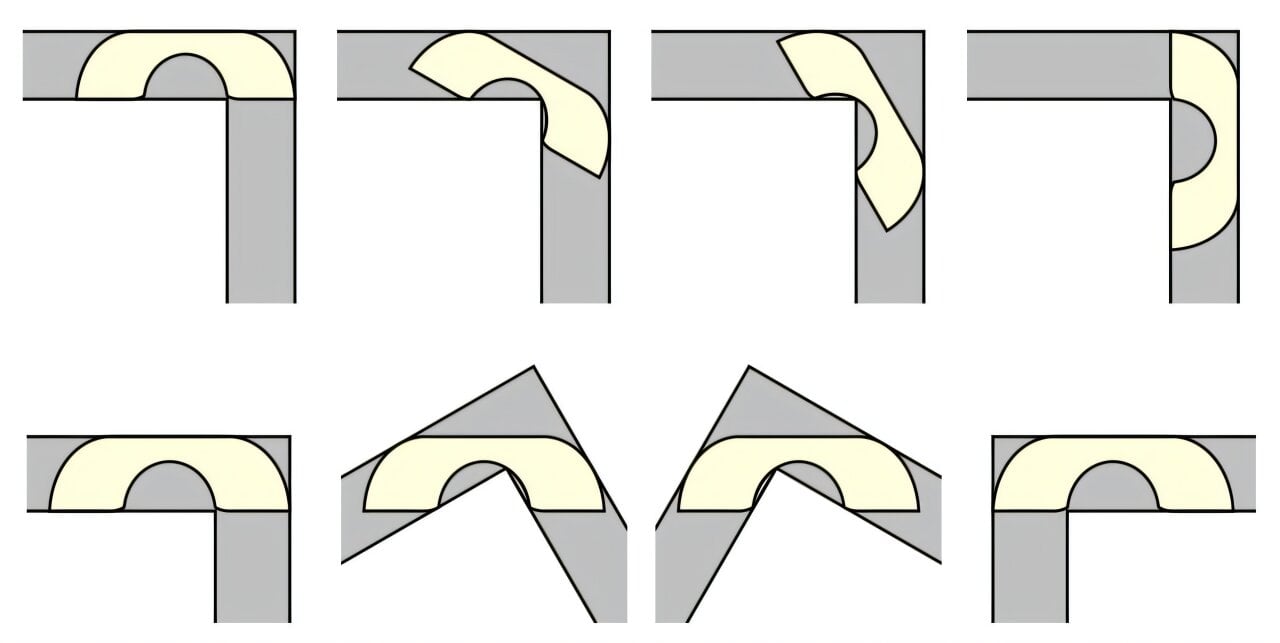
Jineon Baek, a mathematician from Yonsei University, claims to have solved the moving sofa problem, a mathematical challenge posed by Leo Moser in 1966. Baek's proof, posted on arXiv, uses the Gerver sofa shape to determine that the maximum area of a sofa that can navigate a right-angled hallway of one unit width is 2.2195 units. The proof awaits validation by the mathematical community.

Physicists have been debating the stability of a quantum phenomenon known as many-body localization (MBL) in one-dimensional chains. Recent research has challenged the long-held belief in the eternal stability of MBL, with the discovery of a new thermalization-causing phenomenon called avalanches. These findings have led to a reevaluation of the MBL phase diagram, suggesting that MBL may not be as stable as previously thought. The debate revolves around a mathematical proof of MBL's existence, with researchers working to either contradict or verify it. While the stability of MBL remains uncertain, physicists are excited about the opportunity to discover new phenomena in quantum systems.
A recent study by Ramis Movassagh, a researcher at Google Quantum AI, mathematically demonstrates the difficulty of simulating random quantum circuits and estimating their outputs for classical computers. The study shows that this task is highly challenging, known as #P-hard, and provides computational barriers for the classical simulation of quantum circuits. Movassagh's proof, based on new mathematical techniques, is direct and does not involve approximations, allowing for explicit error bounds and quantification of robustness. The research contributes to ongoing efforts to explore the advantages of quantum computers over classical computers and could inform future studies in quantum cryptography and complexity theory.
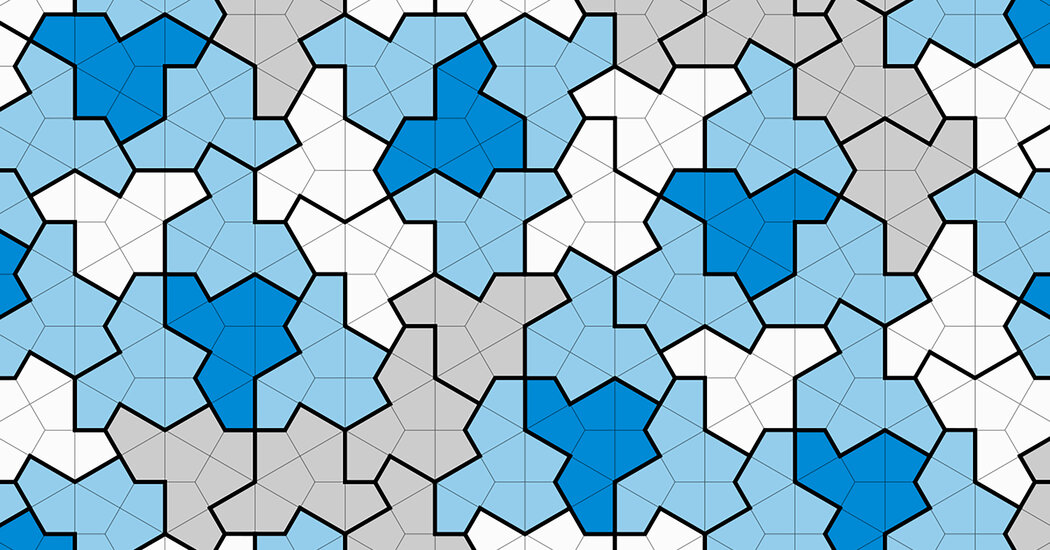
After a decade of attempts, David Smith, a shape hobbyist, has discovered an "einstein," an aperiodic monotile that tiles a plane in a nonrepeating pattern. Smith's einstein, called "the hat," is a polykite made of eight kites. The paper, co-authored by Smith and three others, provides two proofs of the hat's aperiodicity, one of which uses a new technique. The hat's discovery opens up new possibilities for materials with this type of internal structure.
After a decade of attempts, a self-described shape hobbyist from England, David Smith, has discovered an "einstein," an aperiodic monotile that tiles a plane in a nonrepeating pattern. Smith's discovery, called "the hat," was confirmed in a new paper by Smith and three co-authors with mathematical and computational expertise. The paper provides two proofs, one of which offers a new tool for proving aperiodicity. The hat is a polykite made of eight kites and is part of an entire family of related einsteins, including a second one discovered by Smith called "the turtle."