Physicists have long sought a problem that only quantum computers can solve, and now a team led by John Preskill may have found one. By studying the energy of certain quantum systems, they discovered a specific question that is easy for a quantum machine to answer but difficult for a classical one, providing a potential quantum advantage. This problem relates to determining a system's local minimum energy state, which has implications for chemistry and material sciences. While the result is still theoretical and requires testing on an actual quantum computer, it represents a promising step forward in the field of quantum algorithms.
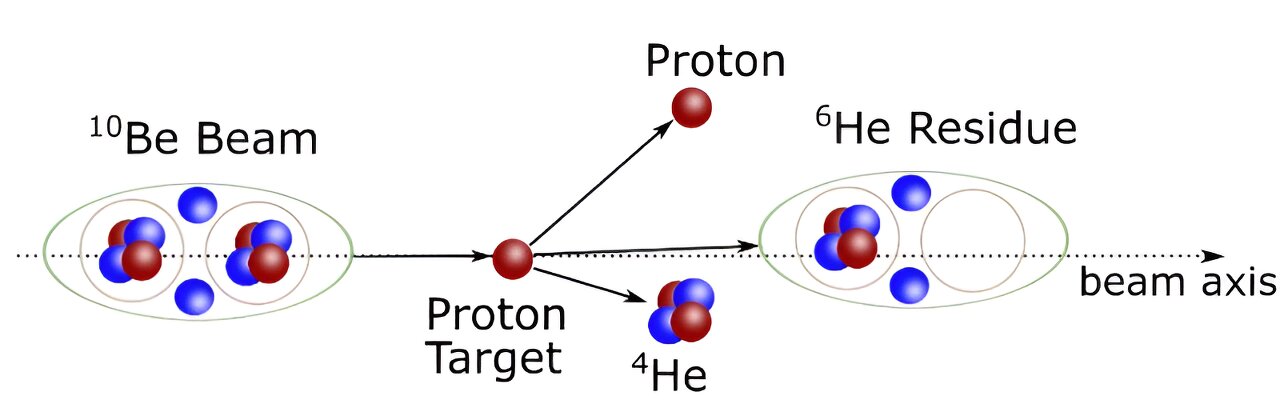
Scientists at the Institute of Modern Physics have discovered molecular-type structures in the ground state of atomic nuclei, providing experimental evidence for a long-standing hypothesis. Using a novel experimental method, they validated the presence of a molecular-type structure in the ground state of beryllium-10, a neutron-rich nucleus. This groundbreaking research opens new paths in nuclear physics research and paves the way for further exploration of cluster structures in neutron-rich nuclear ground states.
Physicists from the Institute of Modern Physics (IMP) of the Chinese Academy of Sciences have discovered a molecular-type structure in the ground state of atomic nuclei. Using a novel experimental method, they validated the presence of a molecular-type structure in the ground state of beryllium-10, a neutron-rich nucleus. The experimental results support the long-standing hypothesis of a molecular-state structure in beryllium-10's ground state, suggesting the formation of an α–α dumbbell-shaped core with two valence neutrons rotating perpendicular to the core axis. This study provides the first experimental evidence for the theoretical description of molecular-state structures in atomic nuclei's ground state.
Researchers have discovered that nuclei can form molecule-like structures, even in their ground states. Experiments with beryllium-10 provided evidence that the ground state of the isotope is analogous to a diatomic molecule, with two alpha particles acting like atoms and two neutrons orbiting like a pair of electrons forming a covalent bond. This finding challenges the traditional view of nuclei as spherical blobs without much internal structure and expands our understanding of nuclear physics.