Researchers are developing a new foundation for quantum cryptography that relies on quantum properties and complex mathematical problems, potentially creating more secure encryption methods that could withstand future computational advances, though practical implementation remains in the future.
Researchers have developed a new theoretical framework for quantum cryptography that relies on quantum-based mathematical building blocks called one-way puzzles, potentially supporting more secure cryptographic systems even if classical hard problems are solvable, though practical implementation remains distant due to current technological limitations.
Researchers have discovered that secure quantum encryption can be achieved even in hypothetical scenarios where all classical computational problems are easy, relying instead on the inherent difficulty of distinguishing certain quantum states. This breakthrough suggests that quantum cryptography could remain secure even if classical cryptography fails, potentially requiring a new theoretical framework to fully understand quantum information.
Scientists are proposing a new "space encryption" technology that uses light particles beamed around the world via satellites to protect sensitive communications from potential decryption by future quantum computers. This approach, known as "quantum cryptography," leverages the principles of quantum mechanics to secure data transmission. A mission called "Quick3" aims to use photons to transmit data through a massive satellite network, with the system set to be tested in space in 2025. This technology could potentially provide a secure means of communication that is resistant to interception and decryption by quantum computers.
Scientists are proposing a new "space encryption" technology that uses light particles beamed around the world via satellites to protect sensitive communications from potential decryption by future quantum computers. This quantum cryptography system, known as "Quick3," encodes information into individual light particles, making it impossible to intercept without detection. The system involves transmitting data through a massive satellite network and is set to be tested in space with a satellite launch scheduled for 2025.
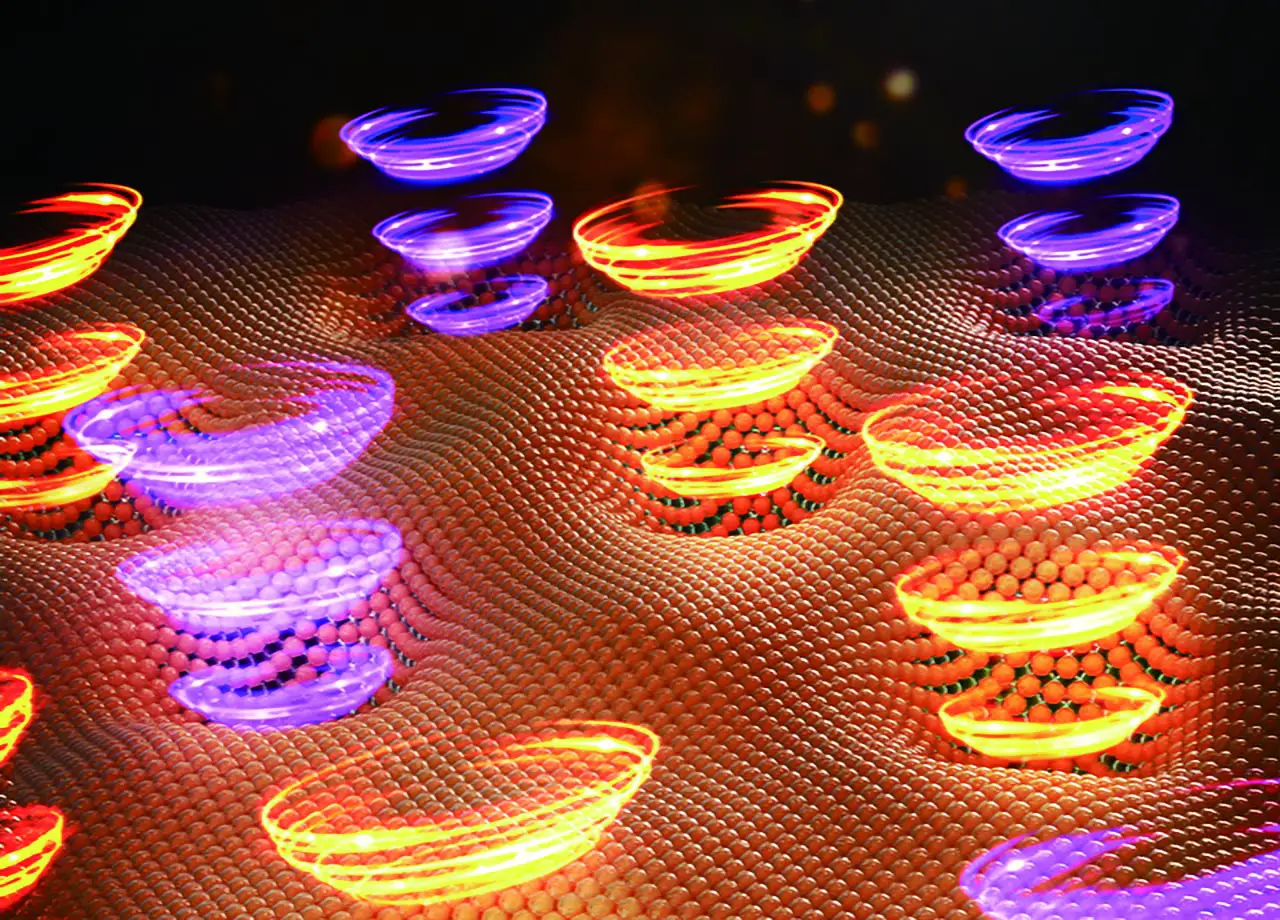
Scientists at Los Alamos National Laboratory have developed a new technique to generate circularly polarized single photons, a crucial step towards quantum communication and information processing. By using nanometer-scale indentations on a stack of atomically thin materials, the researchers were able to emit circularly polarized light without the need for an external magnetic field. This breakthrough could pave the way for advancements in quantum cryptography, communication, and the development of a hyper-secure quantum internet.