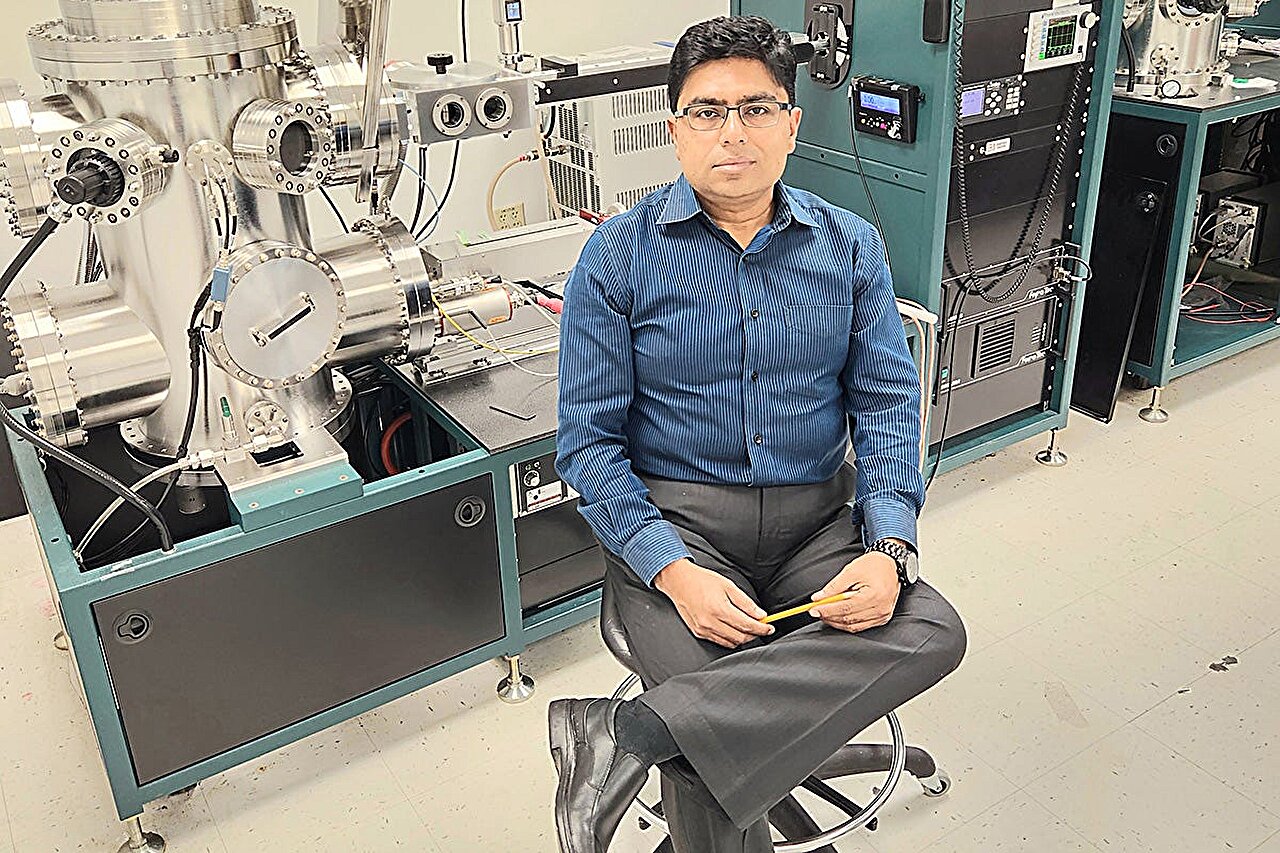
University of Central Florida researcher Debashis Chanda has developed a new technique for detecting photons by modulating the frequency of an oscillating circuit, using a special phase-change material. This advancement could lead to more precise and efficient technologies in various fields, including medical imaging, communication systems, scientific research, and security measures. The technique offers a high sensitivity, low-cost, and uncooled infrared detection scheme that can be easily integrated with electronic readout circuitry, without the need for complex hybridization.
Researchers at the National Institute of Standards and Technology (NIST) have developed a superconducting camera with 400,000 pixels, 400 times more than any other device of its kind. The camera, made up of ultrathin electrical wires cooled to near absolute zero, can detect weak light signals, making it useful for applications in astronomy and biomedical research. By combining signals from multiple pixels onto a few readout wires, the researchers overcame the challenge of connecting each pixel to its own wire. The team plans to improve the camera's sensitivity to capture every incoming photon, enabling it to image faint galaxies, measure light in quantum computers, and contribute to biomedical studies.
Scientists at the National Institute of Standards and Technology (NIST) have developed a superconducting camera with 400,000 pixels, 400 times more than any previous device of its kind. The camera uses ultrathin electrical wires cooled to near absolute zero, where current moves with no resistance until a photon strikes a wire, disrupting the superconductivity and creating an electrical signal. By combining signals from multiple pixels onto a few readout wires, the researchers overcame the challenge of connecting each pixel to its own wire. This breakthrough could open up new applications in science, such as imaging faint galaxies or planets, measuring light in quantum computers, and biomedical studies using near-infrared light to examine human tissue.
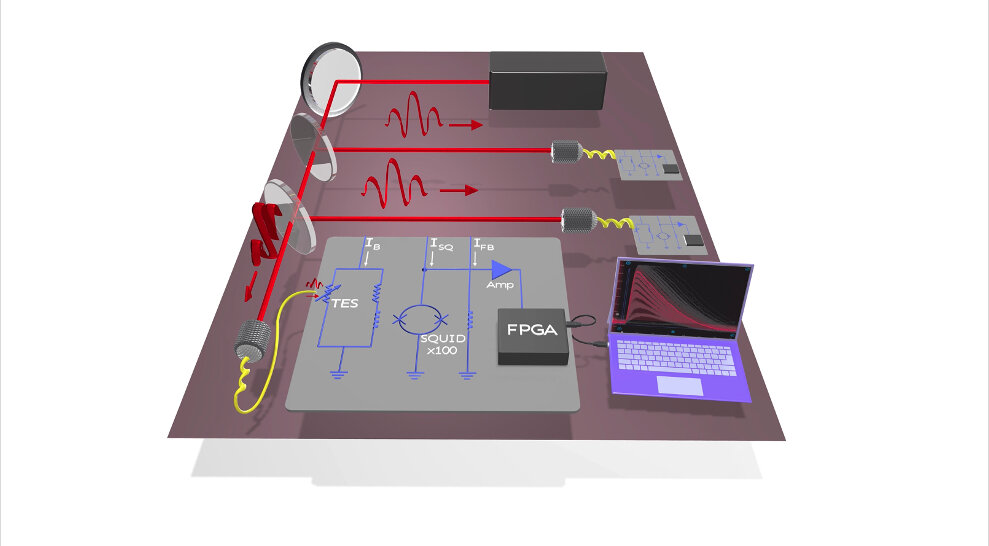
Researchers at the Thomas Jefferson National Accelerator Facility have designed a photon detection system that can accurately resolve more than 100 photons, a major step forward in capability for quantum computing development efforts. The system may also enable quantum generation of truly random numbers, a long-sought goal for developing unbreakable encryption techniques for applications in military communications and financial transactions. The team blew past the record of 16 photons and demonstrated a photon count of about 35 per single detector and reached 100 photons with a three-detector system.