Tag

Personal Income

All articles tagged with #personal income

US Inflation Remains Elevated as Consumer Spending Continues

Originally Published 4 months ago — by U.S. Bureau of Economic Analysis (BEA) (.gov)

In July 2025, U.S. personal income increased by 0.4%, driven mainly by higher wages and compensation, with personal consumption expenditures rising by 0.5%. Personal savings stood at $985.6 billion, and the PCE price index increased modestly by 0.2%. The BEA will release updated economic data later in September, including revised GDP figures.

US Personal Income and Spending Report for May 2025

Originally Published 6 months ago — by Forex Factory

Featured image for US Personal Income and Spending Report for May 2025
Source: Forex Factory

In May 2025, US personal income declined by 0.4%, with personal savings remaining high at $1.01 trillion. The core inflation rate rose to 2.7%, exceeding expectations, while the overall PCE price index increased slightly by 0.1%, indicating inflation is slightly above the Fed's target. These indicators suggest a mixed economic outlook with cautious inflation control.

Inflation Pressures Persist as Fed Weighs Next Move

Originally Published 1 year ago — by Investor's Business Daily

Featured image for Inflation Pressures Persist as Fed Weighs Next Move
Source: Investor's Business Daily

The core PCE price index, a key inflation measure for the Federal Reserve, rose 0.3% in October, aligning with forecasts and raising the 12-month core inflation rate to 2.8%. This increase complicates the likelihood of a December rate cut, with market odds for a cut rising to 66.5%. Personal income and spending also saw increases, with income rising 0.6% and spending 0.4%. The S&P 500 dipped slightly following the report, reflecting investor uncertainty about the Fed's next move.

Inflation Stays Stubbornly High, Meeting Fed Expectations

Originally Published 1 year ago — by Benzinga

Featured image for Inflation Stays Stubbornly High, Meeting Fed Expectations
Source: Benzinga

The Federal Reserve's closely monitored inflation gauge, the Personal Consumption Expenditures (PCE) price index, rose to 2.3% year-over-year in October, aligning with expectations. Core PCE, excluding food and energy, increased to 2.8%. Personal income surged by 0.6%, surpassing forecasts, while personal spending slightly slowed but still exceeded expectations. Despite these inflationary signals, market expectations for a December interest rate cut remain unchanged. The U.S. dollar index fell, and stock markets showed little movement ahead of the Thanksgiving holiday.

US Consumer Spending Rises in October Amid Persistent Inflation

Originally Published 1 year ago — by Bureau of Economic Analysis

In October 2024, U.S. personal income rose by $147.4 billion (0.6%), while disposable personal income increased by $144.1 billion (0.7%). Personal consumption expenditures (PCE) grew by $72.3 billion (0.4%). The PCE price index rose 0.2%, with a 0.3% increase excluding food and energy. Real disposable income and real PCE saw modest gains of 0.4% and 0.1%, respectively. The increase in income was driven by higher compensation and asset income, while PCE growth was led by services, particularly healthcare and housing. The personal saving rate was 4.4%.

Fed's Preferred Inflation Measure Rises at Slowest Pace This Year

Originally Published 1 year ago — by Mish Talk

Featured image for Fed's Preferred Inflation Measure Rises at Slowest Pace This Year
Source: Mish Talk

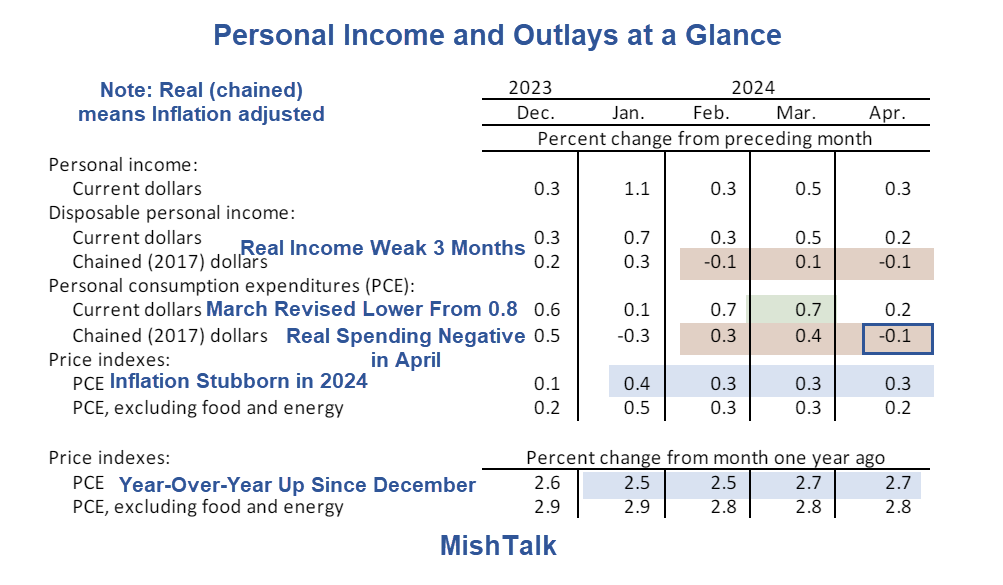
The Fed's preferred inflation measure, the PCE price index, showed no progress in April, remaining flat at 0.3% for the month and 2.7% for the year. Real income and spending were negative, indicating a weakening economy. Personal income increased slightly, but real disposable personal income and real personal consumption expenditures both decreased. The economic slowdown continues, driven by declining income and consumer spending.

"Rising Consumer Spending Outpaces Income Amid Inflation Concerns"

Originally Published 1 year ago — by Mish Talk

Featured image for "Rising Consumer Spending Outpaces Income Amid Inflation Concerns"
Source: Mish Talk

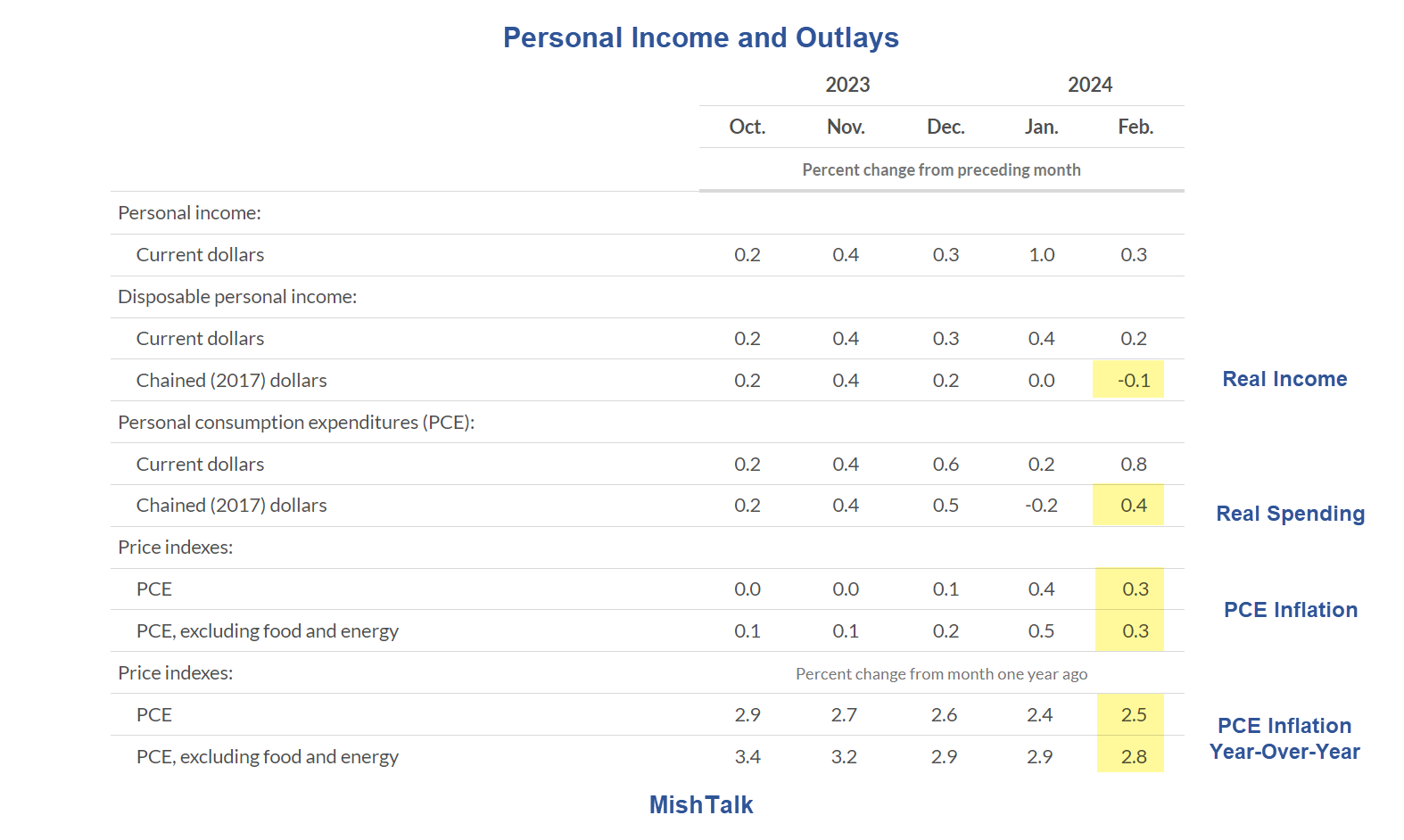
The BEA's report on personal income and spending for February 2024 does not support the need for Fed interest rate cuts, as real income decreased but personal spending surged, and inflation data, particularly the PCE price index, indicates higher inflation than the Fed's target. Additionally, Apartment List reports rent prices have increased for the second consecutive month, and the Case-Shiller National Home Price Index hit a new record high, contributing to the market's expectation of Fed rate cuts despite the data not fully supporting it.

"US February Core Inflation Matches Expectations at +2.8% Year-Over-Year"

Originally Published 1 year ago — by ForexLive

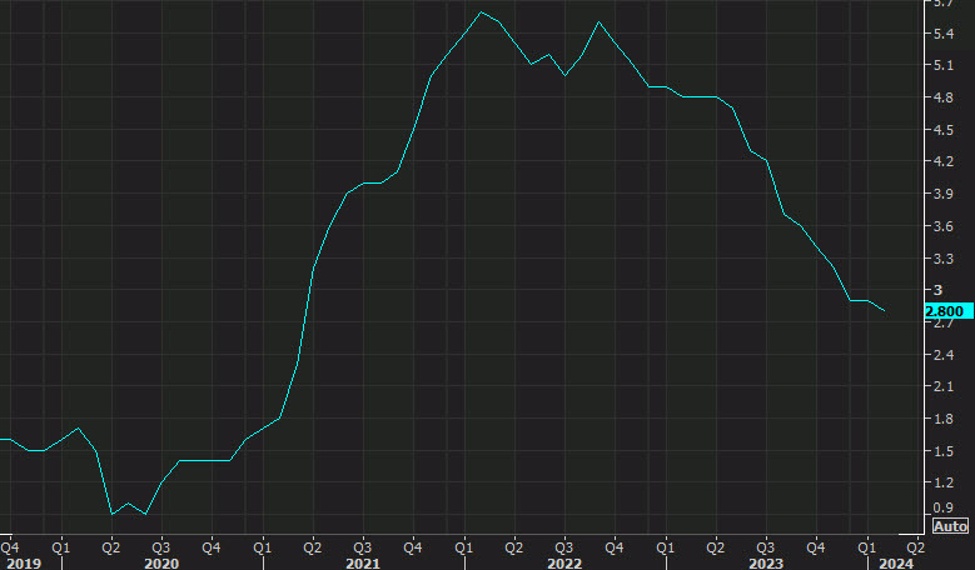
Featured image for "US February Core Inflation Matches Expectations at +2.8% Year-Over-Year"
Source: ForexLive

In February, US core PCE inflation rose by 2.8% year-on-year, meeting expectations, while personal income increased by 0.3% and personal spending surged by 0.8%. The dollar softened despite a lower-than-expected headline monthly inflation reading. Goods prices fell by 0.2% year-on-year, while services prices rose by 3.8% year-on-year, indicating a mixed inflation trend.

"US Consumer Spending Surges Despite Declining Disposable Income"

Originally Published 2 years ago — by Mish Talk

Real disposable personal income has dropped for the third consecutive month, while spending remains strong. Personal income increased by 0.3 percent in September, but real disposable income decreased by 0.1 percent. Personal consumption expenditures increased by 0.7 percent, with goods increasing by 0.5 percent and services by 0.3 percent. The PCE price index increased by 0.4 percent, while core PCE (excluding food and energy) increased by 0.3 percent. Despite the drop in real disposable income, real personal consumption expenditures continue to rise as consumers dip into savings.

Fed Inflation Gauge Meets Expectations, Spending Surpasses Estimates

Originally Published 2 years ago — by CNBC

Featured image for Fed Inflation Gauge Meets Expectations, Spending Surpasses Estimates
Source: CNBC

Inflation in the US accelerated in September, with the core personal consumption expenditures price index rising 0.3%, in line with expectations. However, consumer spending exceeded forecasts, increasing by 0.7%. Personal income also rose by 0.3%, slightly below estimates. The Federal Reserve focuses on core inflation, which has been on a downward trend but remains above the central bank's 2% target. The report is unlikely to change the Fed's view that inflation will slow in the coming months as demand moderates. Traders are pricing in a near-100% chance that the Fed will not announce a rate hike at its upcoming policy meeting.

Inflation Moderates and Personal Income Rises, Impacting Stock Market and Fed Gauge.

Originally Published 2 years ago — by Seeking Alpha

Featured image for Inflation Moderates and Personal Income Rises, Impacting Stock Market and Fed Gauge.
Source: Seeking Alpha

Personal income rose by 0.3% in February, while personal spending increased by 0.2%, according to the Bureau of Economic Analysis. Inflation slowed during the month, with the core PCE Index rising by 0.3%, down from 0.6% in January. The personal saving rate was 4.6% in February, up from 4.4% in January. The Y/Y increase in the core PCE Index remains more than double the Federal Reserve's goal of 2% inflation.