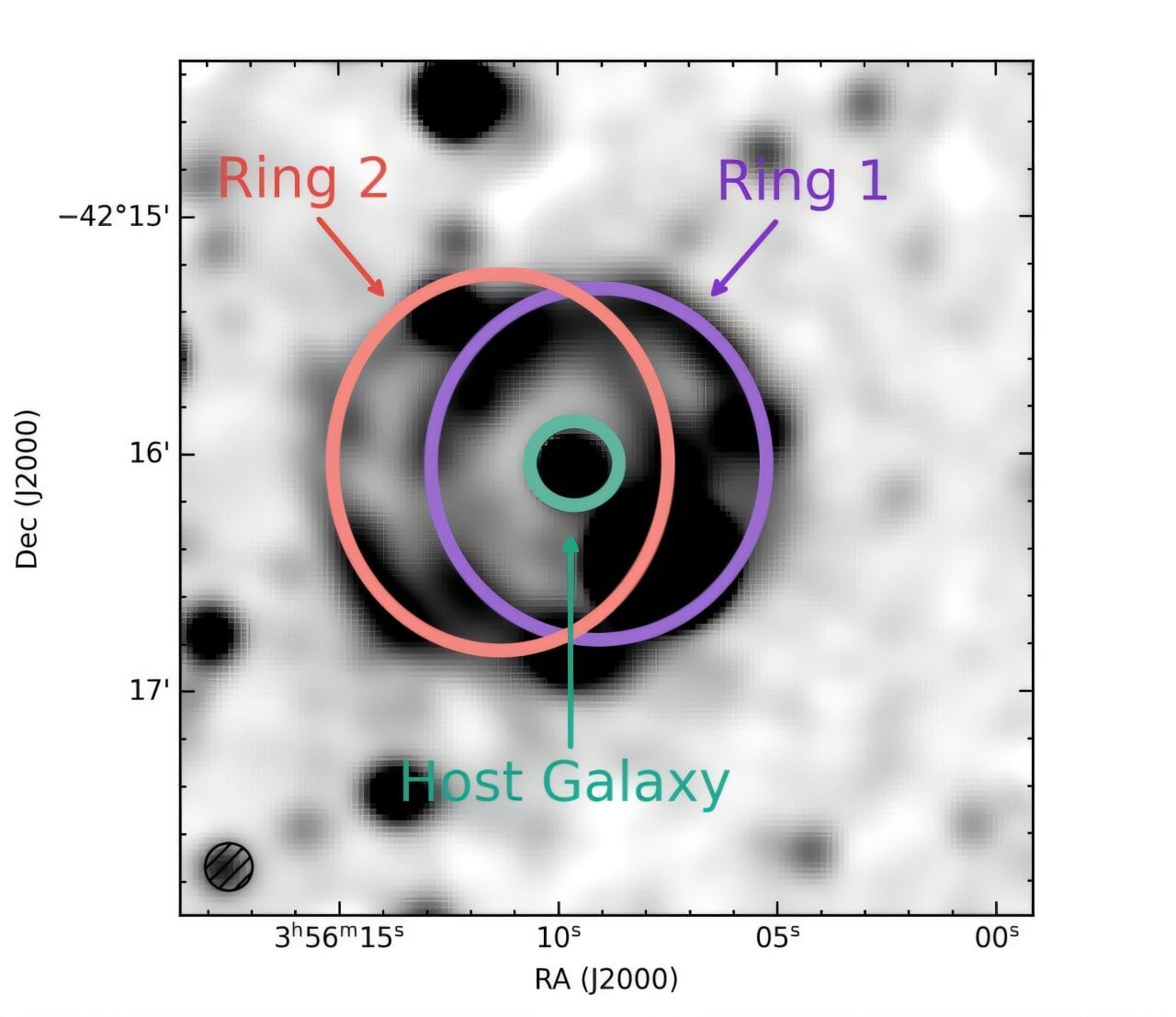
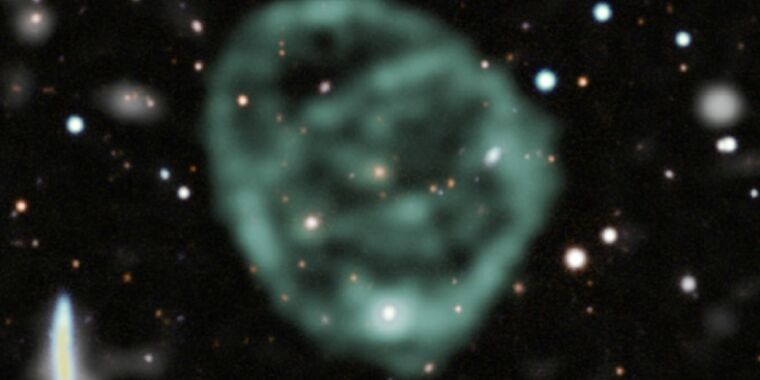
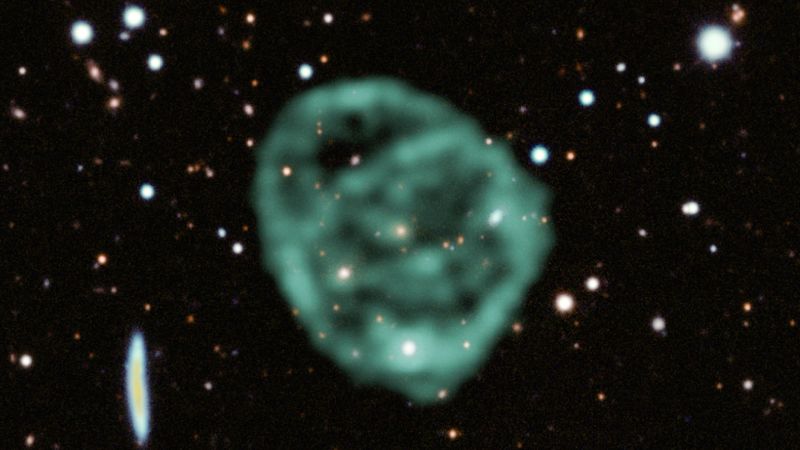
Astronomers have discovered the most powerful and distant 'odd radio circle' (ORC), featuring a rare twin-ring structure, which may be linked to superwinds from host galaxies, providing new insights into galaxy and black hole evolution.
Astronomers have discovered the most distant and powerful odd radio circle (ORC) to date, featuring a rare twin-ring structure that may be linked to superwinds from host galaxies, providing new insights into galaxy and black hole evolution.
Citizen scientists discovered the most powerful twin odd radio circles (ORCs) in space, revealing new insights into these large, mysterious structures that are linked to galaxy activity and black hole phenomena, with implications for understanding galaxy evolution and the role of plasma interactions in space.
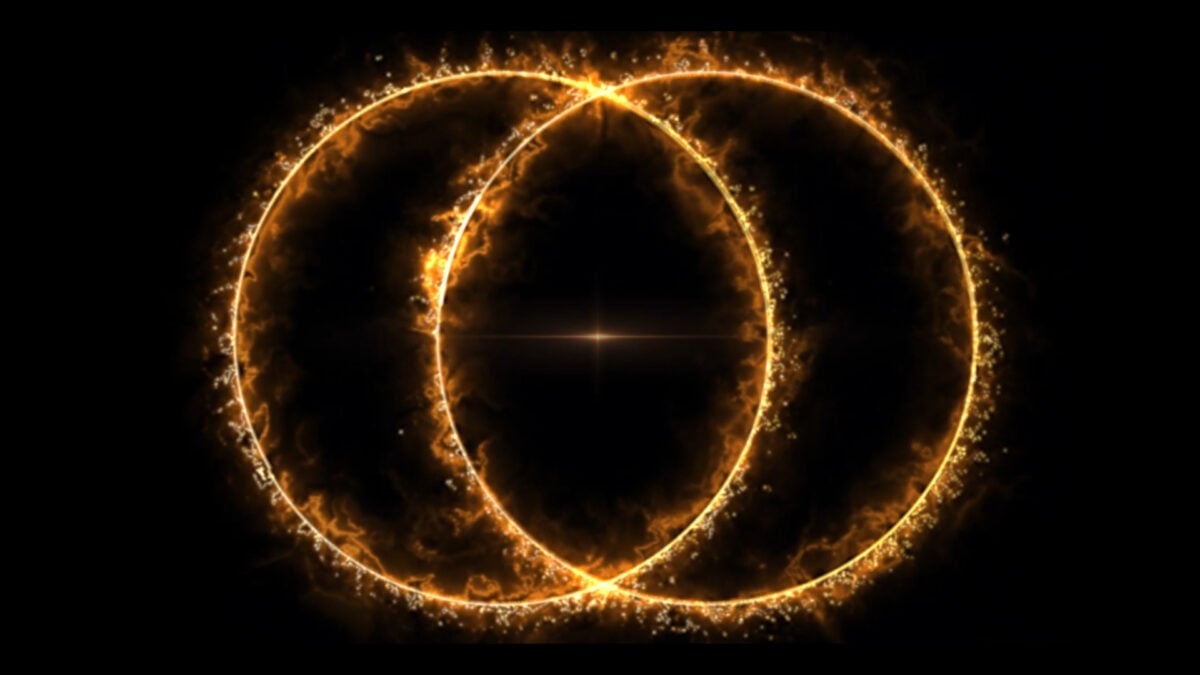
Citizen scientists discovered two crossing rings of extragalactic radio signals forming a near-perfect Venn diagram, identified as 'odd radio circles' (ORCs), which are vast, magnetized plasma rings visible only at radio wavelengths. These findings, among the most distant and powerful, suggest ORCs may result from galactic superwinds and black hole activity, providing insights into galaxy and black hole co-evolution. The discovery underscores the value of human pattern recognition in scientific research.
Astronomers have studied a newly discovered odd radio circle, ORC J0356–4216, revealing a double ring structure likely caused by past active galactic nucleus activity or large-scale shock waves, providing insights into these mysterious cosmic phenomena.
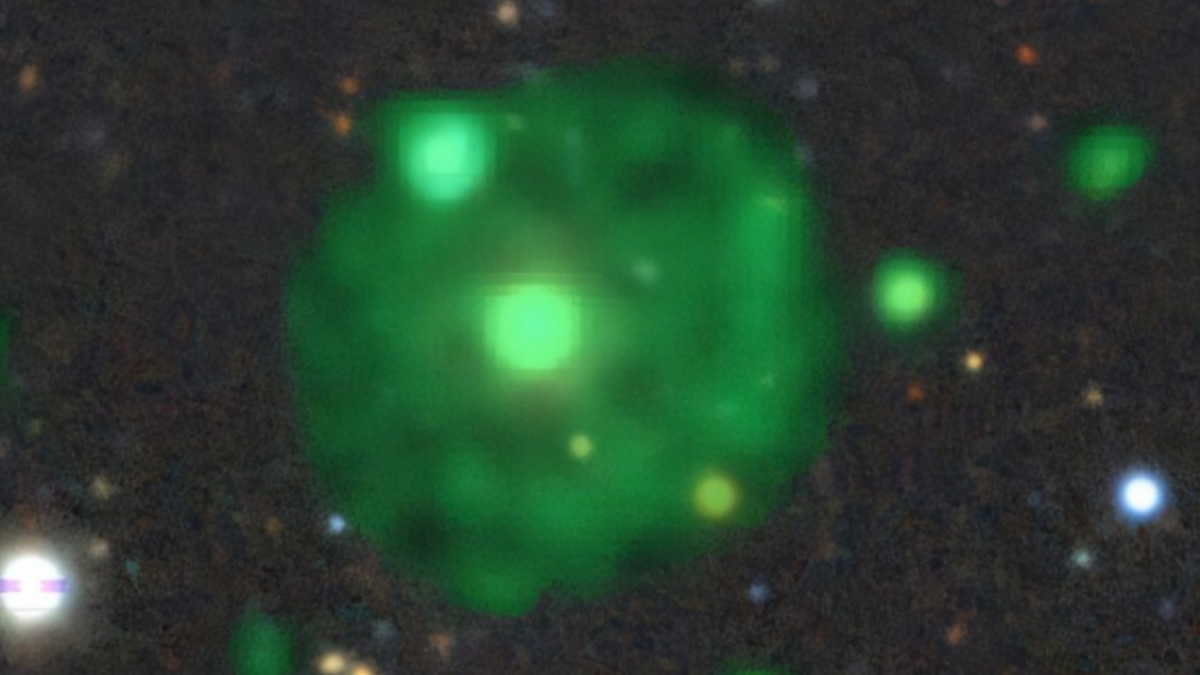
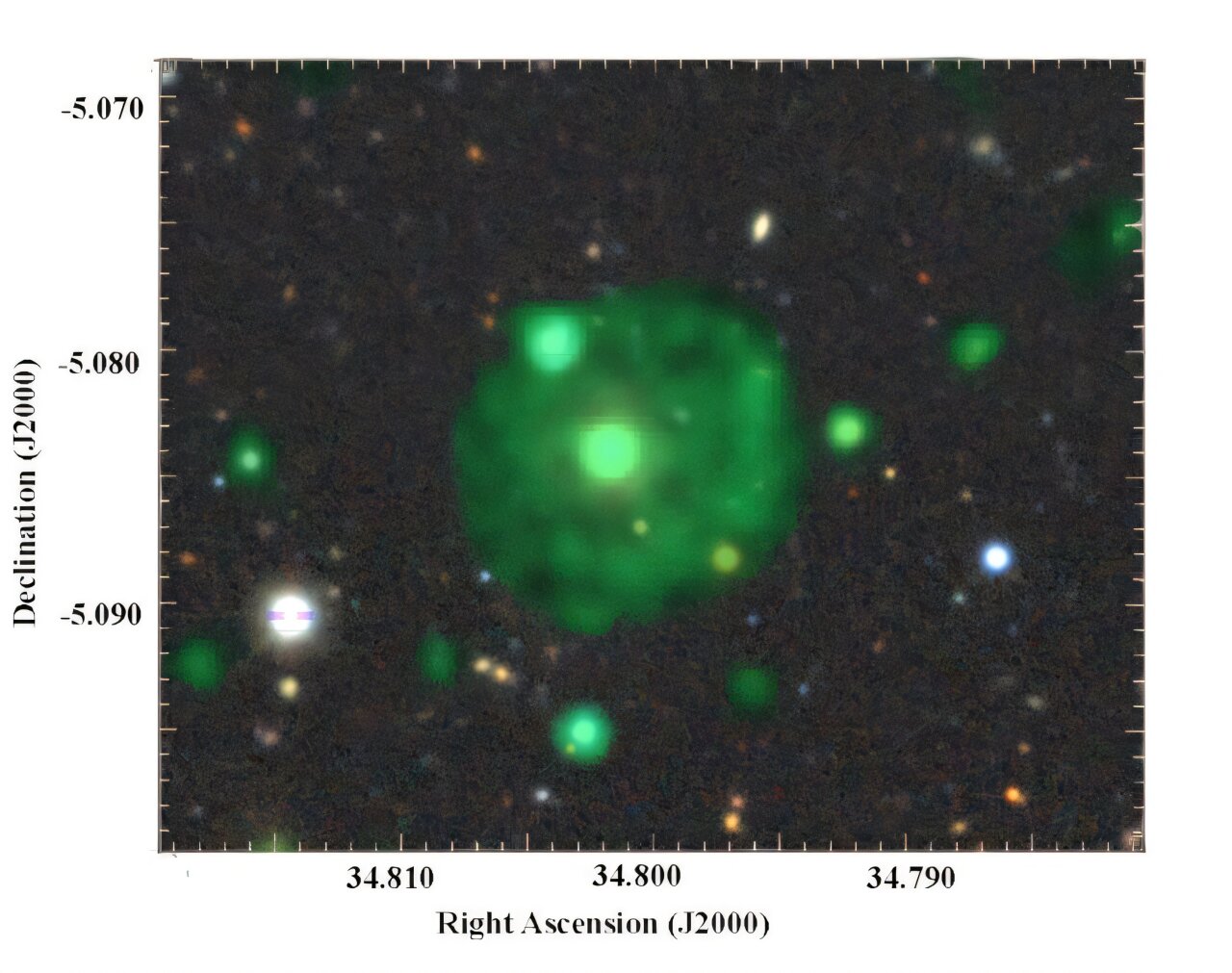
Astronomers have discovered a new Odd Radio Circle (ORC), ORC J0219–0505, using the MeerKAT radio telescope in South Africa. This massive circle of radio light, associated with the elliptical galaxy WISEA J021912.43–050501.8, is 371,600 light-years wide and differs from previously discovered ORCs, suggesting a selection bias in earlier detections. The origins of ORCs remain unknown, with theories suggesting they result from shockwaves caused by cosmic collisions or merging supermassive black holes. The discovery highlights gaps in current astronomical knowledge and the need for further research.
Astronomers using the MeerKAT telescope have discovered a new odd radio circle (ORC J0219–0505) associated with the elliptical galaxy WISEA J021912.43–050501.8. This ORC, part of the MIGHTEE survey, is a faint, edge-brightened ring of radio emission, potentially resulting from a galaxy merger. The discovery suggests a fainter population of ORCs may exist, prompting further investigation into their origins and characteristics.
Scientists may have solved the mystery of cosmic ORCs, vast odd radio circles that can encompass entire galaxies, by pointing to powerful winds erupting from bursts of exploding stars as the cause. These winds, driven by simultaneous supernova explosions in starburst galaxies, create shockwaves that generate the ORCs, which can spread out for hundreds of thousands of light-years. This discovery could provide insights into galactic evolution and the prevalence of extreme outflowing galactic winds.
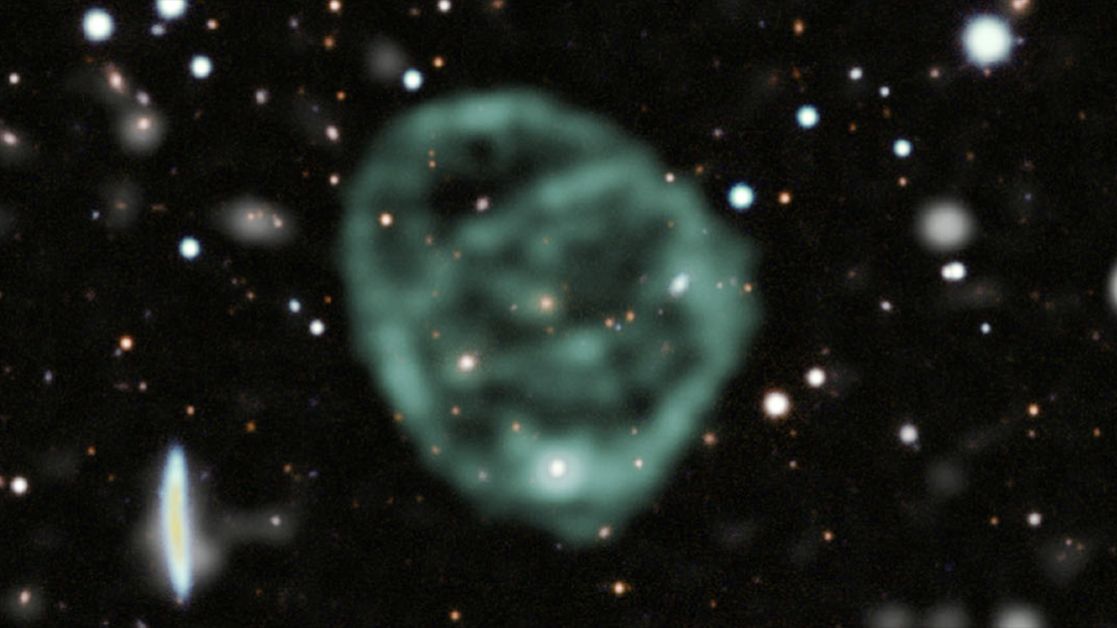
Astronomers have identified the origin of enormous "odd radio circles" (ORCs) as outflowing galactic winds from exploding stars in starburst galaxies, which occur when two large galaxies collide, pushing gas into a small region and causing intense bursts of star formation. These ORCs, measuring about a million light-years across, were initially thought to be imaging artifacts but have been confirmed as a new class of astronomical object only visible in the radio spectrum. Computer simulations and spectrograph data support the theory that ORCs are formed by powerful outflowing galactic winds, providing a rare opportunity to study galactic winds through radio data and spectrometry.
Astronomers have proposed a new theory suggesting that odd radio circles (ORCs) in space, massive celestial structures with galaxies at their centers, are formed by powerful galactic winds resulting from the explosions of massive stars. The theory is based on observations of ORC 4 using the W.M. Keck Observatory, which revealed the presence of heated gas in visible light. These findings shed light on the origins of ORCs and their potential impact on shaping galaxies over time, providing insights into galactic evolution.