Tag

Nucleus

All articles tagged with #nucleus

Physicists Reveal Inner Structure of Molecule Nucleus with Electron Probes

Originally Published 2 months ago — by Live Science

Featured image for Physicists Reveal Inner Structure of Molecule Nucleus with Electron Probes
Source: Live Science

Physicists have for the first time observed how magnetism is distributed within a radioactive molecule's nucleus, specifically in radium monofluoride, using electrons as probes. This breakthrough allows for more precise studies of nuclear asymmetries that could reveal new physics beyond the Standard Model, and demonstrates the potential of molecules in fundamental physics research.
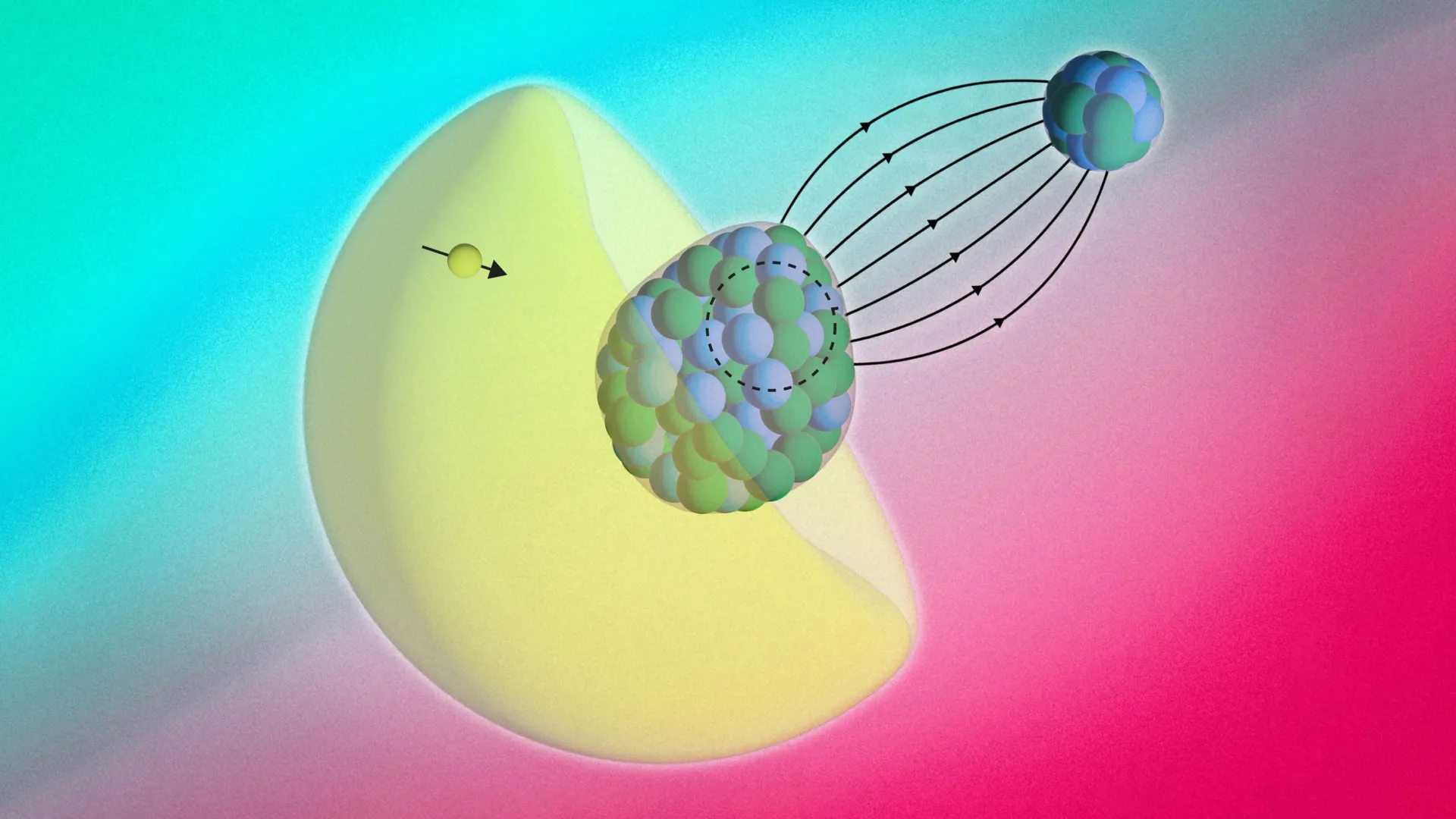
MIT Physicists Develop New Electron-Based Technique to Explore Atomic Nuclei

Originally Published 2 months ago — by Science Daily

Featured image for MIT Physicists Develop New Electron-Based Technique to Explore Atomic Nuclei
Source: Science Daily

MIT physicists developed a tabletop technique using molecules to study the interior of an atom's nucleus by tracking electron energy shifts, providing a new way to probe nuclear structure and fundamental symmetries, especially in radium, which could shed light on matter-antimatter imbalance in the universe.

Unprecedented Observation: Nucleus Decays into Four Particles in Groundbreaking Study

Originally Published 2 years ago — by Phys.org

Featured image for Unprecedented Observation: Nucleus Decays into Four Particles in Groundbreaking Study
Source: Phys.org

Scientists have made the first observation of a nucleus decaying into four particles after beta decay. The decay mode involves a lighter form of oxygen breaking into three helium nuclei, a proton, and a positron. By studying the breakup products of a single nucleus, researchers gained insights into decay processes and nucleus properties. The experiment involved using a particle accelerator to produce a beam of radioactive nuclei and a detector to measure the emitted particles. This discovery expands our understanding of radioactive decay and the stability of isotopes.

Unprecedented Discovery: Scientists Uncover Mysterious Oxygen Isotope Defying Physics

Originally Published 2 years ago — by ScienceAlert

Featured image for Unprecedented Discovery: Scientists Uncover Mysterious Oxygen Isotope Defying Physics
Source: ScienceAlert

Scientists have discovered a new isotope of oxygen, oxygen-28, with the highest number of neutrons ever observed in an oxygen atom. While it was expected to be stable due to its "magic" numbers of protons and neutrons, it actually decays rapidly. This challenges our understanding of the stability of isotopes and the concept of magic numbers in atomic nuclei. The findings suggest that the neutron shell in oxygen-28 is not completely filled, raising questions about the stability of isotopes with 20 neutrons. Further research is needed to explore the nucleus in an excited state and investigate alternative methods of oxygen-28 formation.

Unveiling the Hidden Threat: Fat Droplets' DNA Danger Revealed

Originally Published 2 years ago — by Phys.org

Featured image for Unveiling the Hidden Threat: Fat Droplets' DNA Danger Revealed
Source: Phys.org

Researchers at the University of Pennsylvania have discovered that small fat-filled lipid droplets have the surprising ability to indent and puncture a cell's nucleus, which contains and regulates its DNA. This can lead to elevated DNA damage, potentially contributing to diseases such as cancer. The physical properties of these droplets, including their high curvature, make them capable of deforming and damaging cellular components. The findings highlight the importance of understanding the physics of fat and its impact on cellular health beyond its metabolic functions.

The Perplexing Enigma of the Helium Nucleus Leaves Scientists Bewildered

Originally Published 2 years ago — by Yahoo Life

Featured image for The Perplexing Enigma of the Helium Nucleus Leaves Scientists Bewildered
Source: Yahoo Life

Scientists studying the behavior of protons and neutrons in helium atoms have found a significant mismatch between theoretical predictions and experimental data, suggesting the presence of new physics beyond the Standard Model. The discrepancy, which has been observed since 2013, indicates a lack of understanding of low-energy physics governing interactions within the helium nucleus. The recent research confirms the mismatch and rules out experimental uncertainty as the cause. The findings could have implications for understanding other phenomena, such as neutron star mergers. Future experiments using more advanced facilities may provide further insights into this mystery.

The Perplexing Mystery of the Helium Nucleus.

Originally Published 2 years ago — by Livescience.com

Featured image for The Perplexing Mystery of the Helium Nucleus.
Source: Livescience.com

Scientists are struggling to explain why the protons and neutrons in helium atoms are not behaving as theory suggests they should. The mismatch between theoretical predictions and what they're actually doing could point to new physics beyond the Standard Model. The discrepancy between theory and experiment first became evident in 2013, and the new research proves that this mismatch is real, not an artifact of experimental uncertainty. The upgraded version of the effective field theory gives a better approximation of the effects that complicate models of the strong interactions in the nucleus, yet when the researchers crunched the numbers, they found the theoretical predictions veered even further away from observed phenomena than the cruder approximations did.

The Strong Nuclear Force: The Glue of Reality.

Originally Published 2 years ago — by Interesting Engineering

Featured image for The Strong Nuclear Force: The Glue of Reality.
Source: Interesting Engineering

The strong nuclear force is the most powerful of the four fundamental forces in the standard model of physics and is foundational to the universe as we know it. It allows positively charged protons to clump together in a nucleus despite their electromagnetic charges repelling each other.