Physicist Rajendra Gupta proposes a new theory suggesting that dark matter and dark energy are illusions caused by the gradual weakening of the universe's fundamental forces, offering a simpler explanation for cosmic phenomena and challenging the standard cosmological model.
A new study challenges the existence of dark matter and dark energy, proposing that they are illusions caused by the slow weakening of the universe's fundamental forces over time, which could explain cosmic phenomena without invoking unknown particles or energy components.
Scientists have used laser-excited thorium-229 to develop a highly sensitive method for detecting ultralight dark matter, leveraging its unique nuclear transition to probe interactions with forces much weaker than gravity, opening new avenues in fundamental physics research.
Scientists are exploring the possibility of rewriting the laws of physics as we know them, delving into the realm of theoretical physics and quantum mechanics to challenge fundamental forces and principles. This groundbreaking research could potentially revolutionize our understanding of the universe.
The reason why there is no antigravity is because there is only one type of gravitational charge in the universe: positive mass/energy. Unlike other forces like electromagnetism, which have positive and negative charges, gravity only attracts positive masses. This is due to the fact that all known masses and energies are positive, and there is no evidence of negative mass or energy. While it is possible to create regions with lower mass/energy that behave as if they have negative mass/energy, they still exhibit attractive gravitational forces relative to their surroundings. Unless new physics is discovered that allows for negative mass or energy states, antigravity will remain a mathematical curiosity.
Attosecond-level precision in physics is an incredible achievement, but it is not fast enough to measure all processes in nature. While it can describe gravitational and electromagnetic interactions, it falls short in explaining and probing weak interactions and interactions mediated by the strong nuclear force. To truly understand the universe at its most fundamental levels, scientists will need to achieve yoctosecond (~10^-24 second) precision. This limitation arises from the nature of particles, their lifetimes, and the strong interactions. Attosecond-level precision is sufficient for measuring the positions and properties of atoms and molecules, but for subatomic particles, yoctosecond-level precision is required.
New research suggests that massive bubbles, known as "bubbletrons," may have emerged and collided in the early universe, generating energies that surpass those of human-made particle accelerators. These bubbletrons could have flooded the universe with dark matter particles and microscopic black holes. The expansion and collision of these bubbles would have also produced gravitational waves, which could still be detectable today. Future analysis with pulsar timing arrays and gravitational wave detectors may provide evidence for the existence of these bubbletrons.
Scientists, including researchers from LMU, have made significant progress in the development of nuclear clocks, which could provide a more precise measurement of time and offer insights into fundamental forces of the universe. By accurately characterizing the excitation energy of thorium-229, the element that could be used as the timekeeping component in nuclear clocks, the researchers have taken a critical step towards realizing this technology. Nuclear clocks could open up new research fields that cannot be explored with atomic clocks and have potential practical applications, such as detecting changes in the Earth's gravitational field. The first prototypes of nuclear clocks could be developed within the next decade.
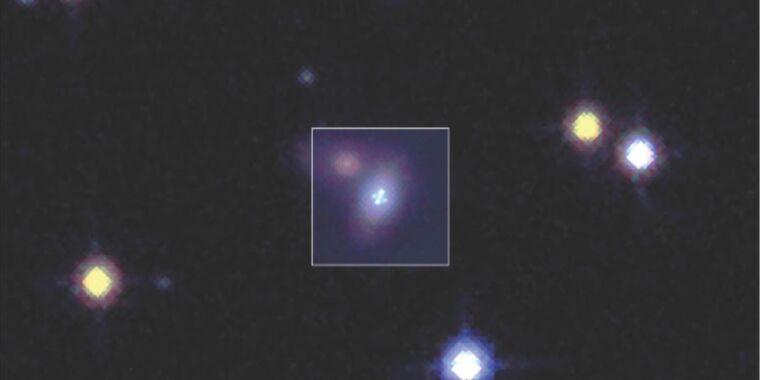
Astronomers have discovered a previously unknown supernova explosion more than 4 billion light-years away using gravitational lensing, which acts as a cosmic magnifying glass. The discovery was made using the Zwicky Transient Facility, a robotic camera attached to the Samuel Oschin telescope. The supernova, dubbed SN Zwicky, was confirmed to be a product of gravitational lensing using adaptive optics instruments at three other telescopes. Co-author Ariel Goobar described the find as "a significant step forward in our quest to understand the fundamental forces shaping our universe."
The strong nuclear force is the most powerful of the four fundamental forces in the standard model of physics and is foundational to the universe as we know it. It allows positively charged protons to clump together in a nucleus despite their electromagnetic charges repelling each other.