Janet Yellen warns that the US approaching a dangerous level of national debt could lead to fiscal dominance, where debt constraints limit the Federal Reserve's ability to control inflation, risking hyperinflation and economic instability, especially as debt surpasses 120% of GDP.
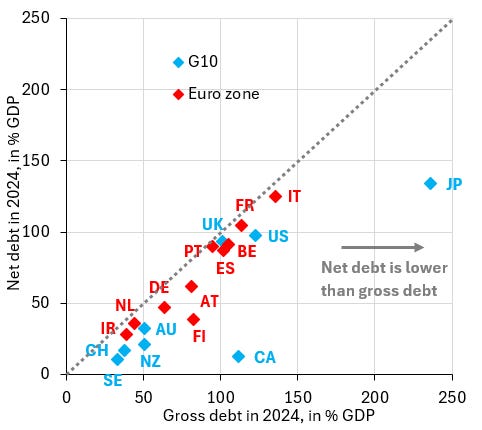
Japan faces a severe debt crisis with gross debt at 240% of GDP, but its large financial assets offer a potential solution: selling assets to reduce debt, which could stabilize the Yen and signal a move towards fiscal responsibility, despite political challenges.
Governments are looking to mobilize private wealth, including incentives like tax-free bonds and potential wealth taxes, to address their soaring debt levels, especially amid the upcoming $80-124 trillion wealth transfer over the next 20 years, raising concerns about private sector investment access and fiscal sustainability.
French companies' borrowing costs have fallen below those of the government amid rising concerns over national debt, highlighting shifts in financial market dynamics.
Global bond markets are experiencing a selloff with rising yields in the US, Europe, and the UK, driven by concerns over government debt sustainability and economic fundamentals, prompting safe-haven assets like gold to hit record prices and raising questions about future fiscal and monetary policy responses.
A global selloff in long-dated bonds continues, with yields reaching record highs in Japan, UK, and the US, driven by concerns over government debt and inflation, prompting a surge in gold prices to an all-time high as investors seek safe-haven assets.
President Trump advocates for lower interest rates to boost the housing market and reduce government debt costs, highlighting the potential benefits for consumers, businesses, and the federal budget, while acknowledging the complex relationship between rate cuts and economic indicators.
Global long-term bond yields are rising due to concerns over widening fiscal deficits and government debt, with Japan and Germany experiencing notable increases amid political and economic factors, overshadowing central bank policies and reflecting investor skepticism about debt sustainability.
Japan is entering a phase where rising interest rates are becoming a trend, which could increase government debt costs and impact public trust, although the Bank of Japan is currently hesitant to raise rates further amid market expectations.
Truck drivers in Mexico blocked major highways to protest unpaid bills for work on the Maya Train project, highlighting broader issues with the government's financial management. President Claudia Sheinbaum acknowledged the payment delays, attributing them to the government's budget deficits, which have been exacerbated by ambitious projects and entitlement programs. The financial strain has led to increased government debt and efforts to find new funding sources, including controversial taxes and reallocations.
The Bank for International Settlements (BIS) warns that the increasing supply of government debt could destabilize financial markets by 2025, urging policymakers to act promptly. With global sovereign debt potentially rising to $130 trillion by 2028, concerns are mounting over fiscal policies in the U.S., UK, France, and Japan. The BIS highlights the risk of "bond vigilante" attacks and notes a supply-demand imbalance in the U.S. Treasury market, exacerbated by inflationary pressures from stimulus spending.
UK finance minister Jeremy Hunt is expected to announce a tax cut for workers in the government's last budget before the upcoming general election, despite a struggling economy and soaring government debt. The tax cut, likely to be a reduction in national insurance, comes as the UK faces challenges such as stagnant economic growth, high government debt, and strained public services. The move is seen as a bid to win over voters, but economists warn that the government's plans for public spending may be unsustainable, and cutting future spending on public services to fund tax cuts now could backfire.
The US Treasury is set to hold its largest-ever bond auctions in an effort to address the country's budget deficit, which has been exacerbated by pandemic-related spending. The auctions will involve the sale of $126 billion in long-term securities, reflecting the government's need to finance its substantial debt. This move is expected to have significant implications for financial markets and could potentially lead to higher borrowing costs for the government in the future.
The US government's budget deficit for the first quarter of fiscal year 2024 reached nearly $510 billion, contributing to a total government debt surpassing $34 trillion for the first time. Despite efforts to reduce the deficit through the Inflation Reduction Act, the deficit is on track to exceed $2 trillion by the end of the year. Rising inflation and elevated interest rates have further increased financing costs for the government, with debt as a percentage of GDP reaching 120% in the third quarter of 2023.
Despite recent fluctuations, long-term interest rates are expected to remain above the ultra-low levels seen in the past, even as inflation subsides. The prevailing belief that government debt is a "free lunch" and that interest rates would stay low forever is being challenged. The idea of using central banks to purchase government debt, as seen in modern monetary theory, is flawed as it dismisses the risks of inflation and interest rate increases. The existing debt overhang and its implications are often ignored by proponents of spendthrift fiscal policies. The transition to higher interest rates could be challenging for European economies, and Japan may struggle to move away from its zero-interest rate policies. Policymakers and economists may need to reassess their beliefs in light of current market realities.