Tag

Epidemiology

All articles tagged with #epidemiology

Vegetarian diets linked to lower risk for several cancers, Oxford study finds
health1 day ago

Vegetarian diets linked to lower risk for several cancers, Oxford study finds

A large Oxford-led analysis combining data from around 1.64 million meat eaters and vegetarians found vegetarians have lower risks of pancreatic (21%), breast (9%), prostate (12%), kidney (28%), and multiple myeloma (31%). However, vegetarians also face nearly double the risk of esophageal cancer. Researchers caution that more work is needed to determine causality and whether meat consumption drives these differences, emphasizing that overall healthy, balanced diets matter for cancer risk.

Global study links diet type to varied cancer risks across 1.8 million participants
epidemiology1 day ago

Global study links diet type to varied cancer risks across 1.8 million participants

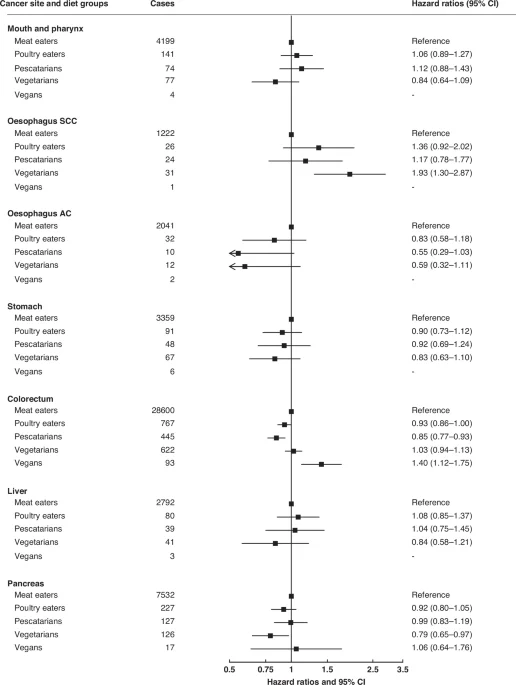
A pooled analysis of 1.8 million adults from nine prospective cohorts across the UK, US, Taiwan, and India found diet‑related differences in cancer risk. Compared with meat eaters, poultry eaters had a lower prostate cancer risk; pescatarians had lower colorectal, breast, and kidney cancer risks; vegetarians had lower risks of pancreatic, breast, prostate, kidney cancers and multiple myeloma but a higher risk of oesophageal squamous cell carcinoma; vegans had a higher risk of colorectal cancer. The authors caution that results may not generalize and could be influenced by residual confounding and misclassification in diet groups.

Vegetarian Diet Linked to Lower Risk for Five Cancers, but Higher Esophageal Cancer Risk
health2 days ago

Vegetarian Diet Linked to Lower Risk for Five Cancers, but Higher Esophageal Cancer Risk

A large international study of about 1.8 million people followed for ~16 years finds vegetarians have 21% lower pancreatic cancer risk, 12% lower prostate cancer risk, 9% lower breast cancer risk, 28% lower kidney cancer risk and 31% lower multiple myeloma risk versus meat eaters, but nearly double the risk of esophageal squamous cell carcinoma; vegans have 40% higher bowel cancer risk, and pescatarians/poultry eaters show some protective effects for certain cancers. Published in the British Journal of Cancer and funded by the World Cancer Research Fund, the study suggests diet-related factors influence cancer risk but the picture is complex and requires further research.

Mediterranean Diet Linked to Lower Stroke Risk, Including Bleeding Strokes, in a 20-Year Study
health2 days ago

Mediterranean Diet Linked to Lower Stroke Risk, Including Bleeding Strokes, in a 20-Year Study

A long-term study of more than 100,000 women over about 21 years found that closer adherence to a Mediterranean-style diet—rich in fruits, vegetables, beans, fish and olive oil—was linked to an 18% lower risk of any stroke, with a 16% reduction for ischemic (clot-related) strokes and a striking 25% lower risk of hemorrhagic (brain-bleeding) strokes. The association held after adjusting for smoking, physical activity and blood pressure, suggesting diet is linked to better brain health, though causality can’t be proven.

health-and-medicine9 days ago

Massive US Study Links Air Pollution to Alzheimer’s Risk in Seniors

A nationwide analysis of 27.8 million Americans aged 65+ shows long-term PM2.5 exposure is associated with higher Alzheimer's risk, mainly through direct brain effects rather than via hypertension, stroke or depression; greater risk among those with prior stroke and in disadvantaged communities with higher pollution exposure underscores environmental justice concerns and a push for stricter air-quality standards. The study relies on ZIP-code level outdoor exposure estimates and notes that indoor/work exposure was not included, indicating a need for mechanistic follow-up research.

Moderate Caffeine From Coffee or Tea Linked to Lower Dementia Risk
health18 days ago

Moderate Caffeine From Coffee or Tea Linked to Lower Dementia Risk

A large, long-term study of about 131,000–132,000 people followed for up to 43 years found that consuming two to three cups of caffeinated coffee daily or one to two cups of caffeinated tea daily was associated with roughly 15–20% lower dementia risk versus little or no caffeine; benefits for coffee plateaued beyond about 2.5 cups per day. The study did not prove causation and could reflect other healthy behaviors, but adjustments for various factors strengthen the association. Decaf showed no similar benefit, and stronger signals appeared before age 75. The study also noted less subjective cognitive decline and slightly better cognitive scores in some subgroups, suggesting caffeine may support brain health via inflammation and vascular pathways, though more research is needed.

Insomnia Linked to About 450,000 US Dementia Cases Annually, Study Shows
health18 days ago

Insomnia Linked to About 450,000 US Dementia Cases Annually, Study Shows

An analysis of 5,899 adults aged 65+ finds insomnia linked to higher dementia risk; using population attributable fraction, about 12.5% of US dementia cases in 2022 (~449,000) could be prevented if insomnia were eliminated. However, PAF is a model, not proof of causation. Burden is higher in women and those 85+, underscoring the need to integrate sleep health into geriatric care and pursue targeted insomnia interventions.

Why Do Men Develop Heart Disease Earlier? New Study Reveals a Seven-Year Gap
health24 days ago

Why Do Men Develop Heart Disease Earlier? New Study Reveals a Seven-Year Gap

A large analysis of the CARDIA study followed more than 5,000 adults for up to 30 years and found that men develop cardiovascular disease about seven years earlier than women, with the biggest gap in coronary heart disease (roughly a decade earlier). Stroke and heart failure occur at similar ages between sexes. The gap persists even after adjusting for common risk factors, suggesting additional biological or social factors may contribute. The findings support earlier heart-health screening for men in their 30s while recognizing that women's risk remains high, especially after menopause, and the study has limitations inherent to observational research.

Full-fat dairy linked to lower dementia risk in 25-year Swedish study
health-and-medicine24 days ago

Full-fat dairy linked to lower dementia risk in 25-year Swedish study

A 25-year Swedish study of 27,670 adults found that higher intake of full-fat cheese (>50 g/day) was associated with a 13%–17% lower risk of Alzheimer's in those without a genetic risk, while higher full-fat cream (>20 g/day) was linked to a 16%–24% lower risk of dementia overall; no stronger links were found for low-fat dairy. The findings likely reflect healthier overall diets and lifestyle, possible substitution effects, and population differences, not a causal protective effect of dairy. Researchers also accounted for early dementia by excluding cases at baseline and reanalyzing after removing early incident cases.

Full-fat Dairy and Dementia Risk: Swedes Find Lower Odds, but Diet Context Matters
health1 month ago

Full-fat Dairy and Dementia Risk: Swedes Find Lower Odds, but Diet Context Matters

A 25-year Swedish study of 27,670 adults found that higher consumption of full-fat cheese (>50 g/day) and cream (>20 g/day) was linked to a modestly lower risk of dementia, especially Alzheimer’s, among those without genetic risk, with no similar benefit seen for other dairy. Authors caution the results likely reflect healthier overall dietary patterns and lifestyle, rather than a protective effect of dairy itself, and substitution effects (replacing red/processed meat with dairy) may influence findings. The study reinforces that dietary patterns—such as Mediterranean-style eating—are more important than any single food, and while dairy supplies brain-relevant nutrients, the evidence does not justify large increases in cheese or cream for dementia prevention.

Two to three kids may be healthiest for longevity, study finds
science1 month ago

Two to three kids may be healthiest for longevity, study finds

A Nature Communications-backed study of about 15,000 Finnish women shows a U-shaped relationship between number of births and aging/mortality: women with two to three children age biologically slower and have lower early death risk, while those with no children or many children (around seven) age faster and face higher mortality. The researchers used epigenetic age markers and caution that the study is observational, so it cannot prove causation. Potential explanations include resource allocation over a lifetime (disposable soma theory) and benefits or health reflections of childbearing, with never having children possibly linked to poorer health. The authors advise against changing personal family plans based on these findings alone.