Tag

Dwarf Planets

All articles tagged with #dwarf planets

science5 months ago

Mysterious Solar System Object Reveals New Celestial Insights

Scientists continue to investigate the possibility of a massive undiscovered planet beyond Neptune, known as Planet Nine, which could explain the irregular orbits of Kuiper Belt objects. While evidence has grown, challenges remain due to limited observations and new discoveries of stable distant objects that suggest such a planet might be farther than initially thought. Ongoing observations and future technology will be crucial in confirming or refuting its existence.

science1 year ago

"Growing Evidence Suggests Hidden 'Planet 9' in Our Solar System"

Scientists are investigating the possibility of a ninth planet, known as Planet Nine or Planet X, in our Solar System. This hypothetical planet, believed to be at least ten times the mass of Earth, could explain the unusual orbits of distant dwarf planets. Despite extensive searches, Planet Nine remains elusive due to its expected faintness and distance from the Sun. New telescopes and surveys in the coming decade may finally confirm or disprove its existence.

astronomy1 year ago

"James Webb Telescope Uncovers Potential for Life on Distant Dwarf Planets"

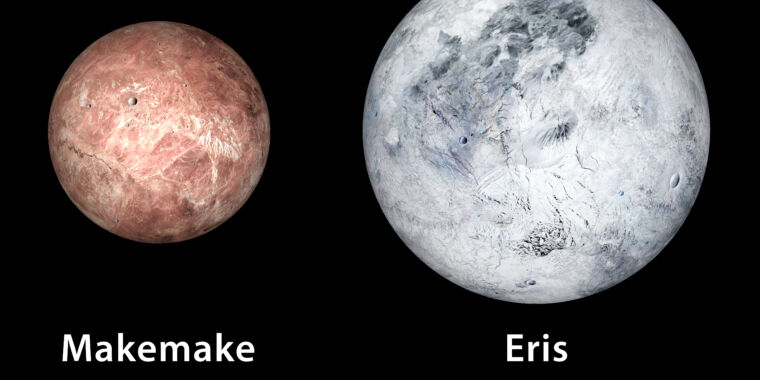
The James Webb Space Telescope has detected potential geological activity on the dwarf planets Eris and Makemake, suggesting the possibility of conditions conducive to supporting alien life. The presence of thermogenic methane in their atmospheres indicates ongoing or recent geological processes, challenging previous assumptions about the activity of dwarf planets. These findings raise the likelihood of life developing on these distant worlds and prompt the suggestion for future exploration missions to further assess their geological potential.

space-science1 year ago

"James Webb Telescope Identifies Potential Life Conditions on Dwarf Planets Beyond Neptune"

The James Webb Space Telescope has detected potential geological activity on the dwarf planets Eris and Makemake, suggesting they could support alien life. The presence of thermogenic methane in their atmospheres indicates ongoing or recent geological processes, challenging previous assumptions about the activity of small celestial bodies. These findings raise the possibility of life on these planets and highlight the need for further exploration to assess their geological potential.

space-science1 year ago

"Potential Warm Oceans on Dwarf Planets at Solar System's Edge"

Scientists have discovered evidence suggesting that dwarf planets Eris and Makemake, located in the Kuiper Belt, may have warm oceans beneath their frozen surfaces. Data from the James Webb Space Telescope revealed isotope ratios in methane on their surfaces consistent with internal heating, indicating the presence of potential subsurface oceans. These findings challenge previous assumptions about the dynamics of the outer Solar System and suggest that conditions for microbial marine life might exist in the Kuiper Belt, making it more dynamic and potentially hospitable than previously thought.

space-science1 year ago

"Potential for Warm Oceans on Dwarf Planets at Solar System's Edge"

Scientists using the James Webb Space Telescope have found evidence suggesting that the dwarf planets Eris and Makemake, located in the Kuiper Belt, may have underground oceans of liquid water due to geothermal activity. Observations indicate that methane on their surfaces is likely produced from within the planets' rocky cores, pointing to potential sources of liquid water beneath their icy surfaces. The findings raise the possibility of these dwarf planets containing habitable oceans and could also apply to Saturn's moon Titan, potentially impacting its presumed habitability.

astronomy1 year ago

"Webb Telescope Uncovers Geothermal Activity on Eris and Makemake in Solar System's Outskirts"

The James Webb Space Telescope has provided evidence suggesting that dwarf planets Eris and Makemake in the Kuiper Belt may be geologically active, despite their frigid, icy origins. By analyzing the infrared spectrum of sunlight reflected off these objects, the telescope was able to identify differences in the hydrogen isotopes found on their surfaces, indicating ongoing geological activity. This discovery challenges previous assumptions about the lack of significant heat sources in the outer Solar System and sheds light on the potential for active geology in distant celestial bodies.

space1 year ago

"Surprising Discoveries: Webb Telescope Finds Evidence of Life-Supporting Conditions on Dwarf Planets"

The James Webb space telescope has made a surprising discovery in the Kuiper belt, revealing that the frozen objects on the outskirts of our solar system may not be as lifeless as previously thought. By studying dwarf planets Eris and Makemake, the telescope found evidence of recent activity, suggesting the possibility of hotter interiors and potential oceans beneath the surface. This unexpected find could point to the existence of "living" dwarf planets in the Kuiper belt, similar to Jupiter's moon Europa, although further exploration is currently limited by the vast distance from Earth.

science2 years ago

Unveiling the Enigmatic Secrets of Dwarf Planet Eris

A recent study provides new insights into the structure and composition of Eris, a small planet similar in size to Pluto. Researchers have discovered that Eris has a rocky inside under a layer of ice, distinguishing it from Pluto, which has a higher ice content and a possible underground liquid ocean. The study also reveals that Eris has a slow churning motion of its ice, driven by leftover heat from its interior, suggesting the absence of a liquid ocean. Eris, the most massive dwarf planet, orbits beyond Neptune and is about 40 percent farther from the sun than Pluto.

space2 years ago

Webb's Glimpse into the Kuiper Belt: Observing 3 Dwarf Planets

Using the James Webb Space Telescope (JWST), astronomers have observed three dwarf planets in the Kuiper Belt, revealing light hydrocarbons and complex organic molecules. The observations provide insights into the orbits and compositions of these objects, enhancing our understanding of the outer Solar System. The findings also demonstrate the capabilities of the JWST in studying objects in our cosmic neighborhood.

astronomy2 years ago

Exploring the Kuiper Belt: JWST's Observations of Sedna, Gonggong, and Quaoar

The James Webb Space Telescope (JWST) has observed three dwarf planets in the Kuiper Belt - Sedna, Gonggong, and Quaoar - using its Near-Infrared Spectrometer (NIRSpec). The observations revealed interesting information about their orbits and composition, including the presence of light hydrocarbons and complex organic molecules believed to be the result of methane irradiation. These findings provide insights into the formation and evolution of objects in the outer Solar System and demonstrate the capabilities of the JWST in studying our cosmic neighborhood.

astronomy2 years ago

"Unseen Giant Planet Discovered in Our Solar System"

Astronomers are searching for evidence of a ninth planet, dubbed "Planet Nine" or "Planet X," in our Solar System. The discovery of dwarf planets and their unexpected orbits suggests the presence of a large planet at least ten times the mass of Earth. However, locating Planet Nine is challenging due to its distance from the Sun and faintness. New telescopes and sky surveys in the next decade may provide the opportunity to confirm or disprove its existence.