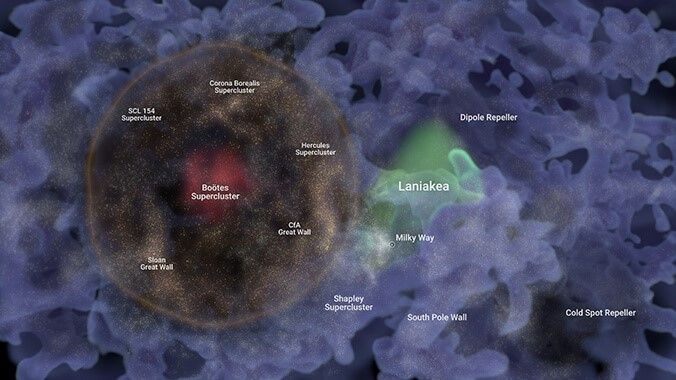
A massive structure named Ho'oleilana, consisting of galaxies clustered around a gigantic spherical void, has been discovered just 820 million light-years from the Milky Way. It is believed to be a baryon acoustic oscillation, a frozen pressure wave from the beginning of the cosmos. The size of the bubble suggests that the universe may be expanding more rapidly than previously thought. Further observations will be conducted to confirm this hypothesis.
Astronomers have discovered a massive bubble of galaxies, named Ho'oleilana, located around 820 million light-years from Earth and spanning one billion light-years wide. This cosmic bubble could be a fossilized remnant from the Big Bang, resulting from density ripples known as Baryon Acoustic Oscillations (BAOs). Ho'oleilana is composed of previously identified structures, including superclusters and a void, and its existence challenges theoretical expectations. The discovery could have implications for understanding the formation and evolution of the universe, as well as the rate of its expansion.