The hypertension drug rilmenidine has been shown to extend lifespan and slow aging in worms and mice by mimicking caloric restriction effects, with potential implications for human health, pending further research.
The blood pressure drug rilmenidine has been shown to extend lifespan and slow aging in worms and mice by mimicking caloric restriction effects, with potential implications for human health and aging, pending further research.
Reducing cysteine levels in fat tissue may promote the transformation of white fat into metabolically active brown fat, leading to increased fat burning and weight loss, suggesting new approaches beyond calorie restriction.
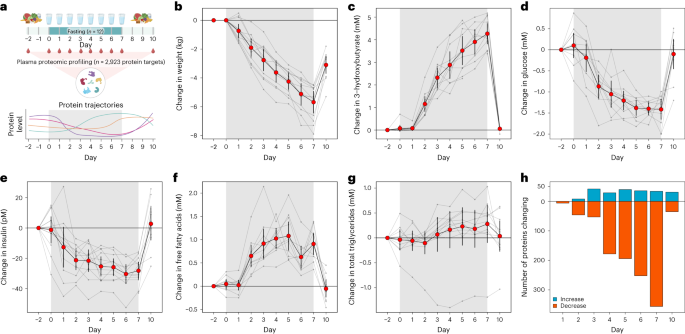
A study by European and UK researchers reveals that the health benefits of fasting, such as improved cardiovascular health and rheumatoid arthritis, only manifest after more than three days of total caloric restriction. The study, involving 12 participants, found significant protein changes in the blood after a seven-day water-only fast. While fasting can offer health benefits, it poses risks and should be done under medical supervision. The study highlights the need for more research to understand fasting's effects and develop safer interventions.
The hypertension drug rilmenidine has been found to extend lifespan and slow aging in Caenorhabditis elegans worms by mimicking the effects of caloric restriction, a method known to prolong life in various animal models. This discovery suggests potential anti-aging benefits for humans, as rilmenidine is already widely prescribed with mild side effects. The study highlights the role of the nish-1 receptor in the drug's effectiveness, opening avenues for further research into its application in human aging. The findings were published in Aging Cell.
A recent study published in Nature suggests that caloric restriction may be more effective than intermittent fasting for extending lifespan, at least in mice. The research found that mice on a calorie-restricted diet lived longer than those on intermittent fasting or unrestricted diets. However, the study also noted that losing weight on a calorie-restricted diet could negatively impact lifespan, highlighting the importance of maintaining body weight and resilience. The findings suggest that genetic factors and moderate calorie reduction play significant roles in longevity, though the applicability to humans remains uncertain.
A new study published in Nature Aging reveals that a reduced-calorie diet can significantly reduce biological aging, as evidenced by data from the CALERIE study. The research, funded by Singapore's Ministry of Education, shows that even moderate caloric restriction (12%) over two years can lower cardiovascular disease risk factors and slow the pace of biological aging.
A study published in Annals of Internal Medicine suggests that time-restricted eating (TRE) may help people lose weight simply because it leads to reduced calorie intake, rather than through complex metabolic changes. The small study involved 41 participants and found that those following a time-restricted diet lost about the same amount of weight as those eating the same diet without time restrictions. The study's limitations include its small size and the specific demographics of the participants, but it provides valuable data on the mechanisms of TRE and its potential as a simplified and accessible dietary strategy for weight loss.
Caloric restriction has been shown to have complex effects on aging, with a recent study finding that participants on a restricted diet initially experienced more rapid telomere loss compared to those on a standard diet, but after two years, their telomere loss slowed down. This highlights the complexity of how caloric restriction affects telomere length and biological aging. Despite this ambiguity, the study has also revealed other health benefits of calorie restriction, such as reduced "bad" cholesterol and blood pressure.
A study explores the systemic proteome adaptations to 7-day complete caloric restriction in humans, shedding light on the molecular effects and clinical applications of fasting, with potential implications for health, aging, disease, weight loss, and metabolic health. The research provides insights into the links between fasting, energy restriction, and various human diseases, offering a comprehensive understanding of the impact of fasting on the human plasma proteome and its potential role in addressing conditions such as cancer, cardiovascular disease, and metabolic disorders.
The hypertension drug rilmenidine has been found to slow down aging in worms, potentially offering a way to extend lifespan and improve health in humans. The drug mimics the effects of caloric restriction, which has been shown to increase lifespans in animals. In a study, worms treated with rilmenidine lived longer and showed improved health markers. Further tests on mice also revealed similar gene activity associated with caloric restriction. The drug's rare and mild side effects make it a promising candidate for anti-aging treatment, although more research is needed to determine its effectiveness in humans.
A study conducted in yeast cells challenges the belief that only caloric restriction can lead to healthier aging. Researchers at the Babraham Institute found that a dietary change from glucose to galactose, without caloric restriction, reduced signs of aging in yeast cells. The positive effects were most pronounced when dietary changes were implemented at a young age, highlighting the potential importance of early-life dietary choices. While the study was conducted in yeast cells, further research is needed to explore the real-world implications for humans.
The hypertension drug rilmenidine has shown potential in slowing down aging and extending lifespan in worms, mimicking the effects of caloric restriction. In tests conducted on worms and mice, rilmenidine increased lifespan and improved health markers. The drug targets a biological signaling receptor called nish-1, which is crucial for its effectiveness. Rilmenidine is already widely prescribed, taken orally, and has relatively mild side effects. While further research is needed to determine its effectiveness in humans, these early findings offer promise for developing an anti-aging drug that could improve health in old age without the need for extreme calorie cutting.
A randomized controlled trial called CALERIE™ found that caloric restriction can slow the pace of aging in healthy adults, with effects similar to smoking cessation interventions. The trial randomized 220 healthy men and women to a 25% calorie-restriction or normal diet for two years. The intervention effect on DunedinPACE represented a 2-3% slowing in the pace of aging, which in other studies translates to a 10-15% reduction in mortality risk. The study suggests that slowing human aging may be possible through interventions like intermittent fasting or time-restricted eating.