Scientists have created a long-lasting (two seconds) dipolar Bose-Einstein condensate of sodium-cesium molecules at near absolute zero using a novel dual-microwave technique, opening new avenues for exploring exotic quantum matter and phases.
Scientists at Columbia University have successfully created a Bose-Einstein condensate from sodium-cesium molecules at ultra-cold temperatures using innovative microwave shielding techniques, marking a significant advancement in quantum physics and opening new avenues for research into quantum states and materials.
Scientists at Columbia University have created a molecular sodium-cesium Bose-Einstein condensate (BEC) that is dipolar and lasts for two seconds, opening new possibilities for exploring exotic states of matter and quantum physics applications. This breakthrough was achieved using microwave fields to control interactions at ultracold temperatures near absolute zero, potentially leading to advances in quantum chemistry and the study of novel quantum phases.
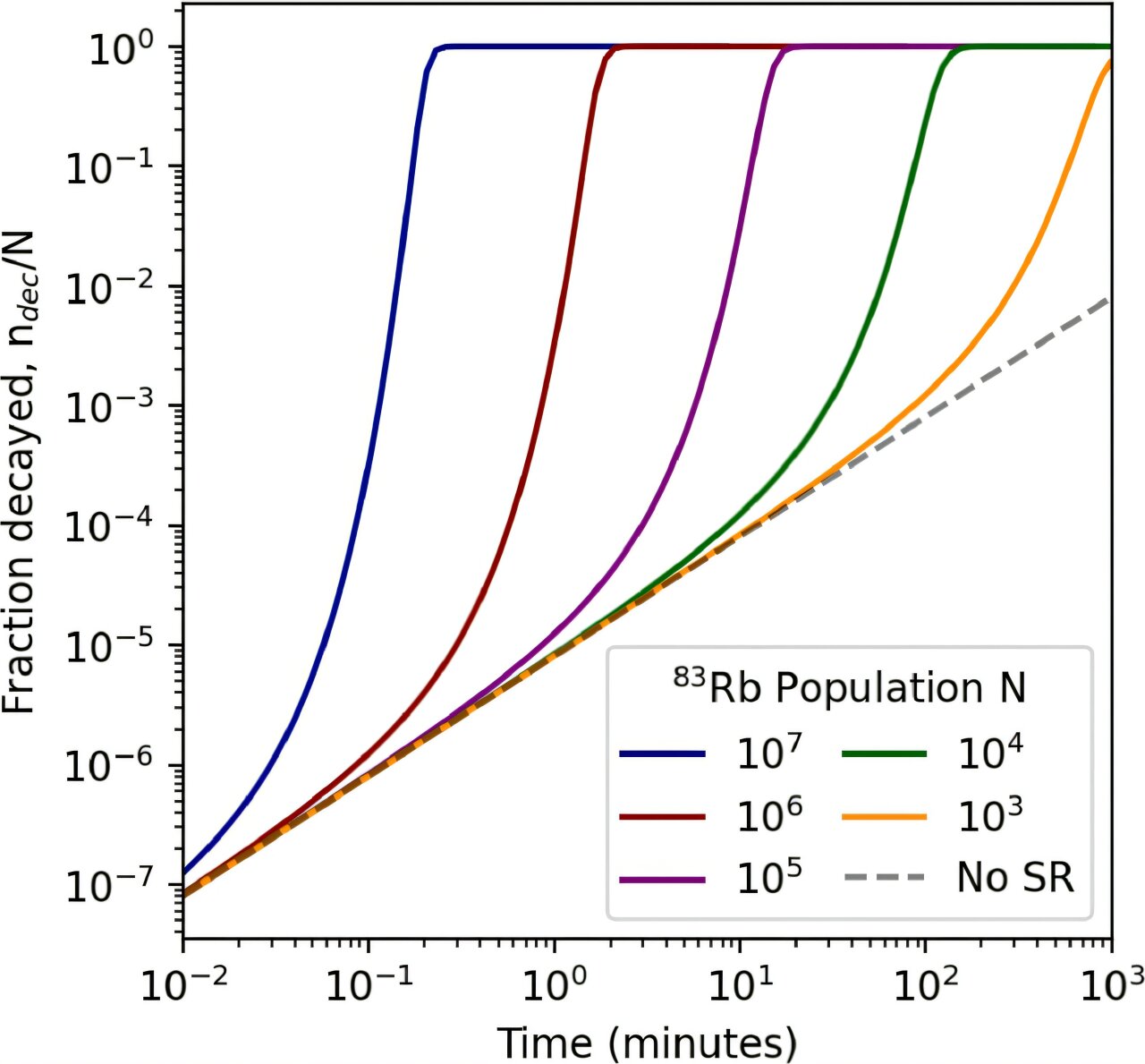
MIT physicists have proposed a theoretical concept for a neutrino laser using a Bose-Einstein Condensate of rubidium-83 atoms, which could enable more precise study of neutrinos and potentially revolutionize particle physics and communication technologies.
MIT physicists propose a novel concept for a 'neutrino laser' that uses super-cooled radioactive atoms in a Bose-Einstein condensate to produce a coherent, amplified burst of neutrinos, potentially revolutionizing communication and medical technology. They plan to test this idea with tabletop experiments, aiming to harness superradiance to accelerate neutrino production.
MIT physicists propose a novel concept for a neutrino laser that could be created by cooling radioactive atoms to a quantum state, potentially enabling faster neutrino production and new applications in communication and medical imaging.
Scientists from Columbia University have created a dipolar Bose-Einstein condensate (BEC) using molecular sodium-cesium, which lasts for two seconds and is only five nanoKelvin above absolute zero. This breakthrough, achieved with the help of two microwave fields, opens the door to numerous applications in exotic matter and quantum chemistry, marking a significant advancement in the study of quantum physics.
Researchers at Columbia University have created a Bose-Einstein Condensate (BEC) using sodium-cesium molecules cooled to five nanoKelvin, stable for two seconds. This breakthrough opens new avenues for exploring quantum phenomena and simulating complex materials' quantum properties, marking a significant advancement in quantum physics and ultracold molecule research.
Physicists at Columbia University have created a Bose-Einstein Condensate (BEC) from sodium-cesium molecules at just five nanoKelvin, utilizing microwaves to prevent molecular collisions and achieve ultracold temperatures. This breakthrough opens new avenues for exploring quantum phenomena and developing quantum simulations, marking a significant advancement in the field of ultracold physics.
Scientists operating the Cold Atom Lab on the International Space Station have successfully generated a quantum gas containing two species of atoms, achieving a milestone in quantum chemistry research. The creation of a Bose-Einstein condensate, an exotic fifth state of matter, in microgravity opens up new possibilities for space-based experiments. This breakthrough could lead to the development of space-based quantum technologies, such as highly sensitive gyroscopes for deep space navigation and improved clocks for applications like high-speed internet and GPS. Additionally, researchers hope to use the Cold Atom Lab to test the equivalence principle, a fundamental concept in Albert Einstein's theory of general relativity.
Scientists operating the Cold Atom Lab aboard the International Space Station have successfully generated a quantum gas containing two species of atoms, achieving a milestone in quantum chemistry research. The creation of a Bose-Einstein condensate, an exotic fifth state of matter, in microgravity opens up new possibilities for space-based experiments. This breakthrough could lead to the development of space-based quantum technologies, such as highly sensitive gyroscopes for deep space navigation and improved clocks for applications like high-speed internet and GPS. Additionally, researchers hope to use the Cold Atom Lab to test the equivalence principle, a fundamental concept in Albert Einstein's theory of general relativity.
Researchers have developed a new technique using microwaves to create shields around sodium-cesium molecules, allowing them to stabilize and cool the molecules to extremely low temperatures. This brings scientists closer to creating an elusive molecular Bose-Einstein condensate (BEC), a state of matter predicted by Satyendra Nath Bose and Albert Einstein. The technique involves using microwaves to prevent the molecules from sticking to each other and getting lost from the sample, enabling successful evaporative cooling. The ultracold sodium-cesium molecules offer a new platform to explore fundamental physics and could lead to the study of new physics phenomena and the understanding of complex molecular interactions.
Researchers propose a top-down approach to building a large quantum register using a Bose-Einstein condensate (BEC) of excitons. By generating and controlling macroscopic quantum states of BEC consisting of millions of identical excitons, they aim to overcome the challenges of short-lived phenomena and ultra-low temperatures typically associated with quantum computing. The use of a superfluid BEC state can prevent quantum decoherence and enable faster quantum gate operations. The proposed system shows promise for scalability and offers computational capabilities and redundancy for quantum error correction.
Scientists have used an ultracold state of matter called Bose-Einstein condensate (BEC) to mimic the behavior of "fuzzy" dark matter, which is believed to be made up of tiny particles with wave-like behavior. The team found that BECs resembled the physical state at the cores of fuzzy dark matter "halos" and that there were specific similarities with BECs. This achievement is promising for future attempts to create laboratory settings that replicate aspects of matter distribution in the universe on a smaller scale.
Scientists at the University of Chicago have discovered that plants utilize quantum mechanical processes during photosynthesis, acting like a Bose-Einstein condensate, a strange fifth state of matter typically found at ultra-cold temperatures. By forming a condensate, the excitons formed one single quantum state, acting like a single particle, forming a superfluid, allowing energy to flow freely between chromophores. This behavior has never been seen above temperatures of 100 Kelvin, making it surprising to see this behavior in a messy, real-world system at normal temperatures. Room-temperature Bose-Einstein condensates may have practical applications for higher levels of energy efficiency and transfer.