
Tag

Molecular Physics

All articles tagged with #molecular physics

Scientists Discover Fifth State of Matter with Bose-Einstein Condensate

Originally Published 11 days ago — by The Brighter Side of News

Featured image for Scientists Discover Fifth State of Matter with Bose-Einstein Condensate
Source: The Brighter Side of News

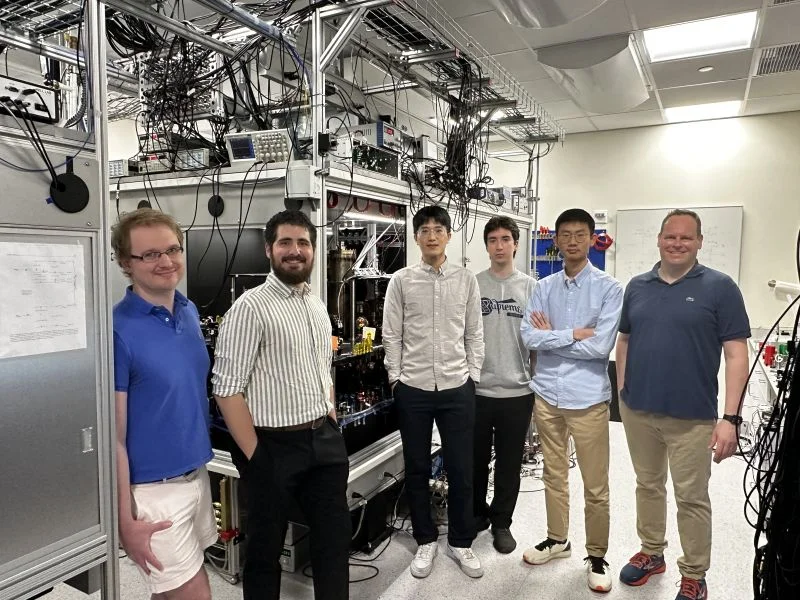
Scientists at Columbia University have successfully created a Bose-Einstein condensate from sodium-cesium molecules at ultra-cold temperatures using innovative microwave shielding techniques, marking a significant advancement in quantum physics and opening new avenues for research into quantum states and materials.

"Tetratomic Supermolecules Achieve Nanokelvin Temperatures"

Originally Published 1 year ago — by Phys.org

Featured image for "Tetratomic Supermolecules Achieve Nanokelvin Temperatures"
Source: Phys.org

Researchers at the Max Planck Institute of Quantum Optics and the Chinese Academy of Sciences have successfully created and stabilized tetratomic "supermolecules" at ultracold temperatures, a significant advancement in the study of exotic ultracold matter. These fragile molecules, composed of more than two atoms, were cooled down to 134 nanokelvin, over 3,000 times colder than previously achieved. The discovery, published in Nature, offers new possibilities in cold chemistry, precision measurements, and quantum information processing, with potential implications for quantum physics and quantum chemistry.

"Study Unveils Revolutionary Kinetic Asymmetry in Molecular Interactions"

Originally Published 2 years ago — by SciTechDaily

Featured image for "Study Unveils Revolutionary Kinetic Asymmetry in Molecular Interactions"
Source: SciTechDaily

Researchers have discovered a new type of non-reciprocal molecular interaction, termed kinetic asymmetry, which does not require external forces such as hydrodynamics. This phenomenon could redefine our understanding of molecular interactions and has implications for the evolution of life and the design of molecular machines. The study, conducted by scientists from the University of Maine and Penn State, suggests that local gradients of reactants and products around catalysts, like enzymes, can lead to one molecule being repelled by yet attracting another molecule. This insight into kinetic asymmetry could also inform the development of synthetic molecular motors and pumps, offering a deeper understanding of the origins of life and the complex behavior of matter.