Physicists have discovered that electrons in Kagome crystals can synchronize and produce a collective quantum 'song' that is influenced by the crystal's shape, revealing a new way to control quantum states through geometry, with potential implications for future material design.
Scientists have developed a novel polymer capable of maintaining quantum states at room temperature, potentially revolutionizing quantum devices by eliminating the need for ultra-cold environments, with applications in sensors, electronics, and quantum computing, though further optimization is needed.
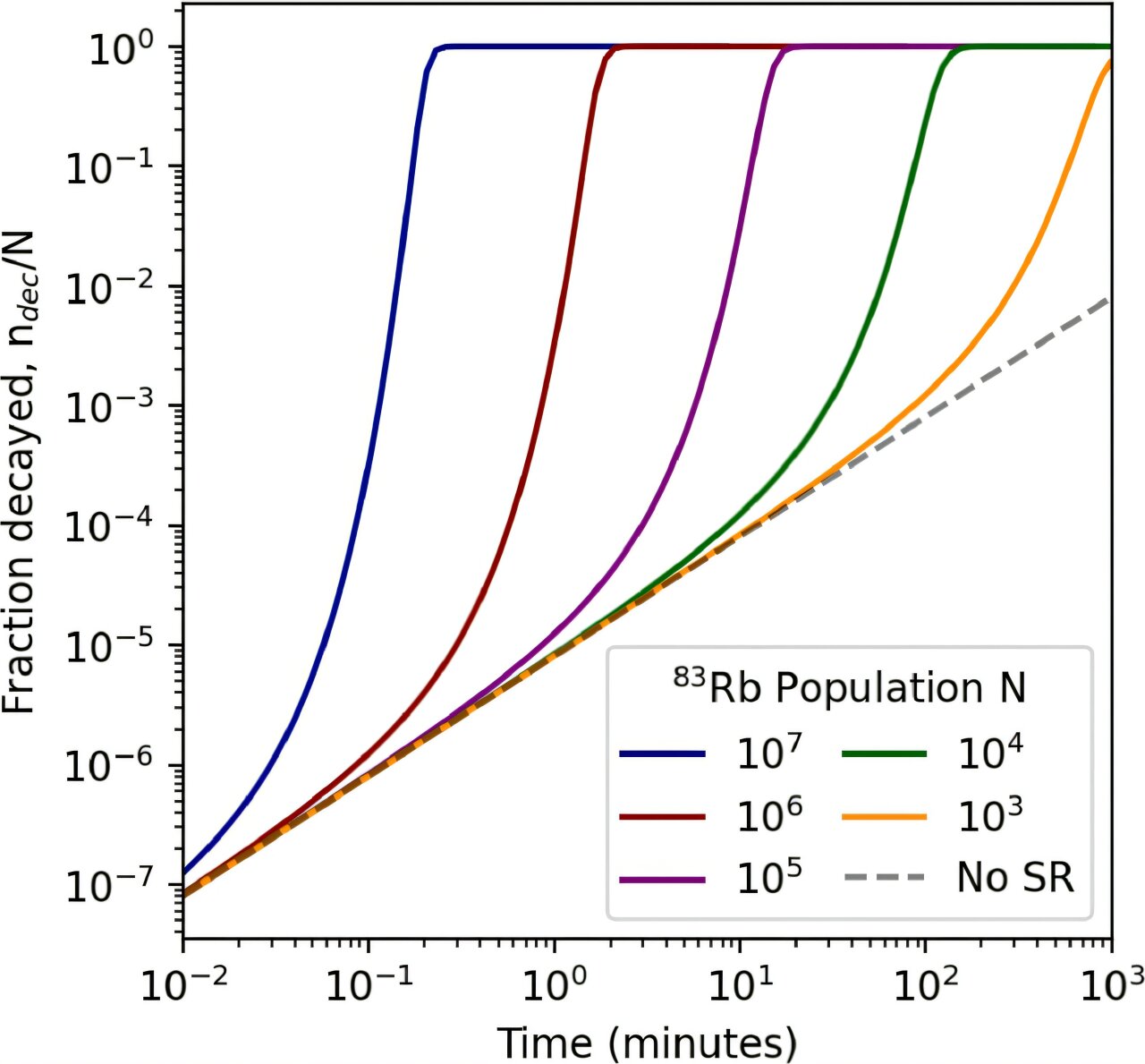
MIT physicists propose a novel concept for a 'neutrino laser' that uses super-cooled radioactive atoms in a Bose-Einstein condensate to produce a coherent, amplified burst of neutrinos, potentially revolutionizing communication and medical technology. They plan to test this idea with tabletop experiments, aiming to harness superradiance to accelerate neutrino production.
MIT physicists propose a novel concept for a neutrino laser that could be created by cooling radioactive atoms to a quantum state, potentially enabling faster neutrino production and new applications in communication and medical imaging.
Researchers at CERN's BASE collaboration have successfully demonstrated the first antimatter quantum bit by trapping and maintaining an antiproton's quantum state for nearly a minute, paving the way for more precise tests of fundamental symmetries between matter and antimatter and advancing quantum sensing techniques.
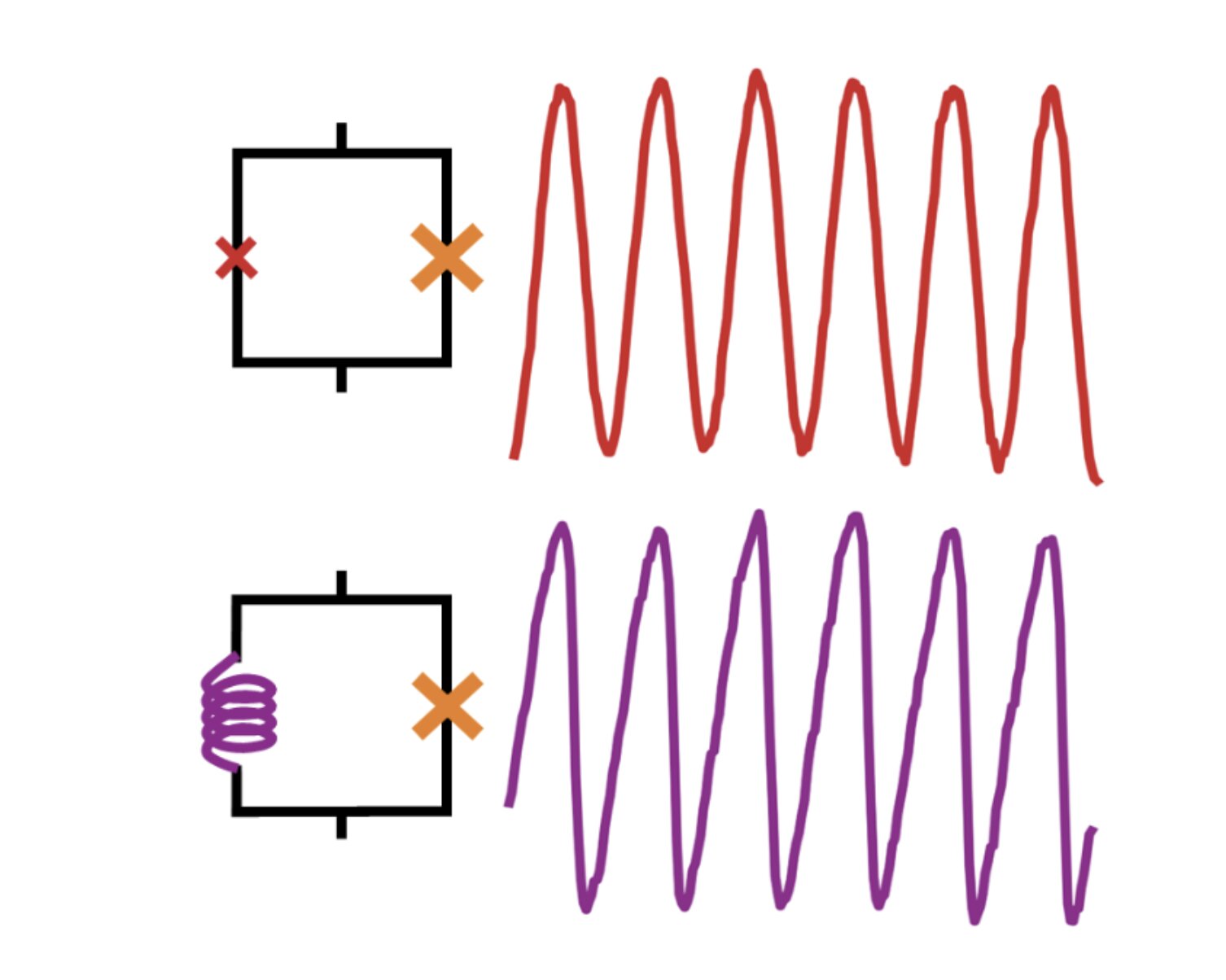
Researchers have discovered that twisted trilayer graphene exhibits high and tunable kinetic inductance and quantum coherence, providing new insights into unconventional superconductivity and potential applications in quantum technologies, although practical use may require further material development.
Researchers have achieved quantum coherence at room temperature, a crucial step in the development of quantum computers, by creating an entangled quintet state in electrons using a chromophore embedded in a metal-organic framework. This breakthrough could lead to more efficient generation of multiexciton state qubits and open doors to room-temperature molecular quantum computing and quantum sensing technologies with higher resolutions and sensitivities.
Researchers at Kyushu University have achieved quantum coherence at room temperature by combining a light-absorbing dye molecule with a metal-organic framework, marking a significant breakthrough in quantum computing and sensing capabilities despite the current nanosecond timeframe for coherence.
Researchers at the University of Rochester have developed a method to extract the spectral density for molecules in solvent using resonance Raman experiments, allowing for a better understanding of quantum decoherence. By mapping decoherence pathways, scientists can now connect molecular structure with quantum decoherence, opening the door to designing molecules with specific quantum coherence properties. The team demonstrated how electronic superpositions in thymine, a DNA building block, unravel in just 30 femtoseconds following UV light absorption. They also found that chemical modifications to thymine can significantly alter the decoherence rate.
Researchers have found that ecotourism activities, such as swimming with sharks, can negatively impact the animals by causing stress and disturbed behavior patterns. Per capita coal emissions from G20 countries are rising, despite promises to transition to sustainable energy sources. Scientists have discovered the versatile uses of snail mucus, which can act as an adhesive glue, lubricant, and sunblock lotion. MIT physicists have developed a method to extend the coherence period of nuclear spin ensembles, crucial for quantum computing systems. Astronomers have observed a sun-like star being gradually consumed by a small black hole, shedding light on black hole feeding behavior.
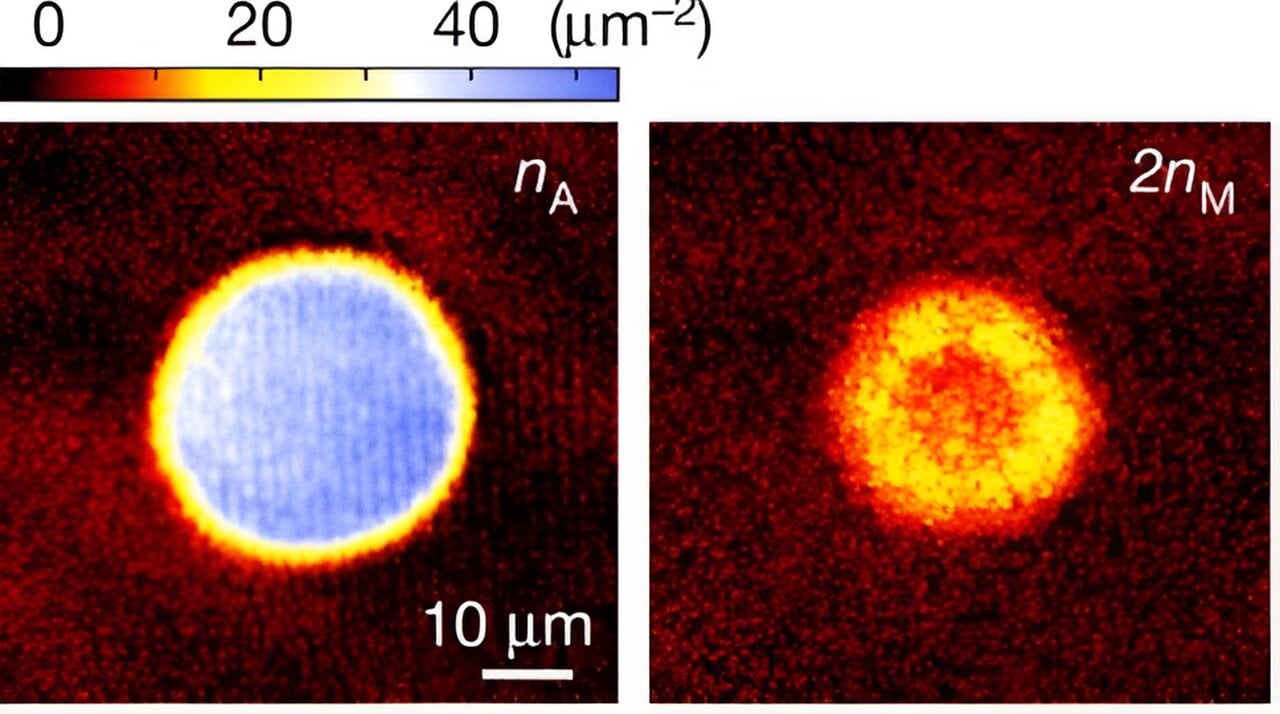
Researchers at the University of Chicago have successfully observed many-body chemical reactions in a quantum degenerate gas, marking a significant step towards understanding and controlling chemical reactions at the quantum level. Using Bose-condensed cesium atoms, the team observed coherent, collective reactions between atoms and molecules, demonstrating macroscopic quantum coherence and Bosonic enhancement. These "super reactions" resemble superconductivity and laser functioning, but with molecules instead of electrons or photons. The findings provide insights into the dynamics of quantum many-body chemical reactions and offer potential applications in precision metrology, quantum information, and quantum control of chemical reactions.