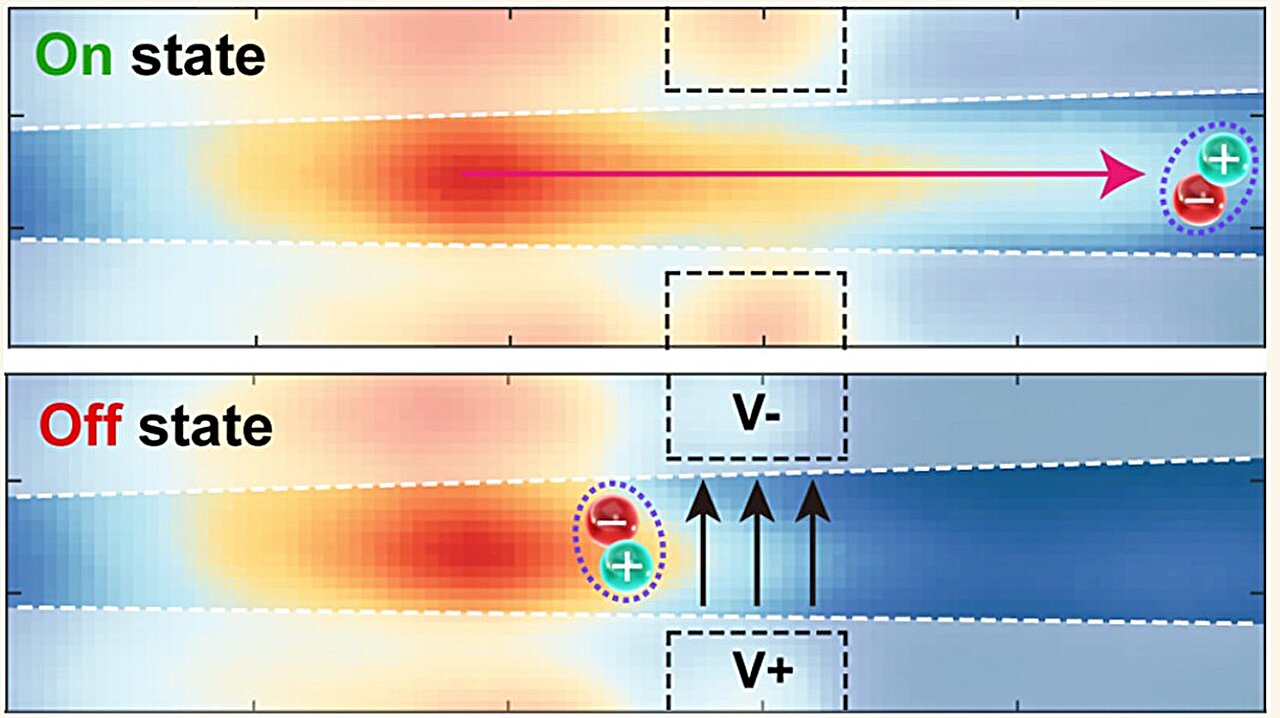
Researchers from the University of Michigan have developed a nanoengineered optoexcitonic switch using tungsten diselenide that reduces energy loss by 66% and surpasses traditional switches in performance, potentially revolutionizing energy efficiency in electronics.
Researchers at UC Irvine discovered a new quantum state in hafnium pentatelluride using high magnetic fields, which could lead to advanced, radiation-resistant electronics suitable for space exploration and self-charging computers.
Researchers at Caltech have discovered Hubbard excitons, which are excitons bound magnetically rather than by electrical forces. This groundbreaking discovery opens up new possibilities for exciton-based technologies. By manipulating the magnetic properties of these excitons, researchers could develop novel technologies that harness both excitons and magnetism. The study used ultrafast time-domain terahertz spectroscopy to observe the generation and decay of these magnetically bound excitons in real-time. The findings have potential implications for the development of solar panels, photodetectors, light-emitting diodes, and other exciton-based devices.
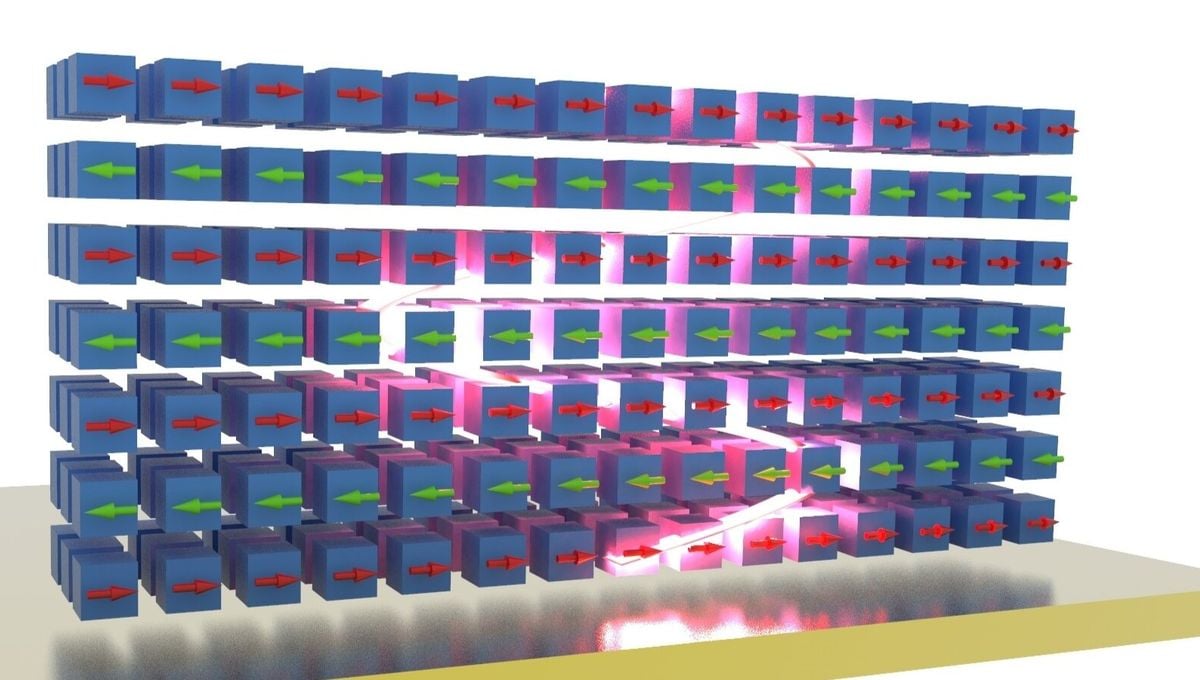
Researchers have discovered a way to trap light inside a magnetic van der Waals material, a type of two-dimensional metamaterial. By shining light on the material, it interacts with excitons, creating a strong magneto-optic response and making the material 10 times more magnetic. This breakthrough could lead to the development of magnetic lasers and optically controlled magnetic memory.
Researchers propose a top-down approach to building a large quantum register using a Bose-Einstein condensate (BEC) of excitons. By generating and controlling macroscopic quantum states of BEC consisting of millions of identical excitons, they aim to overcome the challenges of short-lived phenomena and ultra-low temperatures typically associated with quantum computing. The use of a superfluid BEC state can prevent quantum decoherence and enable faster quantum gate operations. The proposed system shows promise for scalability and offers computational capabilities and redundancy for quantum error correction.
Physicists have discovered a new state of matter called a "bosonic correlated insulator," which takes the form of a highly ordered crystal of subatomic particles. This exotic state of matter, created by densely packing excitons, could lead to the discovery of new types of materials. The research provides new insights into the behavior of bosons and offers potential for creating additional bosonic materials with unique properties.
Physicists have discovered a new state of matter called a "bosonic correlated insulator," which takes the form of a highly ordered crystal of subatomic particles. The researchers created this state of matter by pushing excitons together until they were so densely packed that they could no longer move, creating a new symmetrical crystalline state with a neutral charge. This discovery could lead to the creation of many new types of exotic materials made from condensed matter.
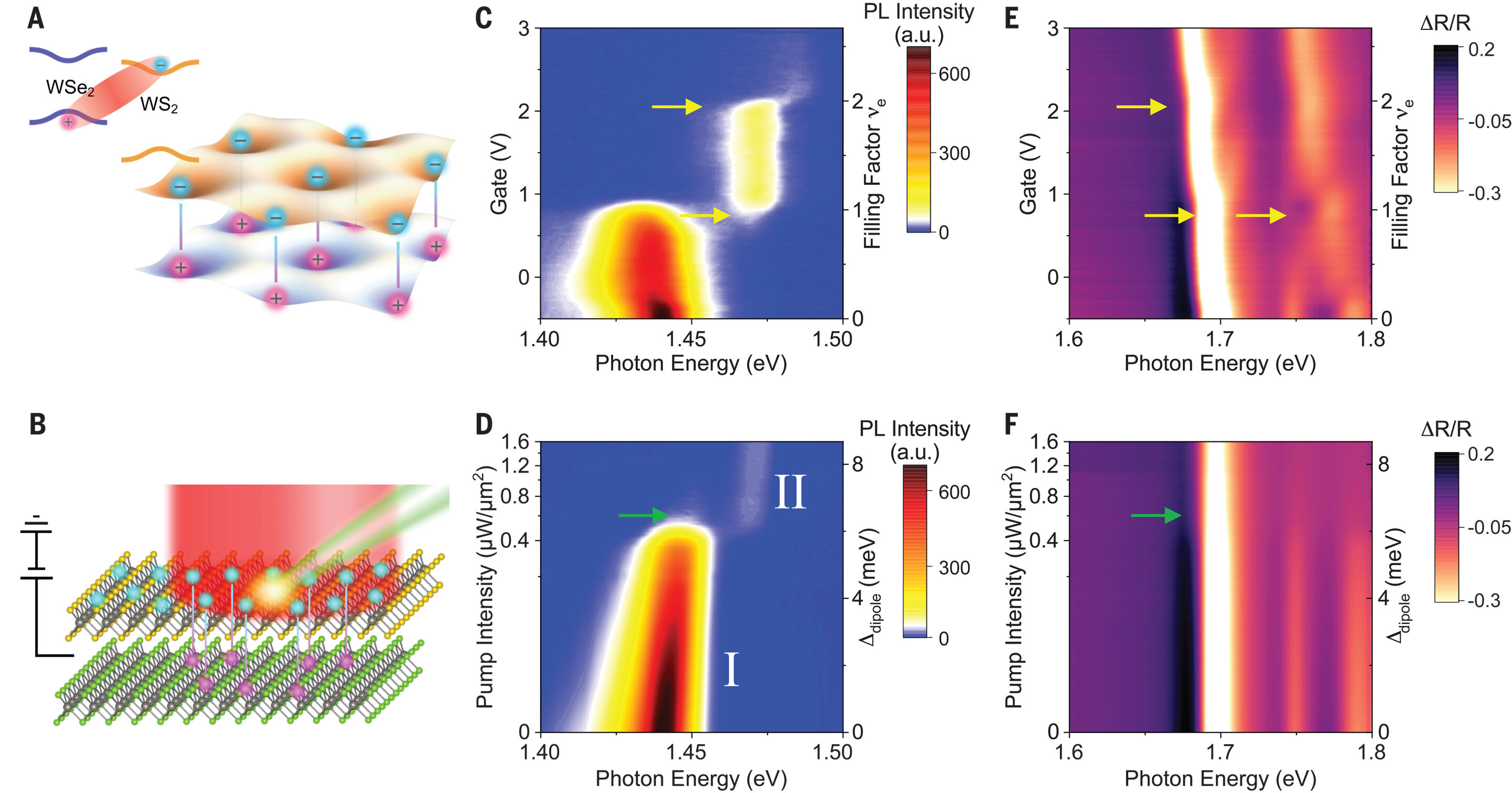
Physicists at UC Santa Barbara have discovered a breakthrough material made of bosons, a less explored realm of particle physics. By overlapping lattices of tungsten diselenide and tungsten disulfide in a twisted configuration, they created a highly ordered crystal of bosonic particles called excitons, resulting in a new state of matter termed a "bosonic correlated insulator."
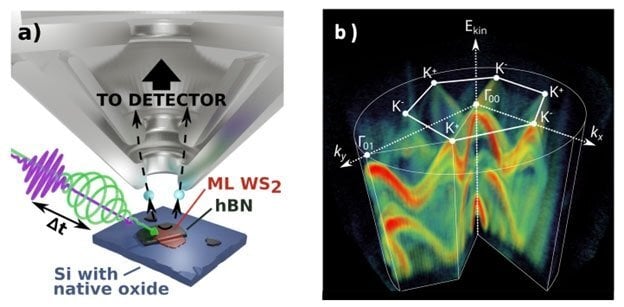
Scientists have developed a new approach to create separate images of individual quantum states in two-dimensional crystals of tungsten disulfide (WS2) using a technique called time-resolved momentum microscopy. By tracking the individual quantum states, researchers showed that the coupling mechanisms that lead to mixing of the states may not fully match current theories. This study provides crucial experimental support for some current theories of exciton coupling in TMDs, but also sheds light on important discrepancies.
Scientists have discovered a new material called a bosonic correlated insulator, which is a whole new state of matter. The material is a lattice formed from a layer of tungsten diselenide and a layer of tungsten disulfide placed on top of each other but not fully aligned, creating a moiré pattern. The researchers used a light-based technique called pump-probe spectroscopy to create and probe the behaviors of the excitons in their system, leading to the discovery of the correlation that drove the bosons into a highly ordered state. The team thinks their approach could lead to the discovery of more bosonic materials further down the line, and an improved way for all scientists to study bosons in real scenarios rather than in synthetic systems.
Physicists have discovered a new state of matter, a "bosonic correlated insulator," through the interaction of bosonic particles called excitons. This research could pave the way for new understandings in condensed matter physics and the creation of new bosonic materials. The unique material is a highly ordered crystal of bosonic particles called excitons. The creation of this exotic state of matter proves that the researchers' moiré platform and pump-probe spectroscopy could become an important means for creating and investigating bosonic materials.
Physicists at UC Santa Barbara have discovered a new state of matter, a bosonic correlated insulator, by creating a highly ordered crystal of bosonic particles called excitons in a moiré pattern of lattices of tungsten diselenide and tungsten disulfide. This is the first time such a material has been created in a "real" matter system. The researchers' moiré platform and pump-probe spectroscopy could become an important means for creating and investigating bosonic materials, opening more windows into the world of condensed matter with new bosonic materials.
Scientists at the University of Chicago have discovered that plants utilize quantum mechanical processes during photosynthesis, acting like a Bose-Einstein condensate, a strange fifth state of matter typically found at ultra-cold temperatures. By forming a condensate, the excitons formed one single quantum state, acting like a single particle, forming a superfluid, allowing energy to flow freely between chromophores. This behavior has never been seen above temperatures of 100 Kelvin, making it surprising to see this behavior in a messy, real-world system at normal temperatures. Room-temperature Bose-Einstein condensates may have practical applications for higher levels of energy efficiency and transfer.
New research suggests that photosynthesis, the process by which plants harness the Sun to survive, has considerable parallels with exciton condensates, something physicists have had to go to great lengths to produce in the lab. Excitons are a boson, and when considered together have quantum properties different from each on its own. A leafy collection of excitons may lack some of the properties associated with macroscopic exciton condensation, but it is likely to retain many of the advantages, including efficient energy transfer.
Scientists have created a long-lived exciton in a topological material using time-, spin-, and angle-resolved photoemission spectroscopy. The exciton is robust to disorder and retains the special spin properties inherent to topological surface states. This breakthrough opens up new research directions for optoelectronics and quantum computing, as longer exciton lifetimes and new ways of transferring information that don't rely on the charge of electrons are needed.