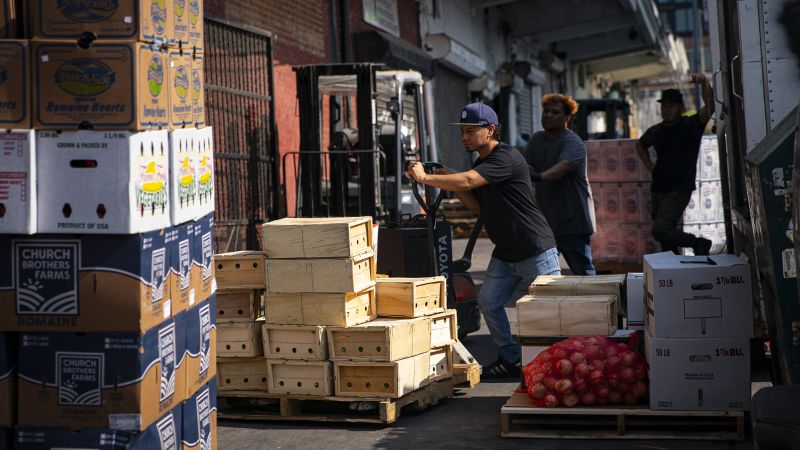
The US wholesale inflation in June was stable overall, with a notable decline in travel and services prices due to reduced travel demand, while the cost of goods increased, reflecting the complex impact of tariffs and consumer behavior amid economic uncertainty.
U.S. wholesale inflation remained unchanged in June, with producer prices rising only 0.3% from May and 2.3% year-over-year, indicating controlled inflation despite concerns over tariffs and recent consumer price increases, as the Federal Reserve remains cautious about the impact of trade policies.
In June, the wholesale inflation measure remained unchanged, indicating minimal impact from tariffs on prices, with the producer price index flat and core PPI slightly up, while annual inflation remains above the Fed's target, influencing monetary policy considerations.
U.S. stock futures are down amid concerns over Boeing's plane crash in India and inflation data, while Oracle's shares soar on strong cloud revenue, and investors await Adobe's earnings report after a mixed outlook.
The Labor Department reported that wholesale inflation surged 0.6% in February, reaching its highest level since September 2023, and core prices, excluding food and energy, rose 0.3%. This data follows the recent increase in consumer prices, indicating persistent high inflation that is impacting U.S. households, particularly low-income individuals. The Federal Reserve is closely monitoring these inflationary pressures and considering potential interest rate adjustments as they aim to bring inflation back to their 2% target.
Wholesale inflation in the U.S. rose by 0.6% in February, surpassing expectations and indicating ongoing concerns about inflation. The producer price index, which measures costs for raw, intermediate, and finished goods, increased more than forecasted, contributing to a decline in the stock market and a rise in Treasury yields. Retail sales rebounded by 0.6% in February, but were still below expectations, while initial filings for unemployment insurance decreased slightly. The Federal Reserve's upcoming policy meeting will be closely watched for insights into future monetary policy decisions.
The Producer Price Index (PPI) rose 0.3% in January, with an annual increase of 0.9%, driven by price hikes among service providers. Despite exceeding economists' expectations, the annual increase is in line with the last quarter of 2023 and remains below pre-pandemic levels. Goods producer prices fell, while food producer prices dropped for the second month in a row. The latest avian flu outbreak caused wild price swings for eggs, but economists believe it won't be as severe as in 2022. Core PPI, excluding food and energy, jumped 0.5% for the month, indicating potential effects from broader geopolitical disruptions. The warmer-than-expected PPI data, along with the latest Consumer Price Index, is unlikely to alter the Federal Reserve's intended path for interest rate cuts this year.
The Labor Department's producer price index, a key measure of wholesale inflation, rose 0.3% in January, exceeding expectations and indicating persistent price pressures in the economy. Core prices, excluding food and energy, surged 0.5% for the month, pointing to ongoing inflationary challenges. This data follows a recent report showing consumer prices rising faster than anticipated. The Federal Reserve, closely monitoring inflation, has signaled caution in considering interest rate cuts amid the persistent inflationary pressures.
Wholesale inflation in the US eased more than expected in December, with the producer price index falling 0.1% from the previous month and up 1% annually, lower than predicted. Core prices, excluding food and energy, were also unchanged for the month and up 1.8% annually. The data comes after a report of a 0.3% rise in the consumer price index in December, above expectations. These reports will impact the Federal Reserve's decisions on interest rates, with investors expecting a quarter-point reduction as early as March.
Wholesale inflation in the US eased more than expected in November, according to the Labor Department's producer price index, indicating a loosening grip on the economy by high consumer prices. The index remained unchanged from the previous month, with prices up 0.9% annually, lower than predicted. Core prices, excluding food and energy, also remained unchanged for the month, down from the estimated 0.2%. These reports will have implications for the Federal Reserve, which has raised interest rates to cool the economy but may soon pivot to cutting rates given the decline in inflation.
Wholesale inflation in the US unexpectedly dropped by 0.5% in October, marking the largest decline in three years, according to the Labor Department. On an annual basis, prices remain up 1.3%, a significant decrease from September's 2.2%. Core prices, which exclude food and energy, remained unchanged for the month, lower than expected. These reports suggest that high inflation may be starting to dissipate, which could have implications for the Federal Reserve's interest rate decisions. Many economists believe the central bank is done raising rates given the notable decline in inflation.
Japan's wholesale inflation slowed below 1% for the first time in over two and a half years in October, indicating a decrease in cost push pressures that had been driving up prices. The slowdown in commodity-led inflation aligns with the Bank of Japan's projections, and attention now turns to whether wages and household spending will increase enough to generate demand-driven consumer price rises. The corporate goods price index (CGPI) increased 0.8% in October, matching market forecasts but cooling significantly from September's 2.2% rise. The slowdown was attributed to declines in prices for wood, chemical, and steel products, reflecting falling global commodity costs.
U.S. wholesale prices rose 2.2 percent in September, the largest year-over-year gain since April, indicating persistent inflationary pressures despite higher interest rates. The producer price index climbed from a 2 percent increase in August, with core inflation rising 2.7 percent year-over-year. Wholesale energy prices surged 3.3 percent, and food prices rose 0.9 percent. The Federal Reserve may leave interest rates unchanged, as the economy remains stronger than expected, and there is optimism for a "soft landing" to control inflation without causing a recession.
US wholesale inflation, as measured by the Producer Price Index (PPI), rose 2.2% for the 12 months ended in September, driven by higher energy and food prices. Gas prices hit new yearly highs in September, but have since swung in the opposite direction. The core PPI, which excludes food and energy, rose 2.7% for the month. While the recent surge in energy prices may cause a short-term pinch, economists do not expect it to have a lasting effect on inflation. The Consumer Price Index (CPI) report for September is expected to show a similar trend, with high but easing gas prices potentially pushing up overall inflation. The markets anticipate the Federal Reserve to hold steady on interest rates.
US stocks opened higher as investors reacted to hotter-than-expected wholesale inflation data, with the Dow Jones Industrial Average up 0.3%, the S&P 500 up 0.4%, and the Nasdaq Composite up 0.6%. The producer price index for September rose 2.2% from a year earlier, surpassing expectations and indicating ongoing inflationary pressures. Treasury yields retreated from recent highs, but analysts remain cautious about the future direction of yields. Investors are now speculating that the Federal Reserve may not hike interest rates at its November meeting. Oil prices continued to slide, while Exxon Mobil agreed to acquire shale rival Pioneer Natural Resources in a $60 billion all-stock deal.