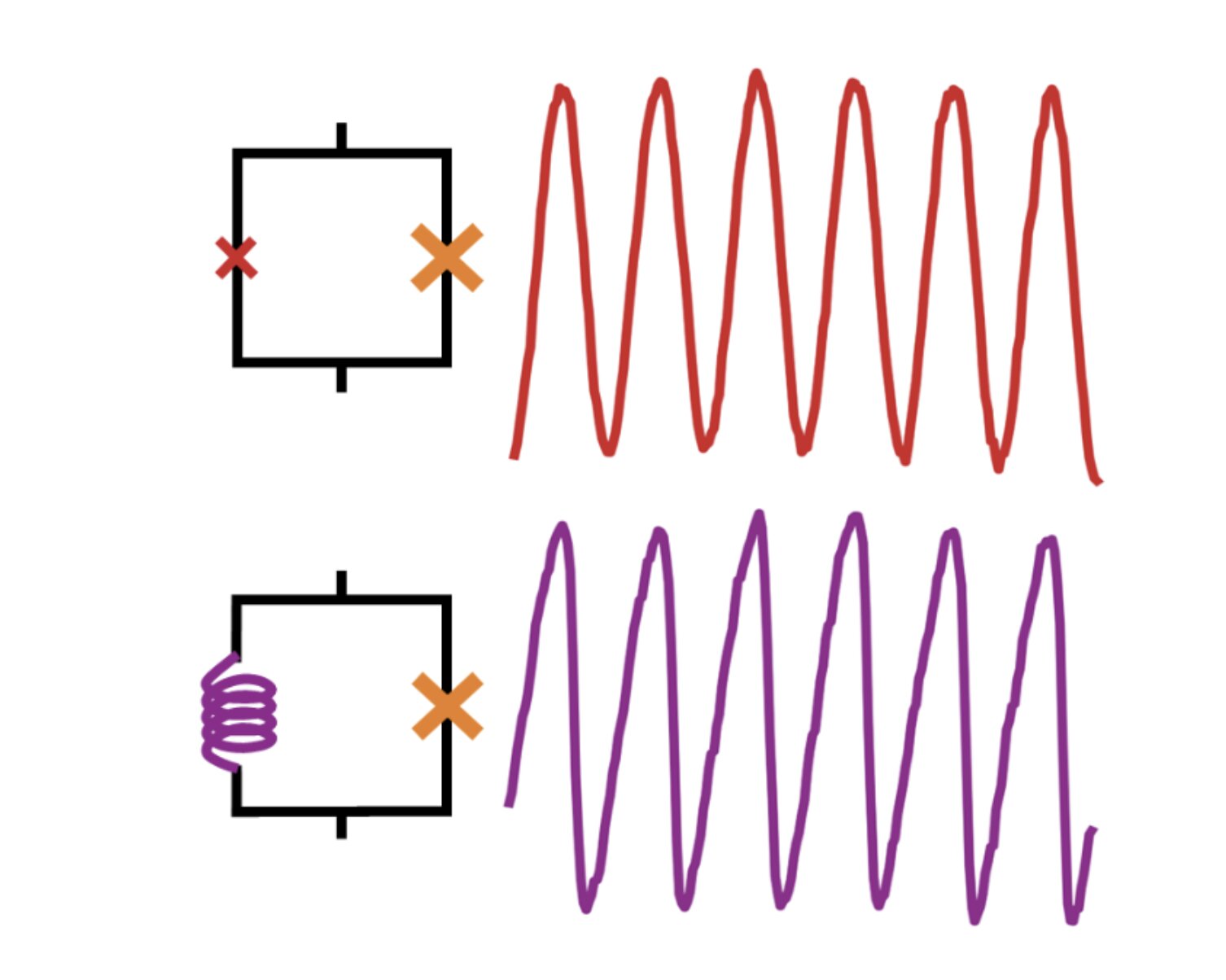
Researchers have discovered that twisted trilayer graphene exhibits high and tunable kinetic inductance and quantum coherence, providing new insights into unconventional superconductivity and potential applications in quantum technologies, although practical use may require further material development.
Researchers have discovered that layered 2D materials, such as graphene and boron nitride, can exhibit a wide range of electron behaviors and even quasicrystal patterns when stacked at specific angles. These moiré materials have allowed scientists to observe the Hofstadter butterfly, a theoretical concept from the 1970s, in experimental data for the first time. The discovery of quasicrystals in these materials opens up new possibilities for studying electron behavior and potentially finding applications in areas such as superconductivity. Additionally, researchers have found that twisting a thin film of graphite can create a hybrid 2D-3D structure with altered electron behavior, further blurring the boundary between dimensions.
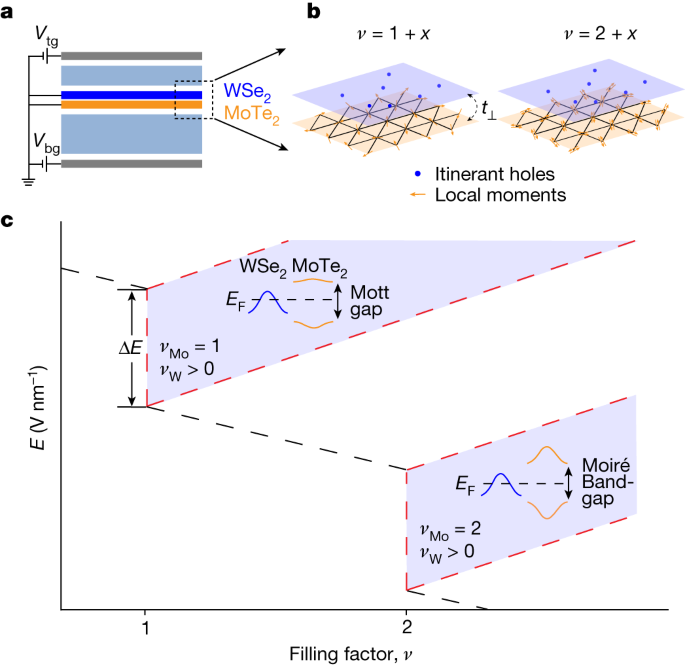
Researchers have realized a synthetic Kondo lattice in AB-stacked MoTe2/WSe2 moiré bilayers, in which the MoTe2 layer is tuned to a Mott insulating state, supporting a triangular moiré lattice of local moments, and the WSe2 layer is doped with itinerant conduction carriers. They observed heavy fermions with a large Fermi surface below the Kondo temperature and demonstrated widely and continuously gate-tunable Kondo temperatures through either the itinerant carrier density or the Kondo interaction. This study opens the possibility of in situ access to the phase diagram of the Kondo lattice with exotic quantum criticalities in a single device based on semiconductor moiré materials.