Tag

Purchasing Power

All articles tagged with #purchasing power

"Maximizing $100K: Where It Goes the Furthest and Why High-Earners Are Budgeting More"

Originally Published 1 year ago — by CBS News

Featured image for "Maximizing $100K: Where It Goes the Furthest and Why High-Earners Are Budgeting More"
Source: CBS News

A study by SmartAsset reveals that the purchasing power of a $100,000 salary varies significantly across U.S. cities, with the least value found in Manhattan, New York, where it's effectively worth $30,914 due to high living costs and taxes. In contrast, the same salary goes the furthest in El Paso, Texas, with a purchasing power of $88,840, attributed to lower living costs and no state or local income taxes. The study highlights the impact of cost of living on salaries in different cities, showcasing the stark differences in purchasing power across the country.

The Permanence of Inflation: A Wall Street Guru's Warning

Originally Published 2 years ago — by Business Insider

Featured image for The Permanence of Inflation: A Wall Street Guru's Warning
Source: Business Insider

Jim Grant, editor of "Grant's Interest Rate Observer," believes that inflation is permanent and that the Federal Reserve will be cautious in cutting interest rates due to inflation remaining above the central bank's target level. Grant argues that the Fed is hesitant to declare victory over inflation prematurely and expects any rate cuts to be gradual and later than the market anticipates. Despite the Fed's efforts to control inflation, Grant asserts that purchasing power lost to inflation cannot be regained. The US Consumer Price Index increased by 3.1% over the year in November.

"Diminishing Salary Prospects: Bleak Outlook for 2024 and Beyond"

Originally Published 2 years ago — by Business Insider

Featured image for "Diminishing Salary Prospects: Bleak Outlook for 2024 and Beyond"
Source: Business Insider

American workers can expect smaller salary increases in 2024, with employers planning to increase salary budgets by about 4%, down from this year's average of 4.3%. However, with inflation projected to slow to 2.6% in 2024, workers could see a net gain of about 1.4% in purchasing power. The raises will vary by industry, with education and healthcare employees expecting a pay bump of 3.5% or less, while energy sector workers will enjoy raises of 4.5%. The tight labor market and pay transparency laws are factors contributing to the need for competitive wages. Experts advise employees to communicate their worth, make requests early, research industry averages, and consider internal job opportunities for potential pay increases. It is recommended not to delay asking for a raise until 2025, as economists predict slower wage growth in the coming years.

"Anticipating Social Security's COLA Increase in 2024: What It Means for Recipients"

Originally Published 2 years ago — by The Motley Fool

Featured image for "Anticipating Social Security's COLA Increase in 2024: What It Means for Recipients"
Source: The Motley Fool

The Social Security Administration will announce the 2024 cost-of-living adjustment (COLA) on October 12, 2023. While the 2023 COLA was a robust 8.7%, the 2024 COLA is expected to be around 3.2%. However, rising Medicare Part B premiums and the potential impact of expensive drugs like Leqembi could eat into the COLA, leaving many retirees with little or no increase in their monthly payout. Additionally, the current method of calculating COLA using the Consumer Price Index for Urban Wage Earners and Clerical Workers (CPI-W) fails to accurately reflect the inflation experienced by seniors, resulting in a decline in the purchasing power of Social Security income over the years.

Costco's Membership Boom: Younger Shoppers Drive Growth as Gold Bars Fly off Shelves

Originally Published 2 years ago — by CNBC

Featured image for Costco's Membership Boom: Younger Shoppers Drive Growth as Gold Bars Fly off Shelves
Source: CNBC

Costco CEO Craig Jelinek revealed that the company is attracting more younger people to its membership base, although their purchasing power differs from older generations. Jelinek emphasized that Costco focuses on offering the lowest possible prices rather than maximizing margins. He also mentioned the popularity of Costco's gold bars, which are priced at $2,000 and quickly sell out on the website, driving more traffic.

US Latino Economic Output Surpasses $3 Trillion, Ranks 5th Largest Globally

Originally Published 2 years ago — by CNBC

Featured image for US Latino Economic Output Surpasses $3 Trillion, Ranks 5th Largest Globally
Source: CNBC

The U.S. Latino economy has reached $3.2 trillion in 2021, growing two and a half times faster than the non-Latino economy over the past decade, according to a report by the Latino Donor Collaborative. If Latinos were an independent country, their GDP would rank fifth in the world. The Latino community's economic impact is particularly strong in California, Texas, and Florida. Despite the growth, a wage gap persists, with Latino workers earning 80 cents for every $1 earned by white non-Hispanic employees. Latinos' purchasing power in the U.S. reached $3.4 trillion in 2021, growing faster than their non-Latino counterparts.

The fleeting triumph of American wage growth over inflation

Originally Published 2 years ago — by CNN

Featured image for The fleeting triumph of American wage growth over inflation
Source: CNN

US workers' real weekly earnings grew on an annual basis in June for the first time in 26 months, as inflation wanes. However, experts warn that this wage growth may not last due to concerns about its impact on inflation and the possibility of a cooling labor market. The Federal Reserve is closely monitoring wage growth and its potential to fuel inflation. While recent research suggests that wage gains have had limited effects on inflation, fears of a wage-price spiral persist. Additionally, the number of people employed part-time for economic reasons increased in June, indicating potential challenges to sustaining wage gains. Nevertheless, favorable labor market trends and cooling supply-side inflation may support workers' ability to maintain real wage gains.

Navigating Inflation: Strategies for Savings and Investments

Originally Published 2 years ago — by Yahoo Finance

While inflation is slowing, consumers are still grappling with price hikes from the past two years, which have outpaced earnings and left many Americans falling behind. During the last two years, prices overall have risen by 13%, while earnings have risen by just 10%. The cost of many necessities has risen by more than overall inflation during the last two years. Housing, the biggest portion of consumer spending, is up 14% during the last two years. Groceries are up 18%. As the inflation rate slows, the pain of rising prices diminishes. But a slowing rate of inflation is not the same as prices that are actually falling, allowing consumers to regain lost purchasing power.

Social Security's COLA and Direct Payments: What You Need to Know

Originally Published 2 years ago — by The Hill

Featured image for Social Security's COLA and Direct Payments: What You Need to Know
Source: The Hill

The Senior Citizens League (TSCL) predicts that the cost-of-living adjustment (COLA) for Social Security recipients in 2024 will be around 3.1%, significantly lower than the 8.7% increase in 2023. TSCL argues that cooling inflation may result in a smaller COLA increase that could have detrimental effects on beneficiaries, as Social Security benefits have lost about a third of their buying power since 2000. Seniors have different spending habits than younger generations, and the Consumer Price Index does not accurately reflect the rising costs of items that older Americans more frequently spend their money on, including prescription drugs, food, housing, or dental services.

The High Cost of Living in Chicago: How $172K Salary Feels Like $100K.

Originally Published 2 years ago — by Crain's Chicago Business

Featured image for The High Cost of Living in Chicago: How $172K Salary Feels Like $100K.
Source: Crain's Chicago Business

According to a recent study by SmartAsset, Chicago residents need to earn an annual income of $172,600 to have the same purchasing power as the average American earning $100,000. The analysis shows that Chicago residents have more purchasing power than those living in cities such as Honolulu, New York, and San Francisco. However, it's still a far cry from many cities in the South, where incomes totaling a lot less feel like much more due to lower taxes and cheaper costs of living. SmartAsset used data from the Council for Community & Economic Research to adjust for cost of living.

The High Cost of Living in America's Priciest Cities for High Earners

Originally Published 2 years ago — by Daily Mail

Featured image for The High Cost of Living in America's Priciest Cities for High Earners
Source: Daily Mail

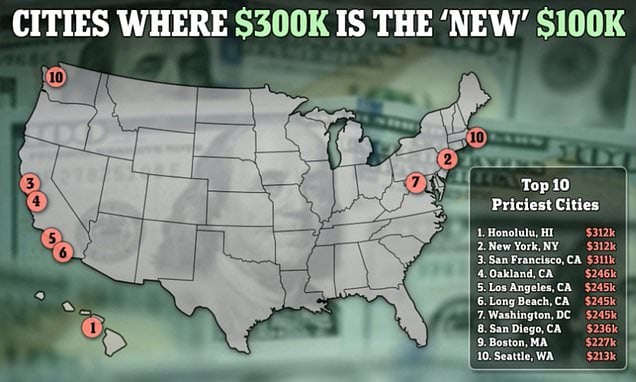
Honolulu is the most expensive city in the US, followed by New York and San Francisco, according to a ranking by SmartAsset. To have the purchasing power of $100,000, you would need an annual salary of around $310,000 in these cities. The ranking is heavily influenced by local taxes, with California, Hawaii, and New York having high income tax rates. In contrast, Tennessee and Texas have no income tax. Memphis is the cheapest city in the US, where an annual salary of $117,000 will leave you with $100,000 worth of purchasing power after tax. US census data shows people are leaving counties in states with high tax and moving to those with less.

The Real Value of a $100,000 Salary in Major US Cities.

Originally Published 2 years ago — by KTLA Los Angeles

Featured image for The Real Value of a $100,000 Salary in Major US Cities.
Source: KTLA Los Angeles

A new study by Smart Asset analyzed the after-tax income for $100,000 in 76 of the largest U.S. cities and adjusted those figures to represent the cost of living in each place. California cities ranked low for the places where $100,000 had the most purchasing power due to high inflation and cost of living expenses. Meanwhile, the six-figure income goes a long way in other states, mainly due to lower taxes and cost of living rates than in California. Texas cities dominated the list of the places with the most purchasing power for $100,000, with Memphis, Tennessee, holding the top spot.

The Real Value of a $100,000 Salary in Different US Cities

Originally Published 2 years ago — by Business Insider

Featured image for The Real Value of a $100,000 Salary in Different US Cities
Source: Business Insider

A new cost of living study by SmartAsset found that a $100,000 salary in New York City leaves workers with what "feels like" just $36,000, the lowest of nearly 80 cities analyzed. The study looked at cities from Buffalo to Los Angeles to find where a dollar stretches the furthest, using the SmartAsset paycheck calculator and Council for Community and Economic Research data to find an estimate of purchasing power after accounting for living expenses. Memphis, Tennessee ranked highest, boasting a buying power of more than $86K, while seven cities in Texas rounded out the top 10.