Tag

Modified Newtonian Dynamics

All articles tagged with #modified newtonian dynamics

JWST Challenges Conventional Galaxy Formation Theories with New Findings

Originally Published 1 year ago — by The Debrief

Featured image for JWST Challenges Conventional Galaxy Formation Theories with New Findings
Source: The Debrief

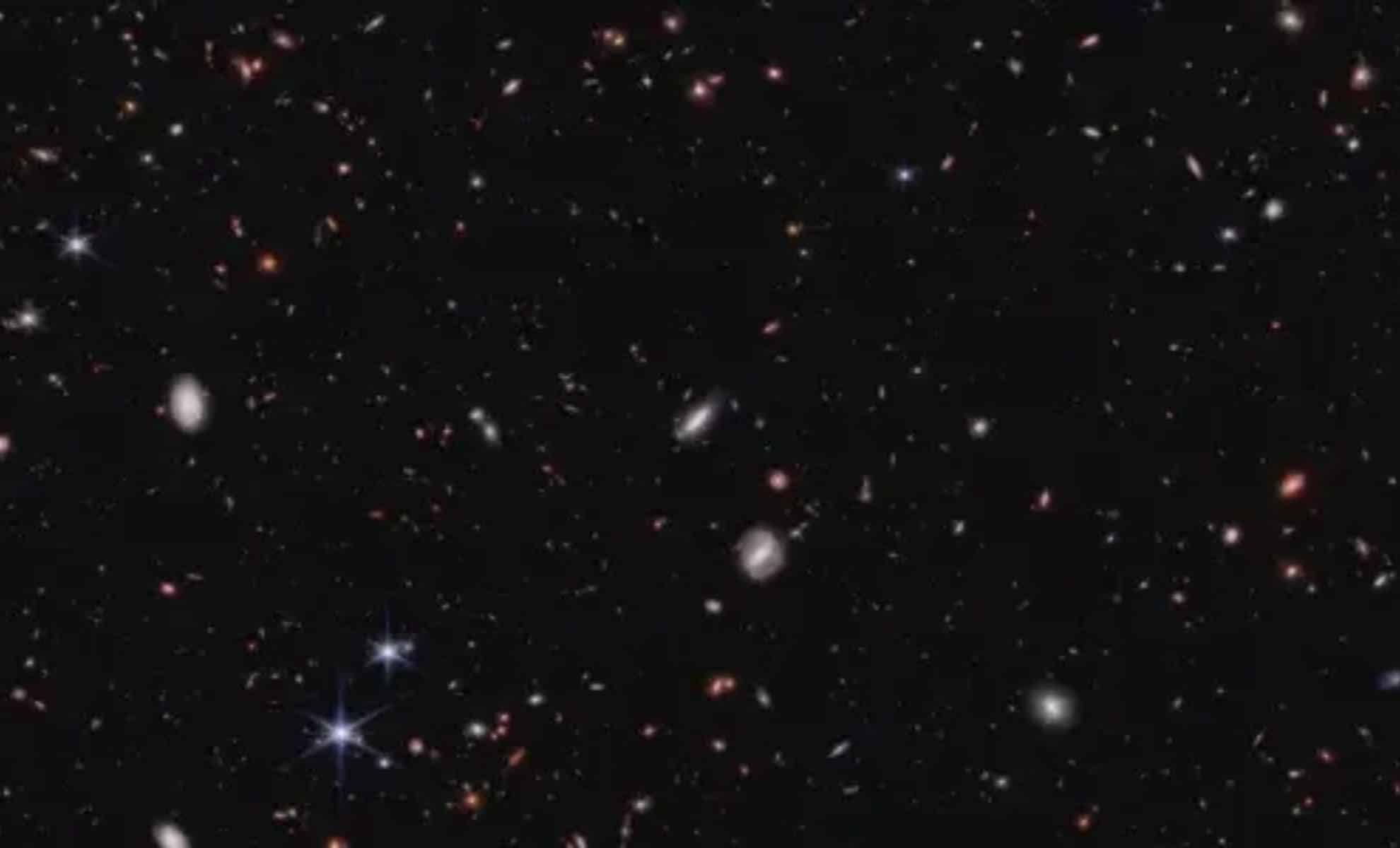
The James Webb Space Telescope has provided evidence that challenges the widely accepted Lambda-CDM model of galaxy formation, which relies on dark matter. Instead, observations suggest support for the Modified Newtonian Dynamics (MOND) theory, which posits that galaxies formed rapidly without dark matter. This finding, led by researchers from Case Western Reserve University, could prompt a reevaluation of current gravitational theories, though MOND remains controversial due to its inconsistency with Einstein's General Relativity.

James Webb Telescope Sparks Rethink of Dark Matter and Galaxy Formation Theories

Originally Published 1 year ago — by The Daily Galaxy --Great Discoveries Channel

Featured image for James Webb Telescope Sparks Rethink of Dark Matter and Galaxy Formation Theories
Source: The Daily Galaxy --Great Discoveries Channel

New data from the James Webb Space Telescope challenges the traditional dark matter model of galaxy formation, suggesting that galaxies in the early universe formed more rapidly than expected. This supports the Modified Newtonian Dynamics (MOND) theory, which proposes an alternative gravitational model that does not rely on dark matter. The findings, published in The Astrophysical Journal, highlight MOND's predictive success but also acknowledge the challenges of integrating it with established cosmological theories like general relativity.

"Unveiling Gravity's Secrets: Wide Binary Stars Challenge Laws of Physics"

Originally Published 2 years ago — by ScienceAlert

Featured image for "Unveiling Gravity's Secrets: Wide Binary Stars Challenge Laws of Physics"
Source: ScienceAlert

Astrophysicist Kyu-Hyun Chae has detected gravitational anomalies in widely separated twin stars, suggesting a breakdown of standard gravity at low accelerations. Analyzing nearly 2,500 wide binary star systems observed by the Gaia space telescope, Chae found that closely orbiting twin stars behaved consistently with classical Newtonian dynamics, but those separated by more than 2,000 astronomical units exhibited a velocity boost inconsistent with classical mechanics. Chae's findings challenge the dark matter paradigm and standard cosmology based on general relativity, but further independent studies are needed to confirm the claimed anomaly and its implications for astrophysics, cosmology, and fundamental physics.

Is our galaxy trapped in an empty void?

Originally Published 2 years ago — by indy100

Featured image for Is our galaxy trapped in an empty void?
Source: indy100

Scientists from Germany, Scotland, and the Czech Republic propose that our galaxy may be situated in a region of space with relatively little matter, resembling an "air bubble in a cake." This hypothesis arises from discrepancies in the Hubble-Lemaitre constant, which measures the distance and speed at which galaxies move away from each other. The researchers suggest that a local "under-density" or void in the universe could explain these deviations, challenging the standard model of cosmology. They propose a modified theory of gravity called "modified Newtonian dynamics" (MOND) to account for the existence of such bubbles. If true, this theory would resolve the Hubble tension and potentially reshape our understanding of the universe's expansion.

Unraveling the Universe's Expansion: The Giant Void Hypothesis

Originally Published 2 years ago — by Giant Freakin Robot

Featured image for Unraveling the Universe's Expansion: The Giant Void Hypothesis
Source: Giant Freakin Robot

Recent observations suggest that our galaxy may exist in a void, an expansive region with significantly less matter. This finding challenges the Hubble-Lemaitre constant and demands a reevaluation of the standard model of the universe. The theory supports the concept of modified Newtonian dynamics proposed by physicist Mordehai Milgrom. Further research is needed to validate this hypothesis and resolve the Hubble tension, a discrepancy in the measurement of the Hubble constant. Alternative theories of gravity and the reluctance to overhaul the Lambda-CDM model are also discussed.

Unraveling the Universe's Expansion: The Enigma of the Supervoid

Originally Published 2 years ago — by Space.com

Featured image for Unraveling the Universe's Expansion: The Enigma of the Supervoid
Source: Space.com

Scientists propose that the discrepancy in measurements of the universe's expansion rate, known as the Hubble Tension, could be explained if our galaxy, the Milky Way, is situated in a two-billion-light-year-wide void called the Keenan-Barger-Cowie supervoid. This hypothesis challenges the standard model of cosmology and suggests that a modified theory of gravity, called Modified Newtonian Dynamics (MOND), could replace the need for dark matter. However, this idea is highly debated among astronomers, and alternative methods of measuring the expansion rate also contradict the hypothesis.

Unraveling the Mystery of the Universe's Expansion: The Giant Void Solution

Originally Published 2 years ago — by Futurism

Featured image for Unraveling the Mystery of the Universe's Expansion: The Giant Void Solution
Source: Futurism

Researchers from the University of Bonn and St Andrews propose a new theory to explain the "Hubble tension" - the discrepancy between the observed and predicted rate of the universe's expansion. They suggest that our solar system is located in a region with a lower density of matter, creating a void where galaxies move away from each other faster than expected. This finding challenges the current standard model and supports the idea of modified Newtonian dynamics, which could resolve the Hubble tension. Further scientific scrutiny is needed to validate this theory.

Unveiling the Enigma: Exploring Modified Gravity and the Hunt for Planet Nine

Originally Published 2 years ago — by SciTechDaily

Featured image for Unveiling the Enigma: Exploring Modified Gravity and the Hunt for Planet Nine
Source: SciTechDaily

The hunt for a ninth planet in our solar system may instead be revealing evidence of a modified law of gravity known as Modified Newtonian Dynamics (MOND), according to theoretical physicists Harsh Mathur and Katherine Brown. MOND proposes that Newton's law of gravity is valid up to a certain point, after which a different gravitational behavior takes over. The researchers found that MOND predicts the observed clustering of objects in the outer solar system, which had initially motivated the search for a ninth planet. While the current dataset is small and other possibilities remain, this study highlights the potential for the outer solar system to test gravity and study fundamental physics problems.

Unveiling the Enigmatic Truth Behind the Elusive Ninth Planet

Originally Published 2 years ago — by The Independent

Featured image for Unveiling the Enigmatic Truth Behind the Elusive Ninth Planet
Source: The Independent

Scientists have proposed that the unexplained movements of objects at the edge of our solar system, previously attributed to a hidden "Planet Nine," could actually be the result of a modified law of gravity known as Modified Newtonian Dynamics (MOND). Researchers plotted the movements of these objects using MOND and found that the data aligned with the theory, suggesting that Newton's gravity may behave differently in the outer regions of galaxies. However, the study does not rule out the existence of Planet Nine or other explanations for the observed phenomena. The findings highlight the potential for the outer solar system to serve as a laboratory for testing gravity and studying fundamental problems of physics.

"The Resilience of Einstein and Newton's Gravity Theories: Debunking Exaggerated Reports"

Originally Published 2 years ago — by IFLScience

Featured image for "The Resilience of Einstein and Newton's Gravity Theories: Debunking Exaggerated Reports"
Source: IFLScience

Recent papers have claimed to challenge the theories of gravity proposed by Einstein and Newton, suggesting that dark matter may not exist and that our laws of gravity need modification. The existence of dark matter is favored due to its predictive power and ability to explain various features of the universe. However, the recent papers testing Newtonian acceleration in binary star systems have yielded conflicting results, making it difficult to draw definitive conclusions. Further studies and more precise observations are needed to determine the validity of these claims.