CoreWeave posted a Q4 revenue beat of $1.57 billion and an adjusted loss of 56 cents per share, but its debt ballooned toward $30 billion and interest costs rose, weighing on the stock which fell about 7% after hours as early investor Magnetar continues selling shares.
Astronomers at ICRAR and partners have identified ASKAP J1832-0911 as a rare long-period transient that emits radio bursts every 44 minutes and, for the first time, X-rays observed by Chandra. This cross-wavelength detection from a source about 15,000 light-years away in the Milky Way provides crucial clues to the origin of LPTs and could point to new physics or revised stellar evolution models, with possible explanations including a magnetar or a magnetized white-dwarf binary. The discovery underscores the value of simultaneous radio and X-ray observations to find more such objects.
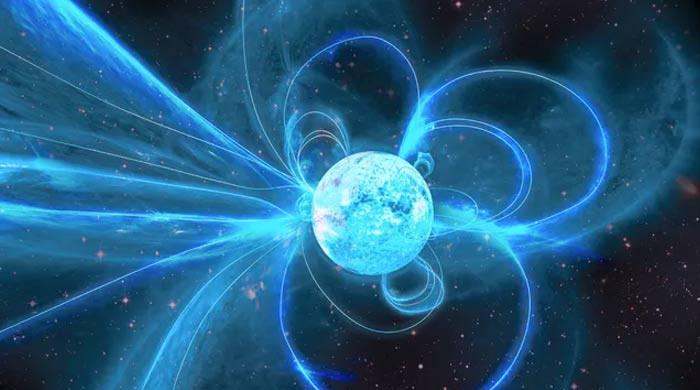
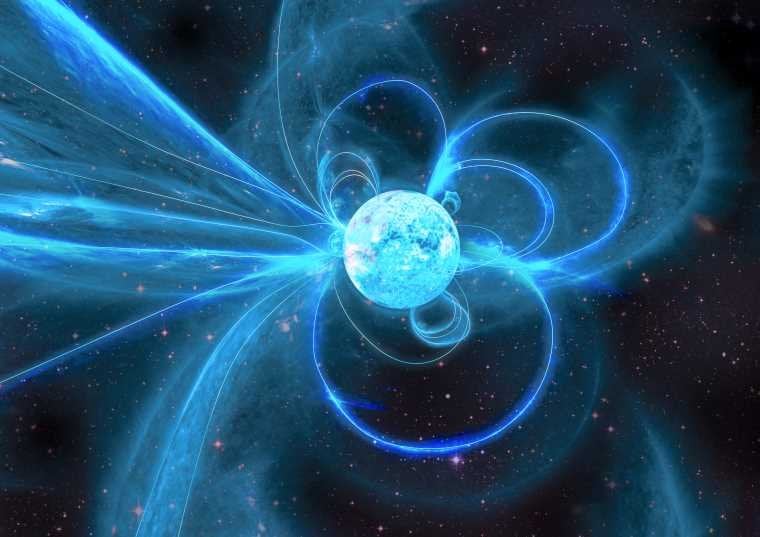
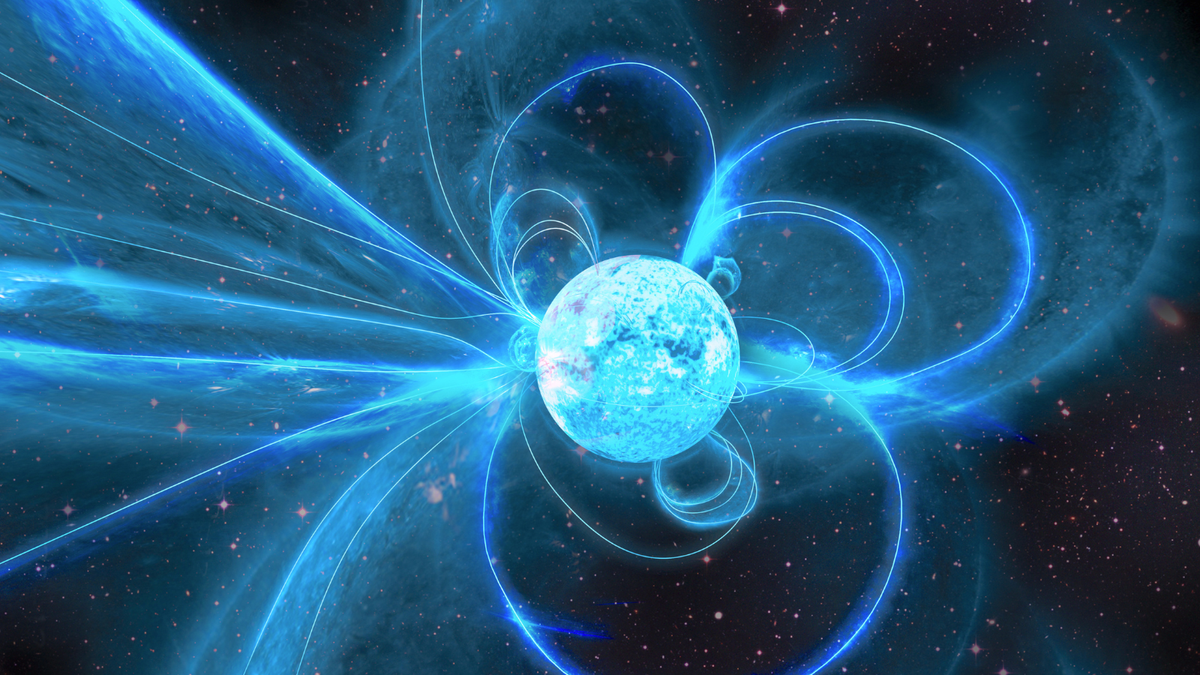
Scientists have detected the 'heartbeat' of a newborn magnetar within a gamma-ray burst, revealing that some GRBs are powered by magnetars rather than black holes, which challenges previous understanding and opens new avenues for cosmic research.
Astronomers detected the brightest fast radio burst (FRB) ever, named RBFLOAT, from a galaxy 130 million light-years away, using advanced telescopes including CHIME and the James Webb Space Telescope. The observations suggest magnetars as a potential source and provide precise localization, helping to unravel the mystery of FRBs' origins and whether they repeat or vary in nature.
Scientists have detected the brightest fast radio burst ever, named RBFLOAT, originating from a galaxy 130 million light-years away, and pinpointed its exact location, providing new insights into their origins, possibly linked to magnetars. The discovery was made using the CHIME telescope and its outriggers across North America, marking a significant advancement in understanding these mysterious cosmic phenomena.
A distant magnetar in the Sculptor Galaxy released an enormous burst of energy equivalent to a billion suns in just 0.16 seconds, marking the most distant such event ever observed and providing new insights into these rare neutron stars.
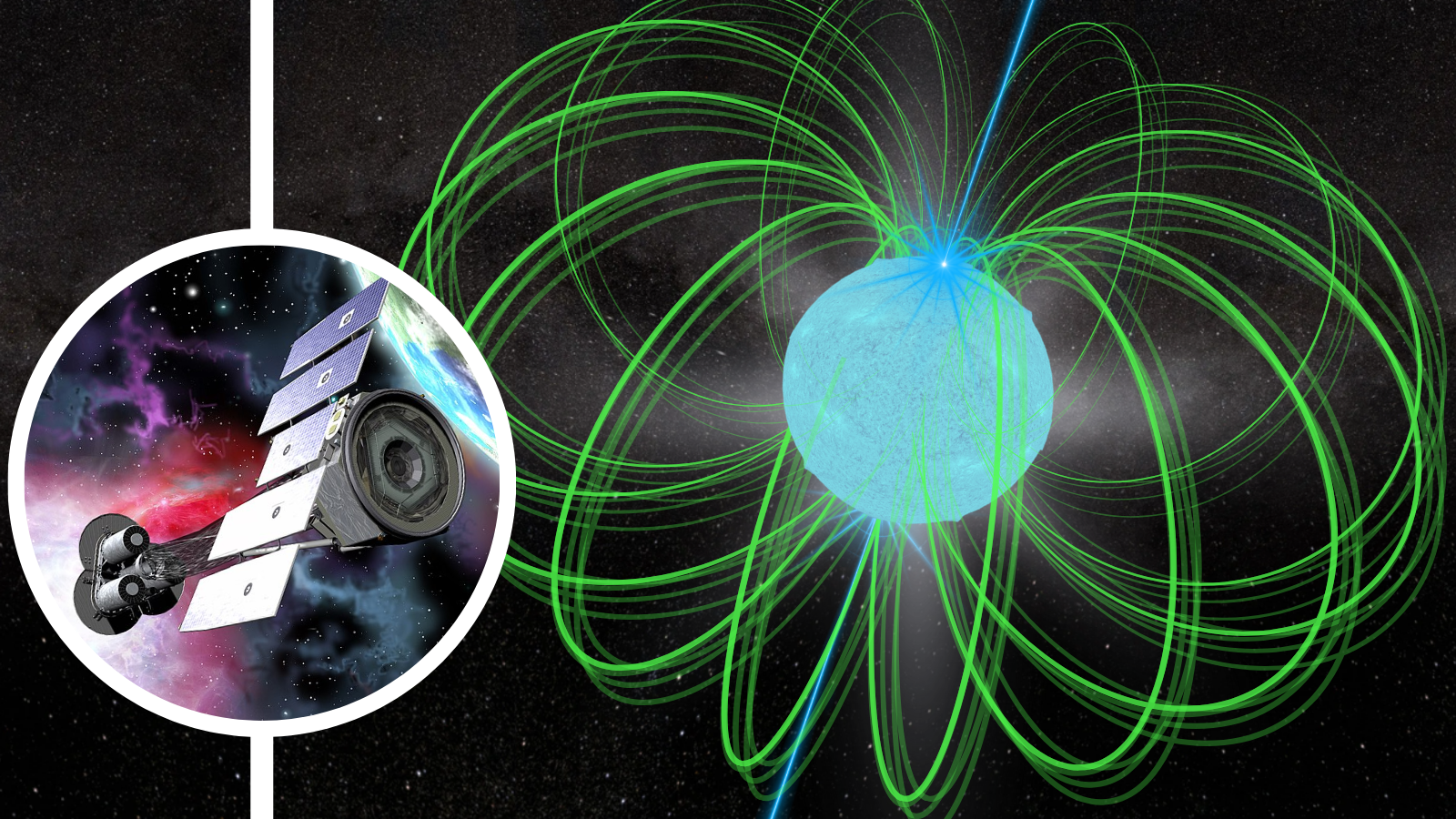
NASA's IXPE spacecraft observed a magnetar, 1E 1841-045, during its first active outburst, measuring X-ray polarization to better understand the magnetic and emission mechanisms of these extremely magnetic neutron stars, which are among the universe's most intense magnetic objects.
Scientists using CSIRO’s Parkes radio telescope detected unusual radio pulses from a previously dormant magnetar, XTE J1810-197, which unexpectedly came back to life. The magnetar, located roughly 8,000 light years away, is emitting unprecedented amounts of rapidly changing circular polarization, unlike any signals seen from other magnetars. This discovery offers insights into the physics of intense magnetic fields and the complex environments they create, challenging previous theoretical explanations.
Astronomers using the Parkes radio telescope in Australia have detected unusual radio signals from Earth’s closest magnetar, XTE J1810-197, which is behaving in unprecedented ways by emitting rapidly changing circular polarization. The signals, first detected in 2003 and then again in 2018, suggest complex interactions at the star's surface, challenging previous theoretical explanations. The cause of these unusual signals remains a mystery, but researchers believe they may be linked to superheated plasma above the magnetar's magnetic pole. Further studies are needed to unravel the complexities of these radio waves, which could provide insights into various extreme phenomena in the universe.
Scientists were surprised when a "dead" neutron star, known as a magnetar, with an incredibly powerful magnetic field unexpectedly emitted strange radio signals, deviating from the current understanding of these celestial objects. The magnetar, XTE J1810-197, located 8,000 light-years away, exhibited unprecedented circularly polarized light, challenging previous knowledge. This phenomenon, observed using the Australian CSIRO Parkes radio telescope, suggests the presence of superheated plasma above the magnetar's magnetic pole, acting as a polarizing filter. The team's research, published in Nature Astronomy, aims to provide insights into various extreme magnetar-related phenomena through continued observations.
Scientists were surprised when a "dead" neutron star with an incredibly powerful magnetic field, known as a magnetar, unexpectedly emitted strange radio signals, challenging current understanding of these celestial objects. The magnetar, XTE J1810-197, located 8,000 light-years away, exhibited unprecedented circularly polarized light, defying expectations. This discovery, made using the Australian CSIRO Parkes radio telescope, suggests the presence of superheated plasma above the magnetar's magnetic pole. Further observations aim to shed light on various extreme magnetar-related phenomena, offering insights into these enigmatic cosmic entities.
A magnetar, XTE J1810-197, emitted strange, wobbly radio signals after "waking up" in 2018, puzzling scientists. These signals cannot be explained by known magnetar behavior, suggesting new processes are at play. Researchers believe a region of undulating plasma near the magnetar's magnetic poles acted as a "polarizing filter," wobbling the radio pulses. They aim to study other radio-emitting magnetars to solve the mystery and gain insights into neutron star formation and high-density matter behavior.
The magnetar XTE J1810-197, which had been dormant for 10 years, has reawakened and is emitting unprecedented levels of circularly polarized light, suggesting the presence of superheated plasma above its magnetic pole. Additionally, the star appears to be wobbling or precessing, but this motion has unexpectedly damped over time. These unusual behaviors could provide new insights into the inner structure of neutron stars and the mechanisms behind fast radio bursts.
NASA's X-ray telescopes observed a fast radio burst from a magnetar, a type of dead star, within our galaxy, providing unprecedented insights into the mysterious signals from deep space. The observation revealed that rapid changes in the magnetar's spin rate, known as "glitches," are crucial to understanding the process of fast radio burst generation. This groundbreaking discovery sheds light on the enigmatic phenomena of fast radio bursts and marks a major step forward in deciphering their origins, although many questions still remain.
Astronomers have observed powerful "glitches" in a highly magnetic neutron star, or magnetar, near the heart of the Milky Way, which could help reveal the star's interior and the origins of fast radio bursts (FRBs). The discovery team studied a magnetar, SGR 1935, using space telescopes and observed two massive glitches that caused significant changes in the star's rotation speed. The return to normal speed for the magnetar is theorized to be the result of a strong, ephemeral and magnetospheric wind blowing from the star, which could also be responsible for boosting X-ray emission and fostering the right conditions for launching FRBs. The research was published in the journal Nature.