Tag

Dead Star

All articles tagged with #dead star

astronomy1 year ago

"Resurrected: The Baffling Reawakening of a Magnetic Star"

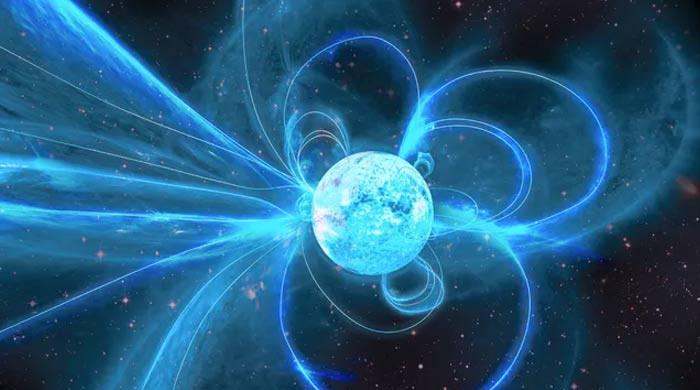
Scientists using CSIRO’s Parkes radio telescope detected unusual radio pulses from a previously dormant magnetar, XTE J1810-197, which unexpectedly came back to life. The magnetar, located roughly 8,000 light years away, is emitting unprecedented amounts of rapidly changing circular polarization, unlike any signals seen from other magnetars. This discovery offers insights into the physics of intense magnetic fields and the complex environments they create, challenging previous theoretical explanations.

astronomy1 year ago

"Cannibalistic White Dwarf Star Displays Metallic Scar from Devouring Planet"

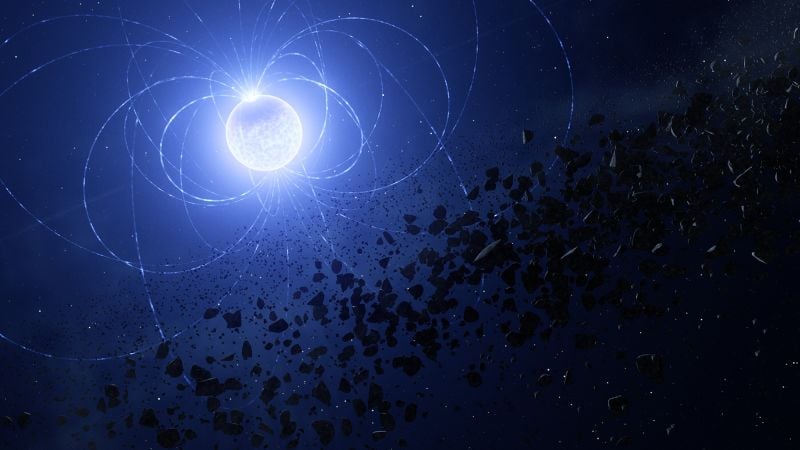
Astronomers have observed a dead star, known as a white dwarf, with a metal scar on its surface, indicating that it consumed a fragment of a planet. This sheds light on the dynamic nature of planetary systems even in the end stages of a star’s life cycle. The observation, made using the European Southern Observatory’s Very Large Telescope, revealed that the star’s magnetic field played a key role in this process, resulting in the scar on the white dwarf’s surface. This finding provides insight into the potential fate of our own solar system as our sun is expected to become a white dwarf in about 5 billion years.

astronomy2 years ago

Resurrected Dead Star Unleashes Unprecedented Cosmic Flares

Scientists at Cornell University have made a remarkable discovery by detecting intermittent flashes of blue light from a deceased star, known as the Tasmanian Devil, located a billion light-years away. The star had previously emitted a luminous fast blue optical transient (LFBOT) before fading, but the recent observations show that it is still radiating powerful flares similar to its original cataclysmic event. This unprecedented finding offers valuable insights into the mysterious world of star births and deaths, challenging previous assumptions about the behavior of dead stars.

science-and-technology2 years ago

NASA's Haunting Images Unveil Supernova Remnants 16,000 Light-Years Away

NASA has released new images of a dead star, known as PSR B1509-58, located 16,000 light-years away. The images were captured by the Imaging X-ray Polarimetry Explorer, providing scientists with insights into the dynamics of matter around the dead star and the magnetic field in the "hand" of the nebula. The telescope has also found similar patterns in other pulsar winds, suggesting that these patterns may be common.

science-and-astronomy2 years ago

"Dead Star's Fate Predicts Sun's Destiny in Cosmic Graveyard"

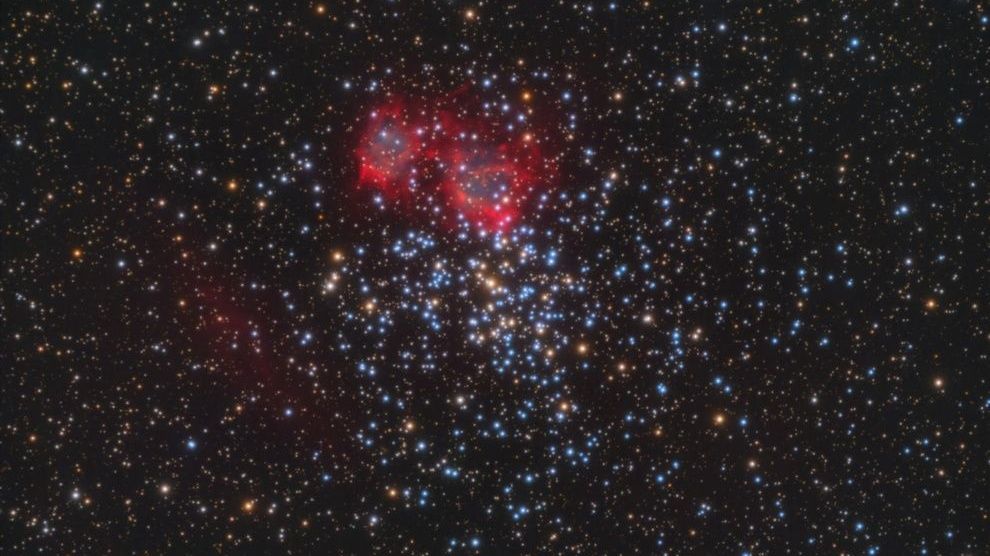
Astronomers have studied a dead star, a white dwarf, located in the open star cluster Messier 37, which is around 4,500 light years from Earth. This study could reveal how the star died and provide insights into the fate of our own sun in around 5 billion years. By studying a dead star in this cluster, scientists can better understand how stars of the same age evolve and die, helping to test theories of stellar evolution. The researchers also determined the chemical composition of the white dwarf, finding it strangely lacking hydrogen on its surface, indicating a violent event in its past. Understanding the initial-final mass relation is crucial for determining a star's lifespan and its final phase, whether it be a white dwarf, neutron star, or black hole.

science-and-astronomy2 years ago

"Exploding 'Vampire' Star Unveils Cosmic Cannonball Mystery"

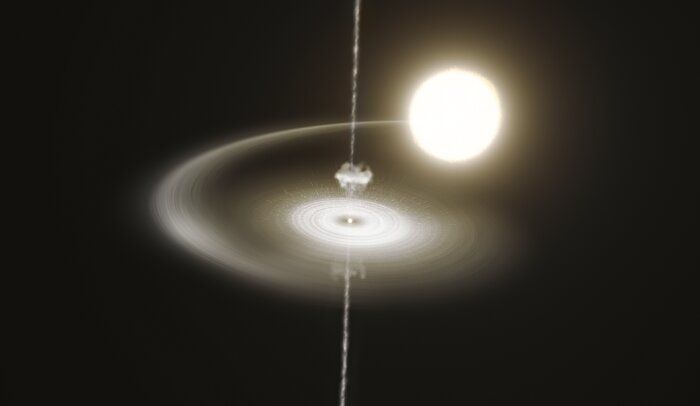
Astronomers have discovered that a dead star, known as PSR J1023+0038 or J1023, is feeding on a companion star and periodically firing out cosmic cannonballs. This pulsar, located 4,500 light years away, switches between two distinct modes of brightness. Researchers found that the mode-switching is caused by an interplay between the high-energy stream of particles blowing from the pulsar and matter falling toward it. When in its low-power mode, the pulsar expels matter in the form of a narrow jet, which accumulates close to the pulsar and gets heated up by the pulsar winds, resulting in the high-power mode. The jet eventually removes the hot material, causing the system to dim and switch back to the low-power phase.

astronomy2 years ago

Mysterious Remains: Unveiling the Strange Cosmic Object

Astronomers have identified a strange cosmic object, PM 1-322, as a variable planetary nebula, which is the ancient remains of a dead star. PM 1-322's light output changes over long periods of time, and it exhibits eruption-like events. Planetary nebulas are important in understanding the distribution of elements in the universe after stars die. The object may be associated with a companion star, and further observations are needed to determine its true nature.