CoreWeave’s stock fell about 16% after Q4 results showed revenue up 110% to roughly $1.57 billion, but a larger loss and rising debt from rapid data-center expansion spooked investors. The company’s guidance for Q1 revenue of $1.9–2.0 billion and an ~8% operating margin, plus 2026 capex of $30–35 billion, suggest profits may stay thin in the near term despite strong demand and a multi‑billion backlog.
CoreWeave posted a Q4 revenue beat of $1.57 billion and an adjusted loss of 56 cents per share, but its debt ballooned toward $30 billion and interest costs rose, weighing on the stock which fell about 7% after hours as early investor Magnetar continues selling shares.
IMF staff’s 2026 Article IV for the United States finds that the 2025 policy shift toward domestic self-reliance—emphasizing domestic manufacturing and energy, tighter immigration, deregulation, and tariff use—supported 2025 growth around 2.2% with unemployment near 4.3% in January 2026. Tariffs provide near‑term revenue but can raise inflation and dampen output; stricter immigration reduces the foreign-born labor supply and lowers activity, while deregulation and energy-focused policies boost dynamism. The outlook projects ~2.4% growth in 2026, core PCE inflation returning to 2% by 2027, and unemployment near 4% through 2026–27, but the current account deficit and NIIP are expected to widen and the debt-to-GDP ratio to rise toward about 140% by 2031 unless a credible frontloaded fiscal consolidation and revenue reforms are enacted. An alternative policy mix—permanent investment expensing, a destination-based tax, more open skilled immigration, and targeted safety-net reforms—could raise employment, reduce deficits and external imbalances, and improve distributional outcomes. The Fed should proceed gradually, maintaining policy credibility and financial stability as regulation and digital assets evolve.
A UK doctor says his student loan debt has grown from £55,000 to about £80,000 due to roughly £25,000 in interest, with around £3,000 added this tax year and only half of that paid off. Interest accrues immediately and can reach up to 6.2%, delaying plans like buying a home. Loans are written off after 25–40 years depending on the region, and while the government defends the system as fair, graduates and policymakers are pushing for reform.
A 73-year-old retiree, Susan Cannon, carries about $39,440 in credit-card debt across 19 cards with interest rates up to 34.99%, a situation worsened by the pandemic and ongoing inflation that forces reliance on cards for essentials; advocates push for caps on credit-card rates as relief, while banks warn such caps could reduce access to credit.
New US DOJ Epstein files imply deeper financial links with Sarah Ferguson, including a 2009 £20,000 rent request and speculation the total support could reach £2 million, challenging her claim she severed ties after Epstein’s 2008 conviction. The piece ties Ferguson to lean post-divorce finances, failed business ventures like Hartmoor LLC, a 2010 sting over access to Prince Andrew for payment, and the rent-free Royal Lodge arrangement funded by Andrew; with King Charles moving to curb subsidised royal living, Ferguson reportedly eyes Beatrice’s Oxfordshire home, and her charity Sarah’s Trust is set to close in 2026.
Oracle announced a calendar-year 2026 plan to raise $45-$50 billion through a balanced mix of debt and equity—including an ATM equity program and mandatory convertible preferred securities—to fund expansion of its Oracle Cloud Infrastructure, with a one-time senior unsecured bond issue early in 2026 and no additional bonds that year, aiming to maintain an investment-grade balance sheet as it serves large cloud customers.
With U.S. debt approaching $40 trillion, former Dallas Fed President Robert Kaplan argues currency stability matters more than gains from a weaker dollar; the piece notes Trump’s praise of the dollar’s decline, the dollar’s reserve-status, and how debt levels shape Treasury demand amid shifting market sentiment.
American Airlines reported record 2025 revenue of $54.6B (Q4 revenue of $14.0B), with GAAP net income of $99M in Q4 and $111M for the year and adjusted net income of $106M and $237M. The carrier reduced debt by $2.1B in 2025 and issued 2026 guidance of $1.70–$2.70 in adjusted EPS and more than $2B in free cash flow, despite a $325M revenue hit from a government shutdown. Early 2026 indicators are positive: Q1 revenue is expected to rise 7–10%, systemwide demand is running double-digit higher at the start of the year, and Premium offerings and network/fleet investments remain a core focus.
Netflix co-CEO Greg Peters says Paramount Skydance’s roughly $108 billion bid for Warner Bros. Discovery “doesn’t pass the sniff test,” arguing it would rely on heavy leverage without Larry Ellison backing it; he contrasts this with Netflix’s own roughly $83 billion all-cash offer as the stronger path, while RedBird Capital’s Gerry Cardinale counters, calling Netflix’s deal the “Harry Houdini of deals” in the ongoing proxy fight.
About 41% of car trade-ins roll over debt into new seven-year loans, extending payments and leaving buyers underwater; rising car costs are pushing households to stretch loan terms, making auto ownership increasingly unaffordable.
A North Carolina man won Mega Millions but couldn’t claim it because a debt tied to his Social Security number appeared to belong to someone else. After more than a month of investigation and intervention by a local troubleshooter, officials erased the SSN from the records and he received his winnings (minus taxes). The debt dates back over ten years and may have been a case of mistaken identity.
JPMorgan CEO Jamie Dimon warned on the company’s earnings call that governments worldwide must confront large deficits, cautioning that debt will eventually bite if borrowing continues unchecked, even as near-term economic indicators look solid. The piece highlights U.S. interest payments, CBO deficit projections for fiscal 2026, and who holds U.S. debt, noting vast holdings by central banks and foreign buyers while Dimon emphasizes focusing on clients rather than predicting outcomes.
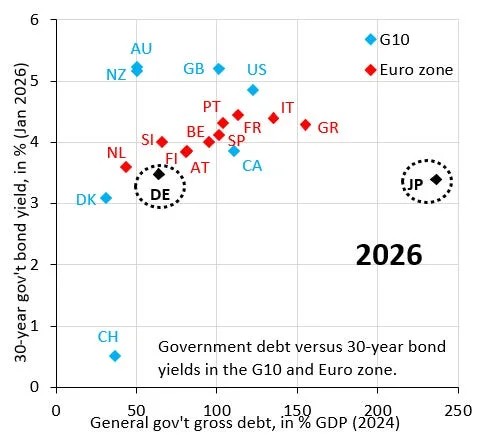
Japan's yen is weakening as markets demand higher interest rates, but raising rates risks a fiscal crisis given gross debt around 240% of GDP while net debt is about 130%. Official FX intervention is unlikely to stop the slide; the more viable path is to reduce gross debt by selling government assets, which could ease depreciation, though illiquid assets and policy risks complicate any such move.
Saks Global, owner of Saks Fifth Avenue, filed for Chapter 11 bankruptcy protection in the Southern District of Texas due to a heavy debt load from its 2024 acquisition of Neiman Marcus. The retailer has undergone leadership changes, with Geoffroy van Raemdonck set to lead through the bankruptcy after CEO transitions from Marc Metrick to Richard Baker. Saks Global has secured $1 billion in debtor-in-possession financing and up to $500 million more on emergence to fund operations and turnaround efforts. The filing, the first major retailer bankruptcy of 2026, comes as luxury shoppers shift toward direct-to-consumer models amid a tougher economy and cautious consumer sentiment; Saks aims to continue serving its luxury brands and customers during the restructuring.