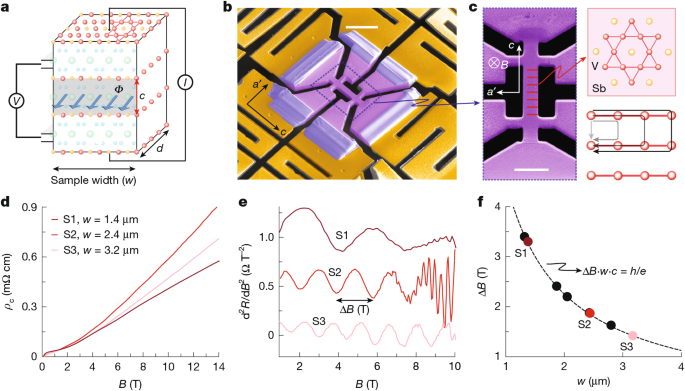
The study presents evidence of a long-range, coherent many-body electronic state in the kagome metal CsV3Sb5, characterized by macroscopic interference effects in magnetoresistance measurements, which persist over micrometers and are sensitive to sample geometry and strain, suggesting a state with similarities to superconductivity but without dissipation.
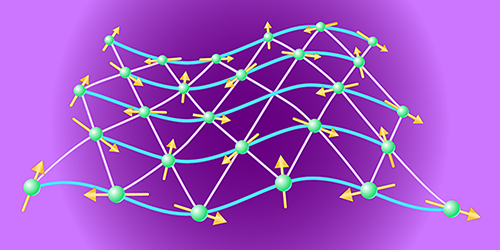
Researchers have found a correspondence between the spectrum of elementary excitations of a quantum spin liquid (QSL) and a quantum field theory, suggesting the possibility of testing particle physics theories with condensed-matter systems. The study focused on a well-studied QSL model, the Heisenberg J1 − J2 triangular antiferromagnet, and found a one-to-one correspondence with quantum electrodynamics in two spatial dimensions plus time (QED3). This discovery opens the prospect of detecting hypothetical elementary particles, such as magnetic monopoles, in a real QSL, and further research is needed to understand how QED3 excitations manifest in the physical response of the frustrated antiferromagnet and its stability to physical perturbations.
Physicists at Purdue University have discovered a new type of emergent particle, the six-flux composite fermion, in the fractional quantum Hall regime, expanding the understanding of quantum states. This groundbreaking finding, published in Nature Communications, challenges previous ideas and theories, and is a rare and significant discovery in condensed matter physics. The unique properties of the six-flux composite fermion provide new insights into the ordering of fractional quantum Hall states and contribute to ongoing research in topological electron physics.
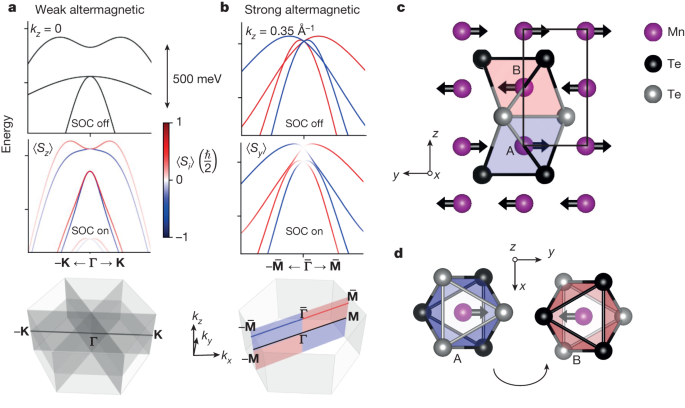
Scientists have discovered a new type of magnet called altermagnetism, which could revolutionize next-generation computers and electronics. This discovery, proven at the Swiss Light Source, opens up possibilities for more efficient electronic devices and a better understanding of condensed-matter physics. Altermagnetism, previously thought to be impossible, has the potential to impact various fields, including spintronics, and was detailed in a study published in the scientific journal Nature.
A new spin-group-symmetry classification has identified an unconventional magnetic phase called altermagnetic, which allows for lifted Kramers spin degeneracy (LKSD) without net magnetization and inversion-symmetry breaking. This altermagnetic LKSD has been confirmed in centrosymmetric MnTe using photoemission spectroscopy and ab initio calculations, revealing two distinct unconventional mechanisms of LKSD. The discovery of altermagnetic LKSD could have broad implications in fields such as spintronics, ultrafast magnetism, and topological matter, and may lead to the exploration of unconventional magnetic phases in various materials.
An international research group has discovered a new state of matter characterized by the existence of a quantum phenomenon called chiral current, which is generated on an atomic scale by a cooperative movement of electrons. This discovery significantly enriches our knowledge of quantum materials and may lead to the development of new electronics employing chiral currents as information carriers, as well as new chiral optoelectronic devices with implications for quantum technologies, sensors, biomedical, and renewable energy fields. The study verified the existence of this quantum state for the first time, paving the way for the development of new ultra-thin electronic devices and revolutionizing quantum physics and technology development.
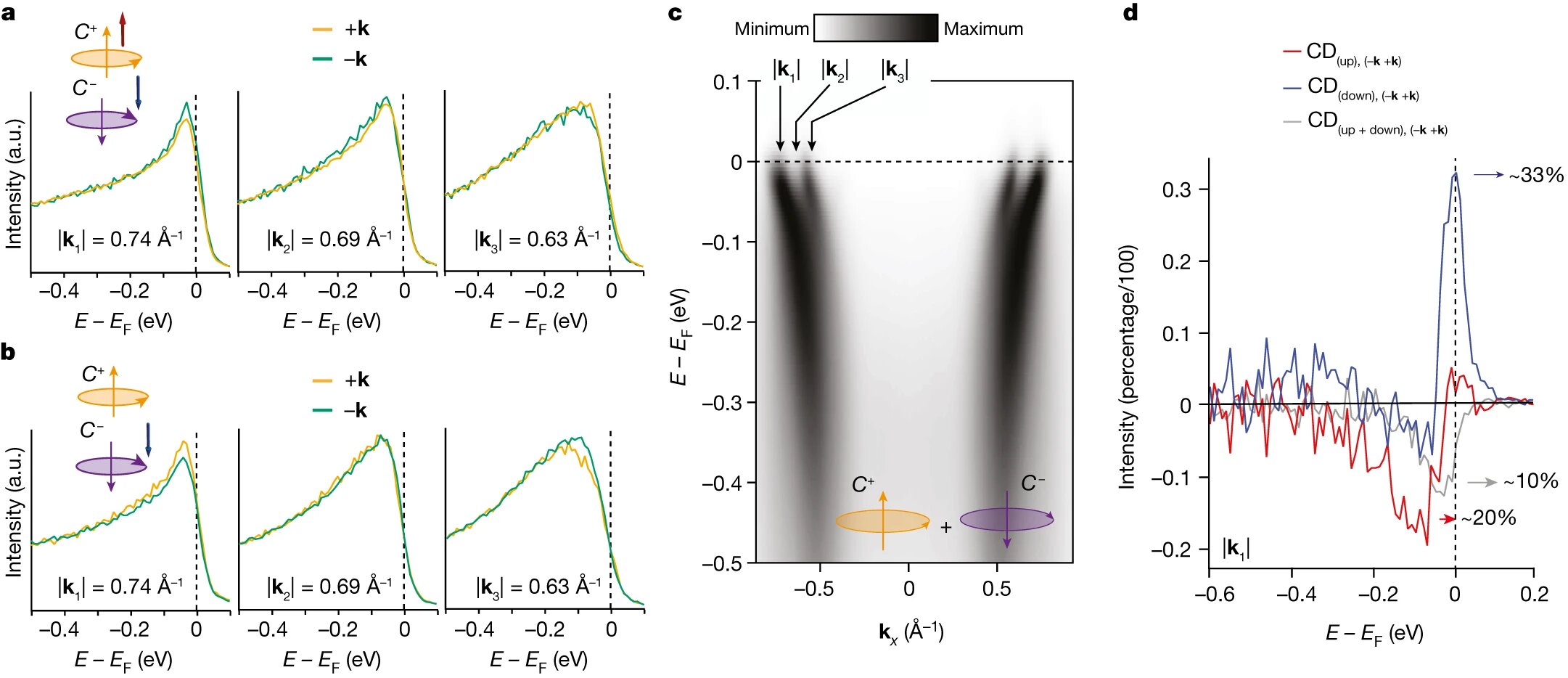
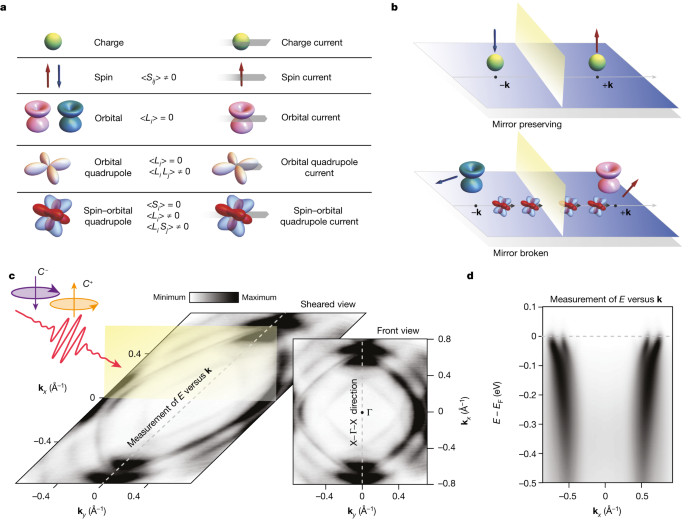
Researchers have discovered a new form of unconventional magnetism, known as chiral electronic ordering, which arises from charge currents at the atomic scale and is associated with a hidden magnetic order. By studying the archetypal quantum material Sr2RuO4, they have revealed signatures of a broken symmetry phase compatible with the formation of spin-orbital quadrupole currents at the material's surface. This discovery was made possible through circularly polarized, spin-selective, angular-resolved photoelectron spectroscopy, providing a methodology to probe otherwise undetectable symmetry-broken chiral electronic states. The study sheds light on the relationship between spin-orbital textures of electronic states and the occurrence of chiral electronic ordering, offering insights into a new phase of matter with potential implications for condensed-matter physics.
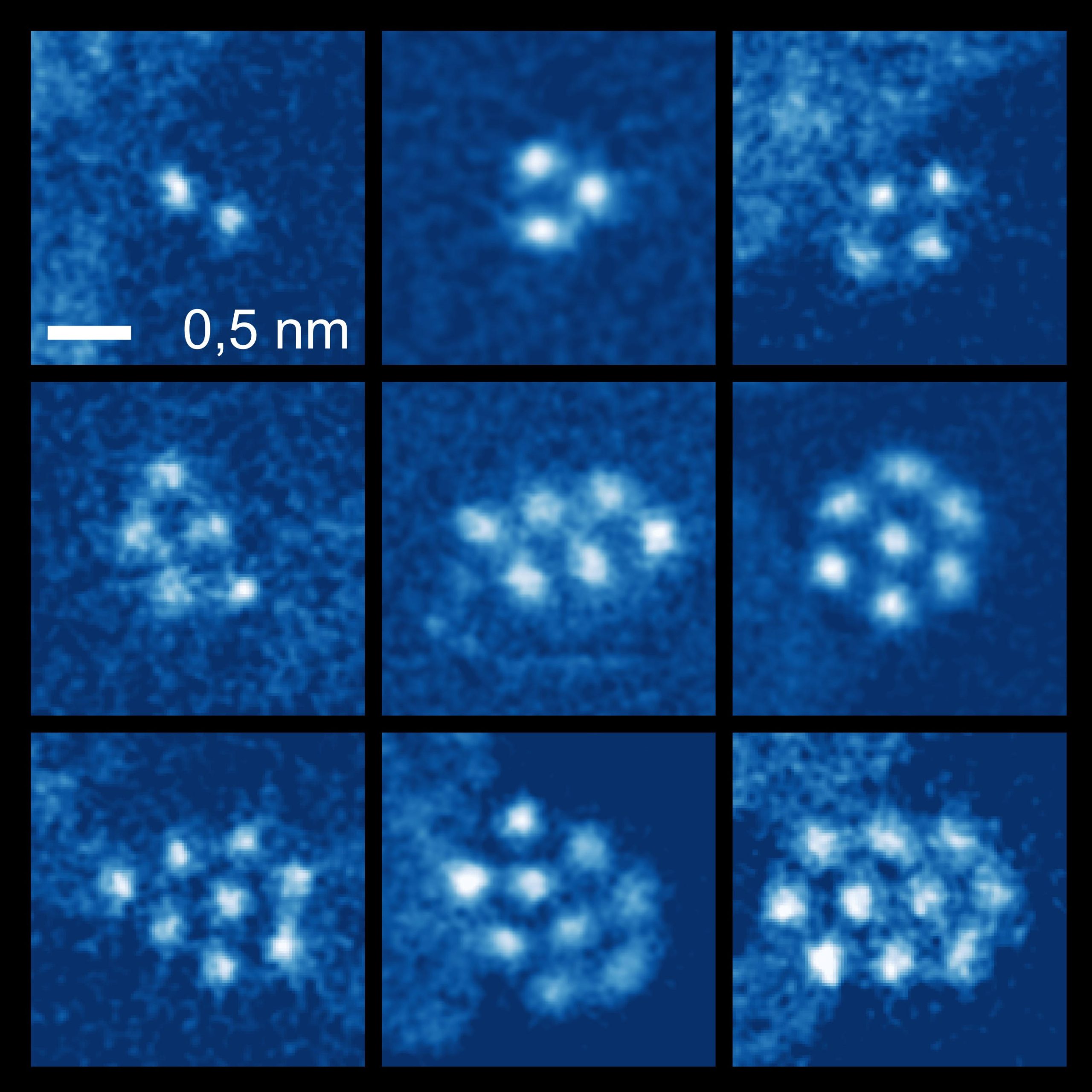
Researchers have achieved a breakthrough by stabilizing and directly imaging small clusters of noble gas atoms, such as krypton and xenon, between two layers of graphene at room temperature. This discovery opens up new possibilities for research in condensed matter physics and potential applications in quantum information technology. The method involves trapping noble gas atoms between graphene layers, allowing for the observation of their behavior using scanning transmission electron microscopy. This development may lead to further studies on the properties of clusters with different noble gases and their potential applications in quantum technology.
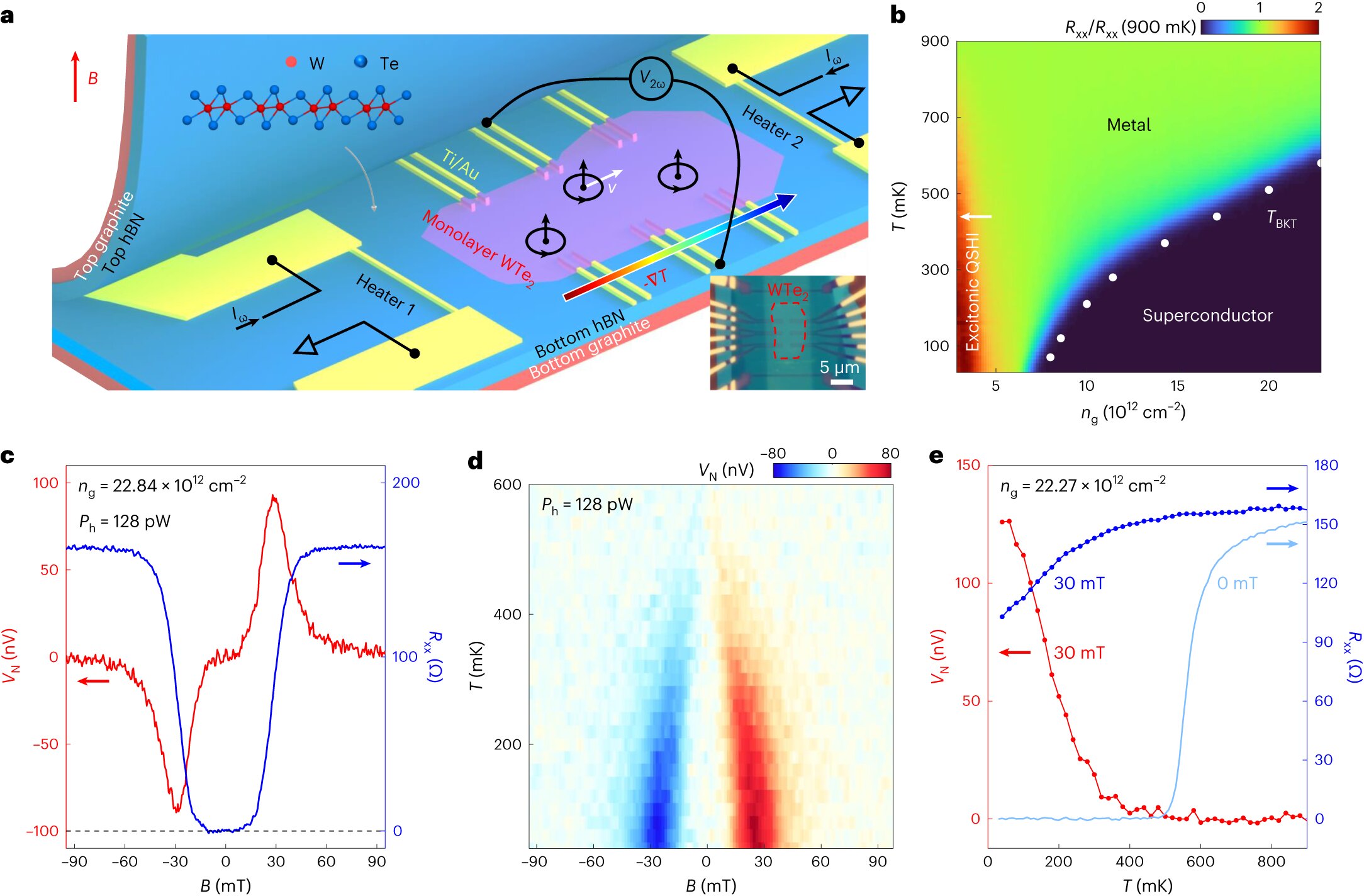
Princeton physicists have discovered a new quantum phase transition in superconductivity, challenging established theories. By experimenting with a three-atom-thin insulator that can be switched into a superconductor, they found evidence of a sudden cessation of quantum fluctuations, defying standard theoretical descriptions. This groundbreaking research promises to enhance our understanding of quantum physics in solids and propel the study of superconductivity in new directions, highlighting the need for a new theory to explain the observed phenomena.
Princeton physicists have observed an unexpected quantum behavior in a three-atom-thin insulator that can be switched into a superconductor, challenging current theories of superconductivity. The abrupt cessation of quantum fluctuations near the transition point exhibits unique properties that defy established theories. This discovery promises to advance our understanding of quantum physics in solids and open new directions for the study of quantum condensed matter physics and superconductivity.
A team of physicists at the University of Cologne has successfully observed the Kondo effect in an artificial atom using a scanning tunneling microscope, marking a significant breakthrough in condensed matter physics. Their innovative approach allowed them to directly observe the Kondo effect in a one-dimensional wire floating above a metallic sheet of graphene, validating theoretical predictions and opening new possibilities for exploring exotic states of matter.
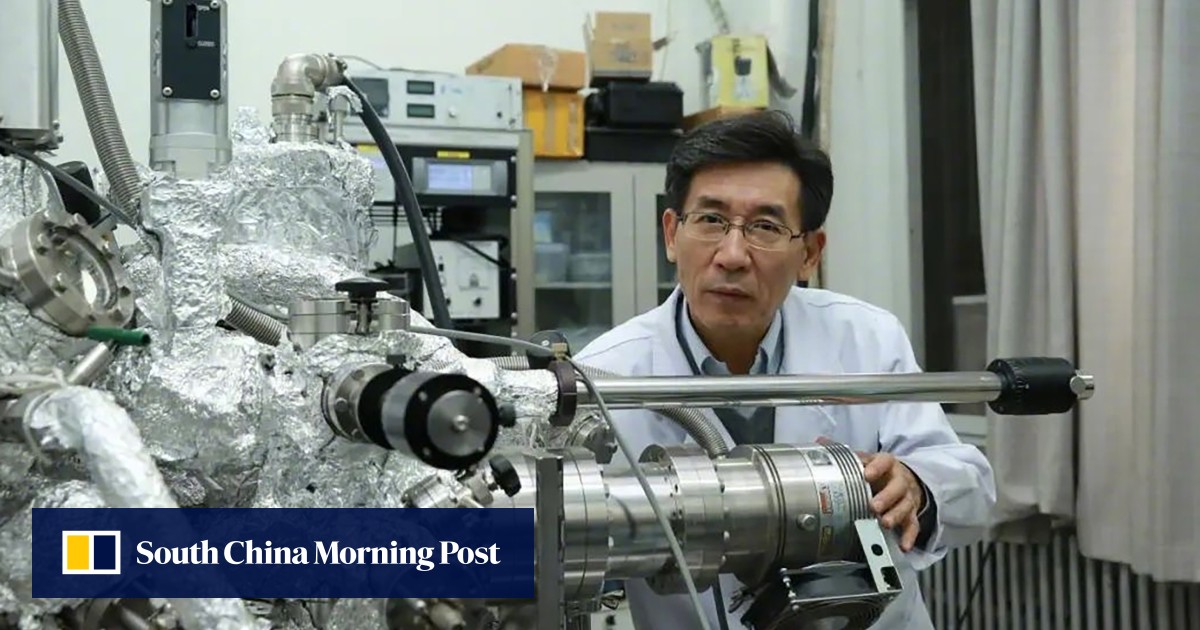
Physicist Xue Qikun from Tsinghua University has become the first Chinese scientist to win the United States' prestigious Oliver E. Buckley Condensed Matter Physics Prize. Xue and Harvard University's Ashvin Vishwanath were jointly awarded for their groundbreaking work on topological insulators, a class of materials with unique electronic properties. Xue's research focuses on synthesizing topological insulators for low-energy consumption electronics. Despite increasing sanctions on China's hi-tech sector, there are calls for stronger collaboration with Chinese researchers. Xue's achievements include being elected to the Chinese Academy of Sciences and conducting the first Nobel Prize-level physics experiment in a Chinese lab.
Researchers at Brown University have conducted a study on the compound H3LiIr2O6 to understand the role of disorder in quantum spin liquids. Contrary to standard magnets, quantum spin liquids remain in a state of flux instead of solidifying as temperatures decrease. The study found that disorder significantly alters the quantum liquid state but does not mimic or destroy it. The research provides insights into how disorder affects quantum systems and has implications for the development of quantum technologies, particularly in quantum computing.
Physicists at Trinity College Dublin, in collaboration with IBM, have successfully simulated super diffusion in a system of interacting quantum particles on a 27-qubit quantum computer. This breakthrough opens up possibilities for deeper insights into condensed matter physics and materials science. The research, published in the journal NPJ Quantum Information, demonstrates the potential of quantum computing in both commercial and fundamental physics inquiries. The team's work focused on simulating the long-time behavior of spin excitations in a Heisenberg chain, revealing the occurrence of super-diffusion governed by the Kardar-Parisi-Zhang equation.
Scientists led by Dr. David Hsieh have observed evidence of stable Hubbard excitons in a photo-doped antiferromagnetic Mott insulator, Sr2IrO4. Hubbard excitons are composite particles that emerge when an electron and a hole interact through electrostatic forces. Unlike regular excitons in semiconductors, Hubbard excitons in Mott insulators are challenging to detect due to complex electronic interactions and the short-lived nature of these excitons. The team used terahertz radiation and a stroboscopic technique to capture the transient response of Sr2IrO4 and detect the spectra of the Hubbard exciton. This discovery opens up possibilities for fundamental understanding and potential practical applications.