Tag

Deimos

All articles tagged with #deimos

Mars' Moons: Born from Asteroid Destruction?

Originally Published 1 year ago — by Space.com

Featured image for Mars' Moons: Born from Asteroid Destruction?
Source: Space.com

New computer simulations suggest that Mars' moons, Phobos and Deimos, may have formed from debris when a large asteroid was torn apart by Mars' gravity. This model explains their circular orbits and differing distances from Mars, challenging previous theories of their origin. The hypothesis will be tested by the upcoming Martian Moons eXploration mission, which aims to return samples from Phobos to Earth for analysis.

Asteroid Impact Theory Sheds Light on Mars' Moons Origins

Originally Published 1 year ago — by NASASpaceflight.com

Featured image for Asteroid Impact Theory Sheds Light on Mars' Moons Origins
Source: NASASpaceflight.com

A new study by NASA scientists using supercomputer simulations suggests that Mars' moons, Phobos and Deimos, may have formed from the debris of a disrupted asteroid that passed too close to Mars. This theory, which differs from previous hypotheses, accounts for the moons' unique shapes and Deimos' large orbital radius. The study's findings could be further explored by the upcoming Martian Moons Exploration (MMX) mission, which aims to collect samples from Phobos and Deimos to better understand their origins.

Scientists Challenge Assumptions About Mars' Moon

Originally Published 1 year ago — by Futurism

Featured image for Scientists Challenge Assumptions About Mars' Moon
Source: Futurism

Scientists from France and Germany propose that Mars' moon Phobos may have originated from a comet, challenging previous theories about its formation. This hypothesis is based on data from the Mars Express spacecraft, which shows Phobos has properties similar to comets. The upcoming Martian Moons eXploration (MMX) mission by Japan aims to study Phobos and Deimos further, potentially uncovering their true origins.

"Rainbow Six Siege's Operation Deadly Omen: New Operator, Anti-Cheat Update, and More!"

Originally Published 1 year ago — by SiegeGG

Featured image for "Rainbow Six Siege's Operation Deadly Omen: New Operator, Anti-Cheat Update, and More!"
Source: SiegeGG

Operation Deadly Omen in Rainbow Six Siege introduces the new operator Deimos with the DeathMark ability and Vendetta .44 revolver, an Anti Cheat update, ranked requirements, Azami nerf, shield rework, scope modifications, new attachments, throw trajectory, rappeling mechanic change, AI Playlist improvements, LMG buffs, Locker addition, and the upcoming release on Mar. 12, 2024.

"Exploring Martian Skies: Can Phobos and Deimos Grace the Surface?"

Originally Published 2 years ago — by Astronomy Magazine

Featured image for "Exploring Martian Skies: Can Phobos and Deimos Grace the Surface?"
Source: Astronomy Magazine

Both Phobos and Deimos, the two moons of Mars, can be seen from the surface of the planet. Phobos is larger and closer to Mars, appearing as bright as magnitude -9, while Deimos is smaller and farther away, peaking at magnitude -5. Phobos undergoes noticeable waxing and waning during a single appearance, while Deimos takes over 30 hours to orbit and goes through a full set of phases roughly twice from moonrise to moonset. Both moons exhibit lunar phases like Earth's Moon.

Deimos: Martian Mini-Me?

Originally Published 2 years ago — by JSTOR Daily

Featured image for Deimos: Martian Mini-Me?
Source: JSTOR Daily

The United Arab Emirates’s space probe Hope recently flew past Mars' moonlet Deimos and gave us our first look at the moonlet’s far side. The initial spectral analysis suggests Deimos is made out of Martian rock. This contradicts the long-held hypothesis that Deimos was an asteroid captured by Mars' gravity. The discovery has led scientists to rearrange their ideas about the origin of Mars' moons.

Exploring the Enigmatic Moon Deimos of Mars.

Originally Published 2 years ago — by Freethink

Featured image for Exploring the Enigmatic Moon Deimos of Mars.
Source: Freethink

The United Arab Emirates Space Agency (UAESA) has captured the highest resolution images of Mars' moon Deimos to date, revealing that the tiny satellite may not have originated from captured asteroids as previously believed. Instead, observations from the UAE's Hope orbiter suggest that Deimos and its larger counterpart Phobos may have formed from leftover material after Mars' formation or may be chunks of the planet that broke free following an asteroid impact. The mystery surrounding the moons may soon be cleared up as Japan plans to send a probe to study them and retrieve samples from Phobos in the mid-2020s.

Hope Probe captures stunning image of Deimos from close range.

Originally Published 2 years ago — by The Hill

Featured image for Hope Probe captures stunning image of Deimos from close range.
Source: The Hill

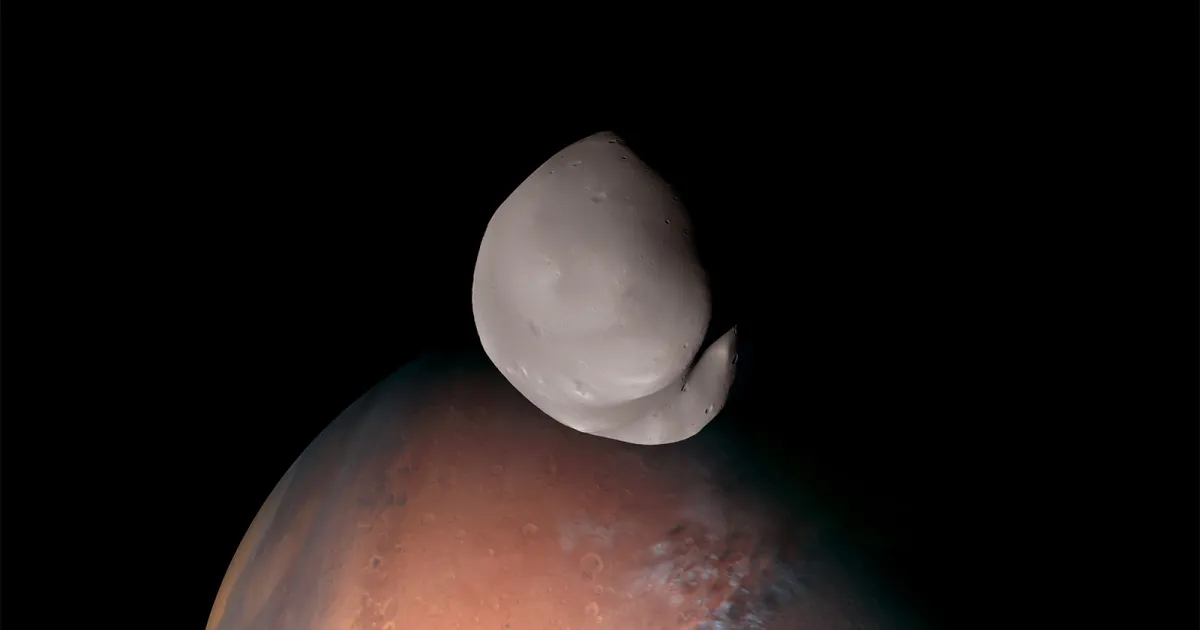
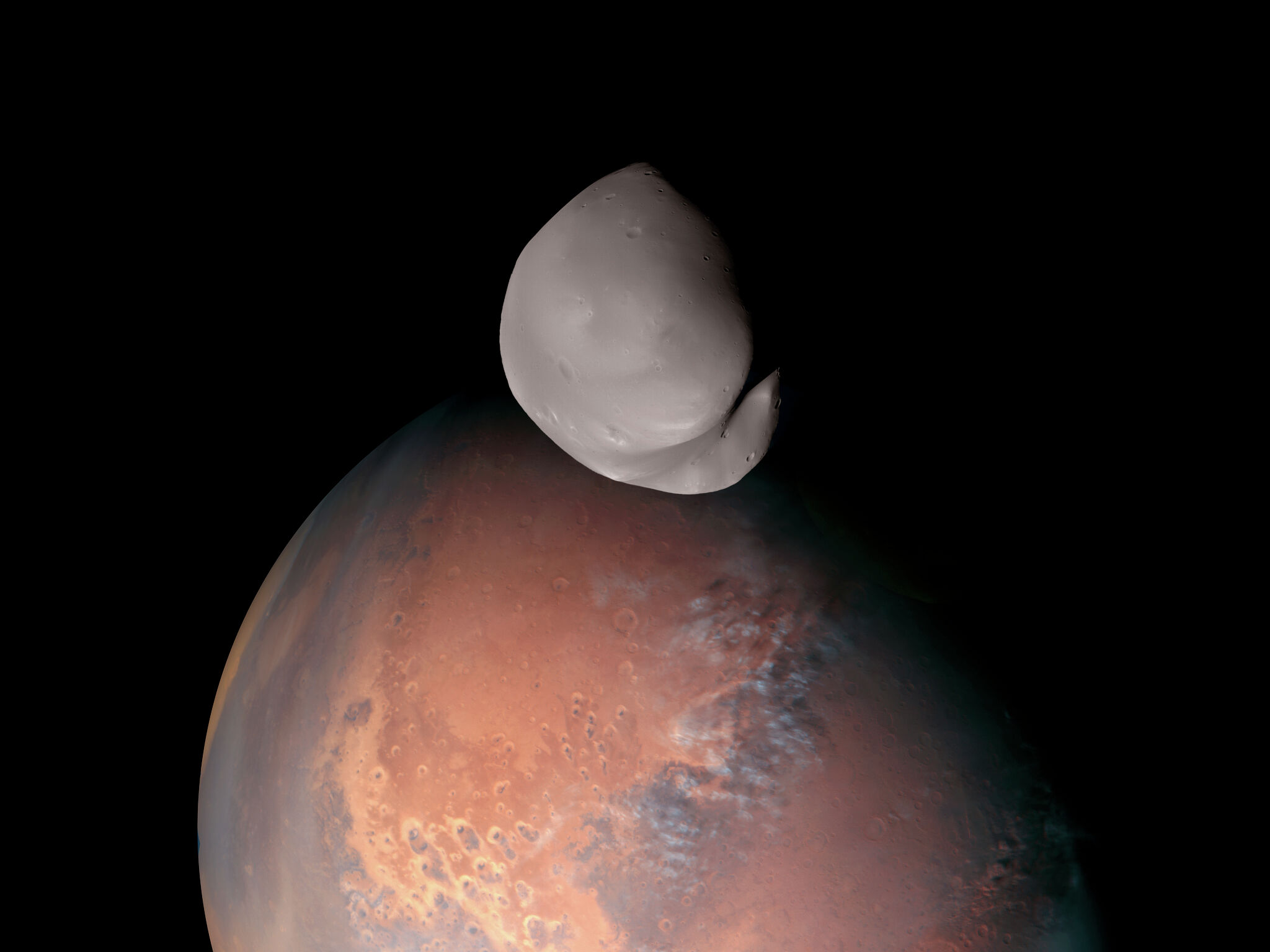
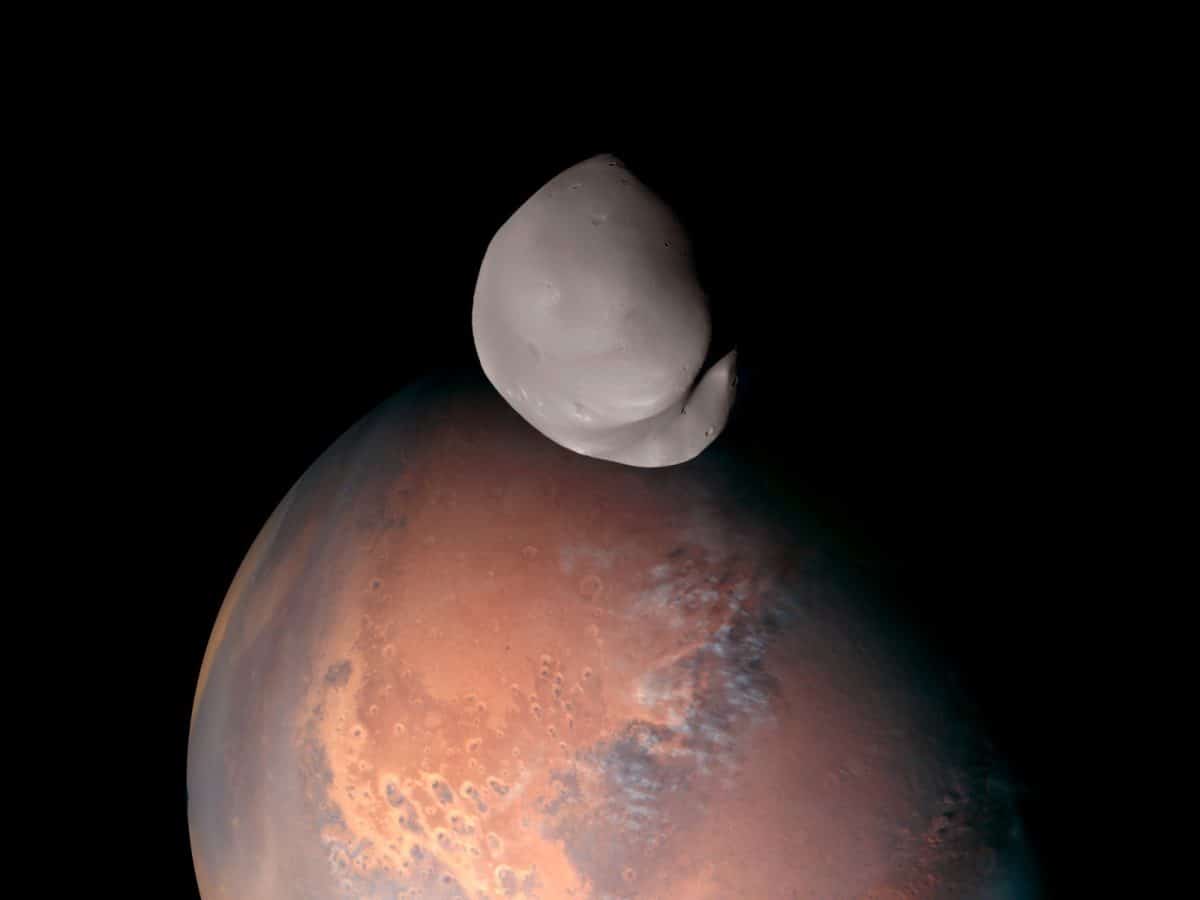
The United Arab Emirates spacecraft, Hope, captured high-resolution images of Deimos, one of Mars's two moons, during its first flyby on March 10. The images suggest that Deimos is more similar to Mars than to carbon-rich asteroids, strengthening the theory that it formed at the same time as Mars. Hope's observations of Deimos will continue through 2024, allowing scientists to analyze differences between the near and far sides of the moon and expand on what we know about Mars.

New data and photos challenge previous theories on Mars' moon Deimos.

Originally Published 2 years ago — by Houston Chronicle

Featured image for New data and photos challenge previous theories on Mars' moon Deimos.
Source: Houston Chronicle

The United Arab Emirates released new images and data of Mars' smaller moon, Deimos, challenging the long-standing theory that the moons are asteroids trapped in the planet's orbit. The images suggest that Deimos is composed of dark, volcanic rock consistent with the Red Planet's composition, indicating that both moons may have formed from leftover debris after something struck Mars. The findings were unveiled during a special session at the European Geosciences Union General Assembly in Vienna.

Unprecedented Close-Up Photos of Martian Moon Deimos Unveiled.

Originally Published 2 years ago — by Boing Boing

Featured image for Unprecedented Close-Up Photos of Martian Moon Deimos Unveiled.
Source: Boing Boing

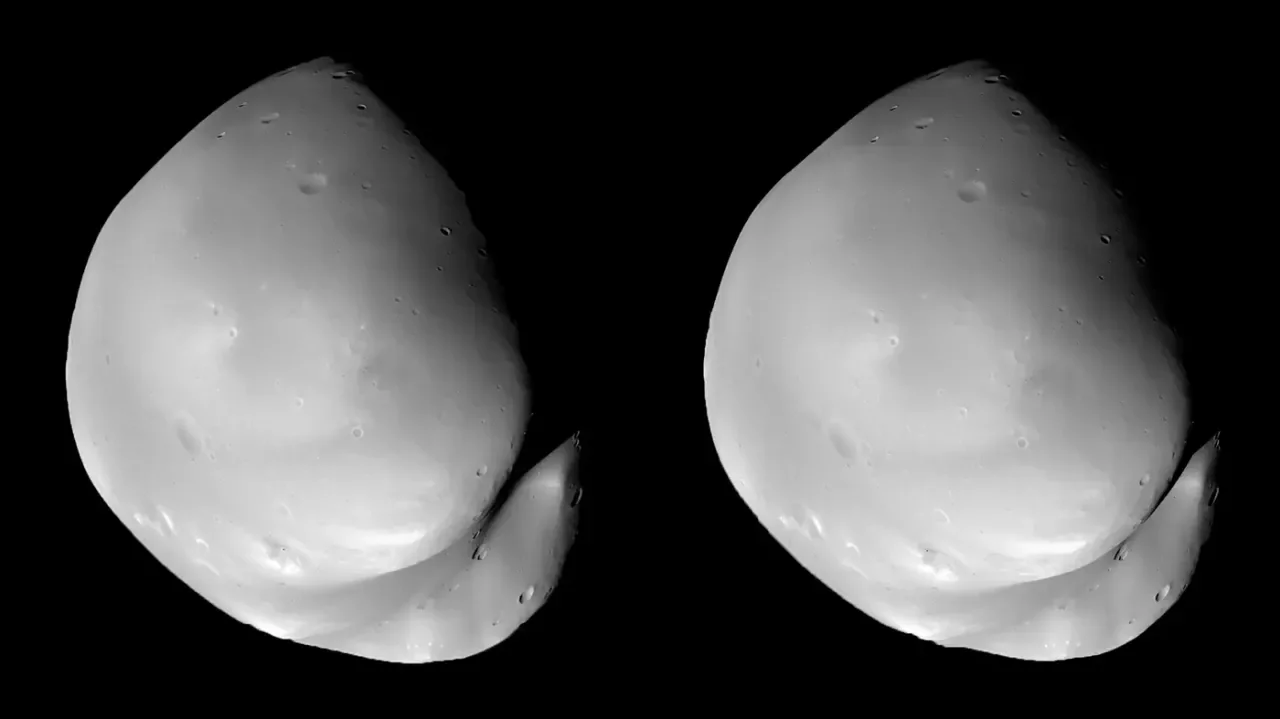
The UAE Space Agency's "Hope Probe" has captured the most detailed photo of Mars' moon Deimos, challenging the theory that it is a captured asteroid and instead pointing to a planetary origin. The observations were made using all three of the probe's science instruments and provide new insights into Deimos' makeup and structure. The Emirates Mars Mission is the first interplanetary exploration undertaken by an Arab nation.

"Hope Mission captures revealing close-ups of Mars' tiny moon Deimos"

Originally Published 2 years ago — by Livescience.com

Featured image for "Hope Mission captures revealing close-ups of Mars' tiny moon Deimos"
Source: Livescience.com

The United Arab Emirates' Hope spacecraft has captured the first-ever close-up photo of Mars' moon Deimos, revealing that it is made of the same materials as Mars itself, challenging theories about its formation. The observations suggest that Deimos formed at the same time as Mars and is not a captured asteroid. The findings were presented at the European Geosciences Union meeting. The Emirates Mars Mission mainly investigated changes in the Martian atmosphere, but the team used the remaining extra propellant to boost the spacecraft into a higher orbit above Deimos, allowing the scientists to image the far side of the Martian moon in detail for the first time.

New insights into the enigmatic Martian moon Deimos.

Originally Published 2 years ago — by The New York Times

Featured image for New insights into the enigmatic Martian moon Deimos.
Source: The New York Times

New high-resolution images of Deimos, the smaller of the two moons of Mars, taken by the Emirates Mars Mission suggest that it may not be a captured asteroid as previously thought. The Hope orbiter found that Deimos is more similar in composition to Mars than to D-type asteroids, the class of asteroids previously suggested as its origin. The spacecraft also obtained the first-ever views of the far side of the moon, which always faces away from Mars. The origins of the moon are still unclear, but further studies by the Hope orbiter and the upcoming Japanese mission called Martian Moons eXploration may provide more answers.

UAE spacecraft captures unprecedented images of Martian moon Deimos.

Originally Published 2 years ago — by Spaceflight Now

The UAE's Hope probe has captured detailed images of the far side of the Martian moon Deimos, suggesting it may have formed from debris left over from an impact on Mars, rather than being a captured asteroid. The spacecraft's three science instruments observed Deimos during the encounter, with the probe's camera recording stunning views of the moon passing across the sunlit side of Mars far below. The flyby with Deimos was the closest any spacecraft has been to the moon since NASA's Viking 2 orbiter in the 1970s.