Tag

Comet

All articles tagged with #comet

ARC Raiders Unveils Firefly and Comet, Deploys Fresh Tactics for Topside Skirmishes
gaming9 hours ago

ARC Raiders Unveils Firefly and Comet, Deploys Fresh Tactics for Topside Skirmishes

ARC Raiders introduces two new top-side enemies: Firefly, a tenacious aerial threat, and Comet, a heavily armored rolling explosive. Tactics include using a Photoelectric Cloak or exploiting the Firefly’s fuel tank while staying in solid cover or indoors; lure grenades can help against Firefly, and aggressive, surgical shots are advised. For the Comet, aggro from a distance to make it expose its inner weak point, use high rate-of-fire or armor-piercing ammo, spread out your squad to minimize group damage, and target armor plating on the sides or the front when it reveals weak points. Quick thinking and coordinated play are key to surviving these predators.”,

Tiny Comet 41P Flips Its Spin After Near-Sun Pass
science5 days ago

Tiny Comet 41P Flips Its Spin After Near-Sun Pass

Analysis of comet 41P/Tuttle-Giacobini-Kresák from its 2017 close solar approach shows a dramatic spin-down followed by an apparent spin reversal, inferred from light curves and Hubble data. The rapid change, likely driven by torques from outgassed jets on its ~1‑km nucleus, exceeds previous records and could spin the comet apart if it continues; the finding is in an arXiv preprint and not yet peer‑reviewed, with the next spin measurements expected at the 2028 perihelion.

Interstellar Comet 3I/ATLAS unveils the building blocks of life
space11 days ago

Interstellar Comet 3I/ATLAS unveils the building blocks of life

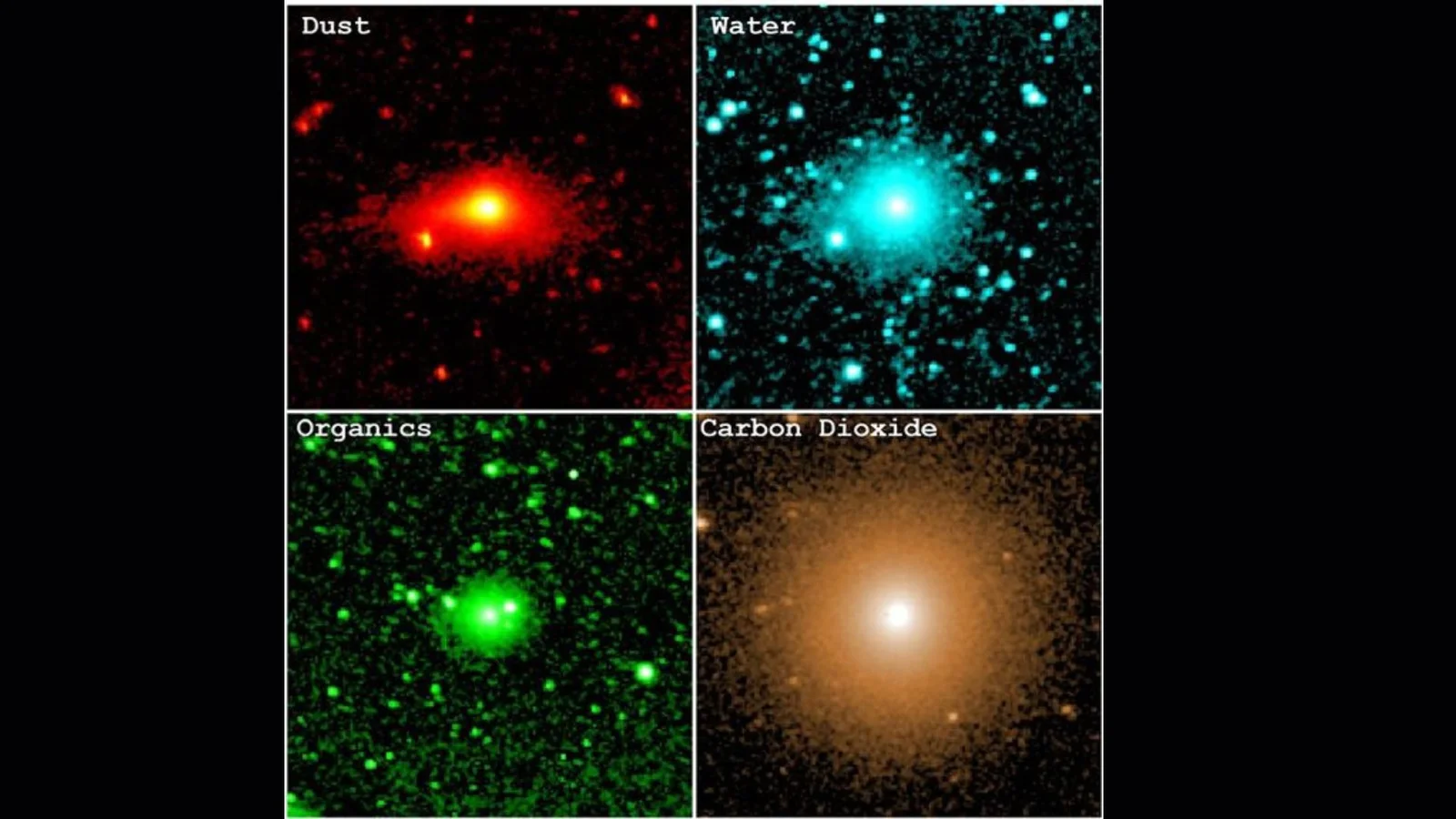
NASA's SPHEREx infrared space telescope observed interstellar comet 3I/ATLAS during its December close approach and detected organic molecules such as methanol, cyanide, and methane, indicating that the materials associated with life can be present in cometary material. The findings, published as a Research Note of the American Astronomical Society, support the idea that comets can deliver bio-relevant compounds, though they do not imply life itself. SPHEREx scans the sky in infrared with 102 color sensors, and captured data as 3I/ATLAS passed by the Sun before heading back into interstellar space.

Interstellar Comet 3I/ATLAS Heads Toward Interstellar Space in Free Livestream
space1 month ago

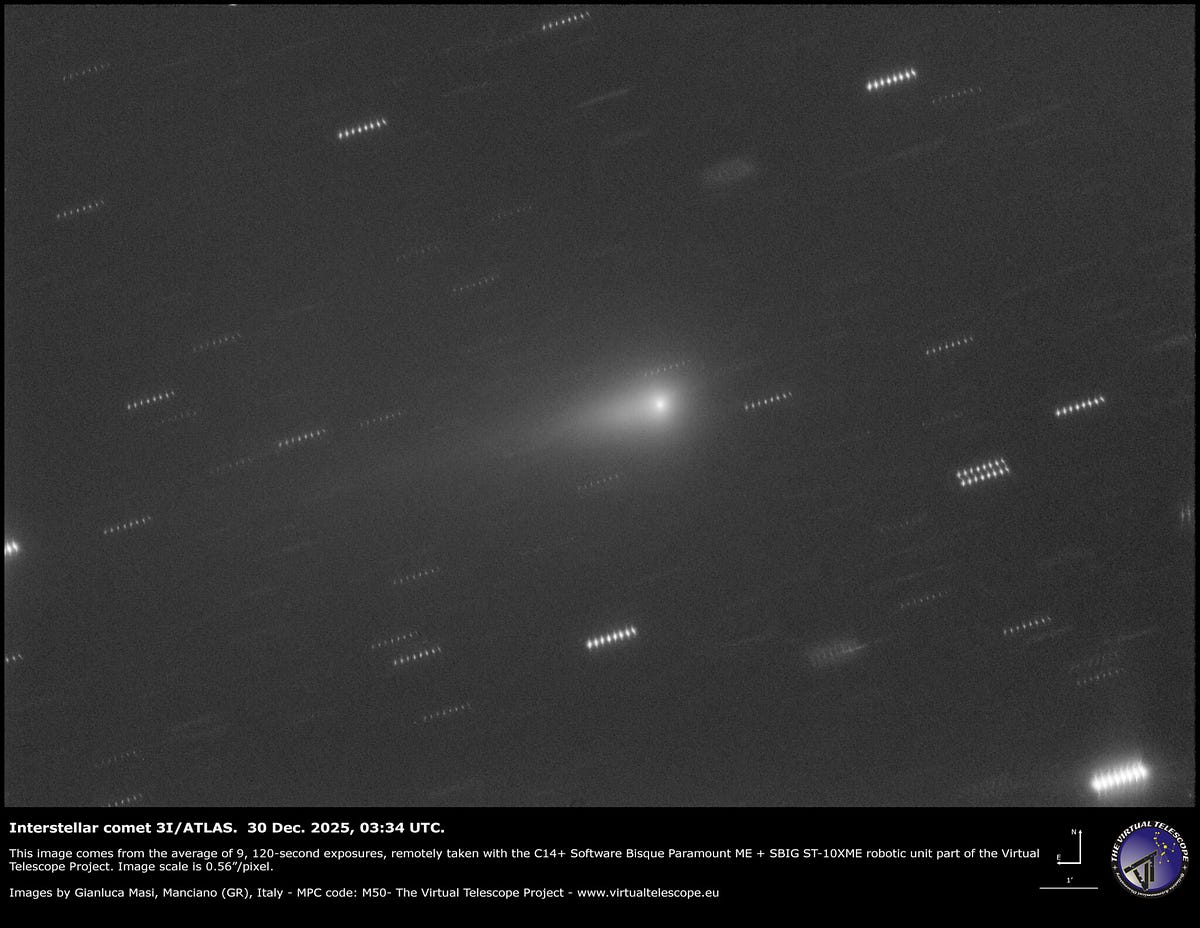
Interstellar Comet 3I/ATLAS Heads Toward Interstellar Space in Free Livestream

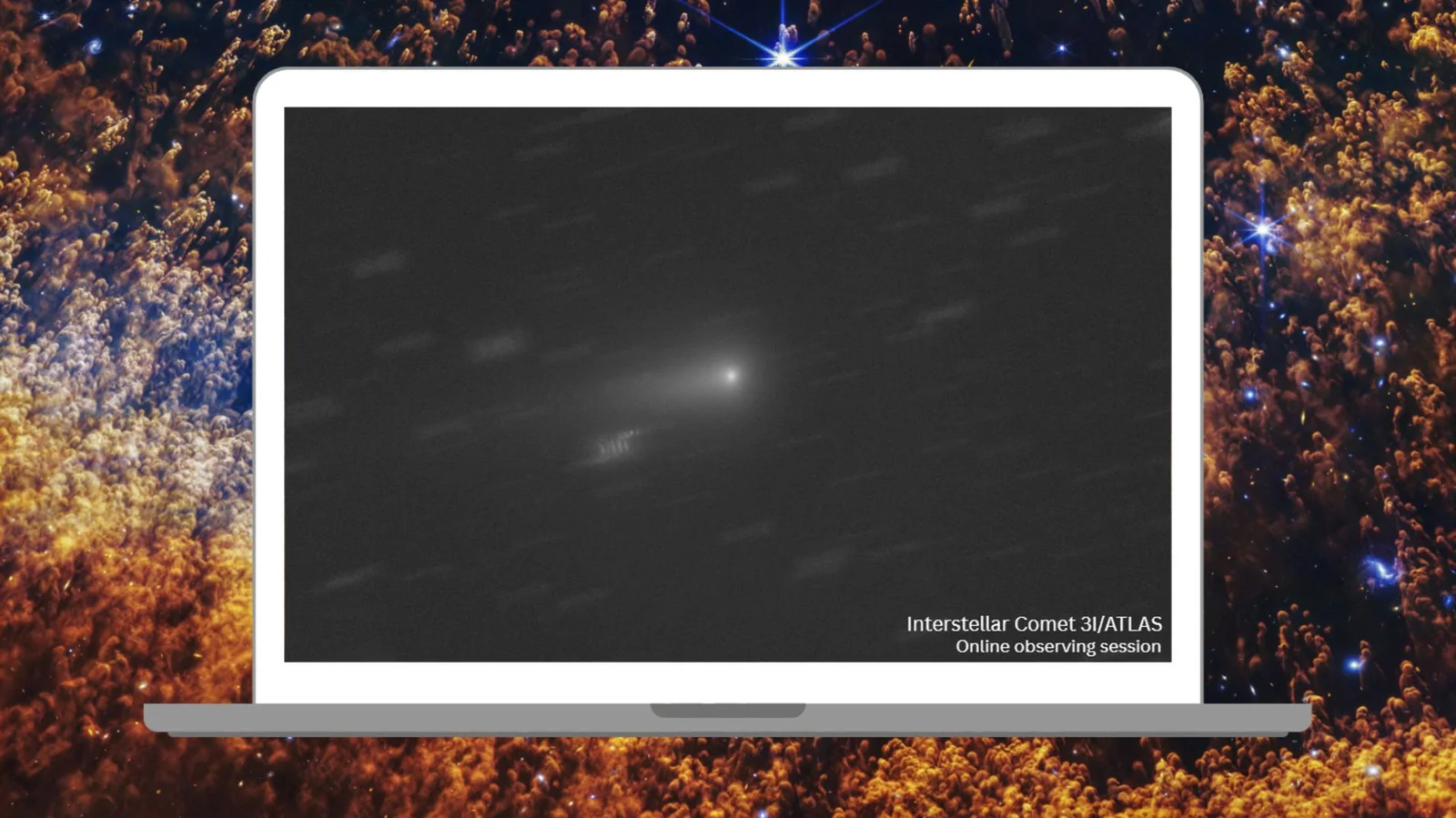
Space.com reports that interstellar comet 3I/ATLAS—the third known visitor from outside our solar system—will be visible in a free livestream tonight from Manciano, Italy’s Virtual Telescope Project, starting at 6:30 p.m. EST. At about magnitude +13.2 it won’t be visible to the naked eye; the comet will be at opposition as it races away from the Sun, following a close pass in late 2025 and a March flyby past Jupiter on its way out of the solar system.

Icy Comet Wierzchos Skims the Sun, Promises a Clearer February View
space1 month ago

Icy Comet Wierzchos Skims the Sun, Promises a Clearer February View

Comet C/2024 E1 (Wierzchos) will reach perihelion today, skimming about 84.6 million km from the Sun and brightening to roughly magnitude +8.1, visible only with binoculars or a telescope. It won’t be naked-eye visible this pass, but it’s expected to return in February for a better chance to be seen from Earth, with a perigee around 93 million miles (1 AU) and viewing opportunities shifting from the Southern Hemisphere this month to the Northern Hemisphere in mid-February after sunset. Discovered in 2024 by the Catalina Sky Survey and likely originating in the Oort Cloud, JWST observations have studied its spectrum; the comet poses no threat.

Comet Wierzchos makes a solar pass at perihelion—will you catch a glimpse?
astronomy1 month ago

Comet Wierzchos makes a solar pass at perihelion—will you catch a glimpse?

Comet C/2024 E1 (Wierzchos) is near perihelion today, Jan 20, skimming about 52.6 million miles from the Sun at 1:24 p.m. EST, which should brighten it but likely won’t be visible to the naked eye (peak magnitude around +8.1). It will require a small telescope or good skies, and observers in the U.S. may have limited viewing as the comet travels through Microscopium and dips below the horizon at night. After Earth’s closer approach on Feb. 17 (about 93 million miles away), it will still be faint and best seen near sunset from favorable southern skies, fading as it moves away. The object was discovered in 2024 by the Catalina Sky Survey and is tracked by space observers like NASA/JWST, with visibility depending on local conditions.

Great Comet of 2026 Could Be Naked-Eye Visible
space1 month ago

Great Comet of 2026 Could Be Naked-Eye Visible

Astronomers say the newly spotted Comet C/2025 R3 (Pan-STARRS) could become 2026’s Great Comet, with perihelion around April 20 and Earth flyby around April 27. Brightness is uncertain—estimates range from magnitude 8 (visible with a telescope) to about magnitude 2.5 (visible to the naked eye). The best naked-eye viewing window may be around April 17 near the new Moon, and the comet will be in Pisces near Pegasus as it approaches the Sun; forward scattering could boost brightness if the geometry aligns.

Interstellar Comet 3I/ATLAS Exhibits Unusual Jet Activity and No Technosignatures
science1 month ago

Interstellar Comet 3I/ATLAS Exhibits Unusual Jet Activity and No Technosignatures

The article discusses whether the anti-tail jet of interstellar object 3I/ATLAS, observed to extend towards the Sun, contains streaming gas beyond approximately 5,000 km from the nucleus. If 3I/ATLAS is a natural comet, the jet should be gas-free beyond this distance, consisting mainly of dust particles. The presence or absence of streaming gas at larger scales could help determine whether 3I/ATLAS is a natural comet or a man-made object, with potential observations suggested using various telescopes.