Tag

Brain Rhythms

All articles tagged with #brain rhythms

Brain Rhythms Direct Memory and Novelty Processing

Originally Published 3 months ago — by Neuroscience News

Featured image for Brain Rhythms Direct Memory and Novelty Processing
Source: Neuroscience News

Researchers have uncovered how the brain dynamically switches between memory recall and processing new information by modulating the balance between slow (theta) and fast (gamma) rhythms through distinct inhibitory circuits, a mechanism that could inform treatments for neurological conditions like Alzheimer's and epilepsy.


Breath Meditation Induces Deep Relaxation in the Brain

Originally Published 4 months ago — by PsyPost

Featured image for Breath Meditation Induces Deep Relaxation in the Brain
Source: PsyPost

A study shows that breath-based meditation, specifically Sudarshan Kriya Yoga, shifts brain activity into a deeply relaxed state characterized by increased theta and delta waves and decreased alpha activity, supporting its potential for promoting mental well-being. The research used EEG to analyze brain changes during different stages of the practice, revealing consistent patterns across experienced practitioners and highlighting the technique's ability to facilitate access to meditative states.

Neuronal Synchronization in Memory Formation and Recall

Originally Published 5 months ago — by Neuroscience News

Featured image for Neuronal Synchronization in Memory Formation and Recall
Source: Neuroscience News

Researchers studying epilepsy patients found that nerve cells in the medial temporal lobe synchronize their firing with slow brain waves, known as theta rhythms, during both learning and recall, suggesting this synchronization is a general feature of memory processing rather than a predictor of successful recall. The findings deepen understanding of brain rhythms in memory and could inform future treatments for memory disorders.

Astrocytes Unveiled as Key Players in Brain Rhythms

Originally Published 6 months ago — by Neuroscience News

Featured image for Astrocytes Unveiled as Key Players in Brain Rhythms
Source: Neuroscience News

New research using computational models and machine learning reveals that astrocytes, previously thought to be support cells, actively influence brain network dynamics, especially during synchronized states crucial for functions like memory and sleep, suggesting a more prominent role in brain function and potential therapeutic targets.

Flexibility Over Focus: Rethinking Intelligence

Originally Published 7 months ago — by Neuroscience News

Featured image for Flexibility Over Focus: Rethinking Intelligence
Source: Neuroscience News

New research indicates that higher cognitive ability is linked to more flexible and dynamic synchronization of theta brainwaves in the midfrontal brain region during demanding tasks, suggesting that intelligence depends more on adaptable neural coordination than constant activity.

Brain Cells Sync to Multiple Rhythms Like a Neural Radio

Originally Published 7 months ago — by Neuroscience News

Featured image for Brain Cells Sync to Multiple Rhythms Like a Neural Radio
Source: Neuroscience News

New research shows that hippocampal neurons can simultaneously respond to slow theta and fast gamma brain waves by switching between firing modes, using bursts for theta and single spikes for gamma, a phenomenon called interleaved resonance. This flexible coding mechanism enhances our understanding of brain functions like navigation and memory and has potential implications for neurological diseases such as Alzheimer's, epilepsy, and schizophrenia.

Unlocking Learning: The Brain's Traffic Controllers

Originally Published 1 year ago — by Neuroscience News

Featured image for Unlocking Learning: The Brain's Traffic Controllers
Source: Neuroscience News

A study from Durham University reveals that interneurons in the hippocampus act as 'traffic controllers' by regulating synchronized brain cell activity, crucial for learning and memory. Activating a single interneuron can trigger coordinated brain activity during rest, potentially aiding memory formation. This discovery suggests that dysfunction in interneurons may contribute to disorders like epilepsy, autism, and schizophrenia, and could lead to targeted therapies for these conditions.

Uncovering the Significance of Brain Rhythms in Cognitive Understanding

Originally Published 1 year ago — by Neuroscience News

Featured image for Uncovering the Significance of Brain Rhythms in Cognitive Understanding
Source: Neuroscience News

A new study emphasizes the significance of brain rhythms in understanding cognition, suggesting that these rhythms play a crucial role in organizing and processing information. The research explores how rhythmic electrical fields influence and align neighboring neurons, enhancing cognitive function and providing insights that could lead to improved interventions for conditions like schizophrenia and epilepsy. The study highlights the role of "ephaptic coupling" and the regulation of sensory information encoding by lower-frequency "beta" rhythms. The authors argue that understanding these dynamics is vital for developing treatments for neurological disorders and advancing comprehension of cognitive processes.

"Uncovering Common Waveform Features in Sharp-Wave Ripples Across Species Using Machine Learning"

Originally Published 1 year ago — by Nature.com

Featured image for "Uncovering Common Waveform Features in Sharp-Wave Ripples Across Species Using Machine Learning"
Source: Nature.com

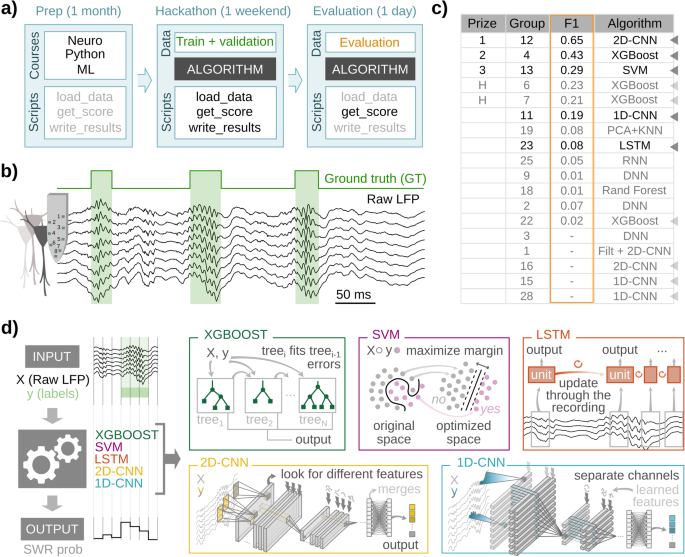
A study on brain rhythms, specifically hippocampal sharp-wave ripples (SWRs), reveals common waveform features across species. Researchers organized a hackathon to develop machine learning models for SWR detection, resulting in the selection of five promising models. The models were trained and tested using LFP recordings from mice and macaques, demonstrating their generalizability. The study also evaluated the influence of input characteristics and processing parameters on model performance, providing insights for the development of new tools for SWR detection.

Revolutionizing Memory with Spatial Computing.

Originally Published 2 years ago — by Neuroscience News

Featured image for Revolutionizing Memory with Spatial Computing.
Source: Neuroscience News

Researchers at MIT and Karolinksa Institute and KTH Royal Institute of Technology in Stockholm have discovered that the brain creates distinct spaces in the cortex for each general rule of working memory and controls those patches with brain rhythms, a concept the authors call “Spatial Computing.” This system explains how the brain can easily sustain a consistent understanding of a process even when the specific contents keep changing. The researchers realized that all these questions could be resolved by the Spatial Computing theory. Individual neurons representing information items can be scattered widely around the cortex, but the rule that’s applied to them is based on the patch of the network they are in.