

Tag

Scandium

All articles tagged with #scandium

science-and-technology2 years ago

Revolutionary Scandium-based Atomic Clocks Ensure Unprecedented Precision for Eons

Scientists have identified scandium as a promising element for the development of nuclear clocks, which could offer accuracy up to 1 second in 300 billion years. Unlike atomic clocks that rely on electron shell oscillation, nuclear clocks use the oscillation of the atomic nucleus for enhanced timekeeping. Scandium's atomic resonances are more acute than those of electrons, making it a potential candidate. However, generating the necessary oscillation in scandium requires X-rays with high energy levels. The researchers demonstrated a resonant width of only 1.4 femtoelectronvolts, suggesting an accuracy of 1:10,000,000,000,000. This advancement could have applications in extreme metrology, nuclear clock technology, and ultra-high-precision spectroscopy.

science-and-technology2 years ago

Revolutionizing Timekeeping: Unleashing the Potential of Scandium in Next-Gen Atomic Clocks

An international research team has made a significant breakthrough in the development of atomic clocks by creating a pulse generator based on scandium that is a thousand times more precise than the current standard atomic clock based on cesium. Using the X-ray laser at the European XFEL, the team achieved an accuracy of one second in 300 billion years, compared to the current standard of one second in 300 million years. Atomic clocks have numerous applications, including precise positioning using satellite navigation, and the breakthrough opens up possibilities for ultrahigh-precision spectroscopy and the measurement of fundamental physical effects.

science-and-technology2 years ago

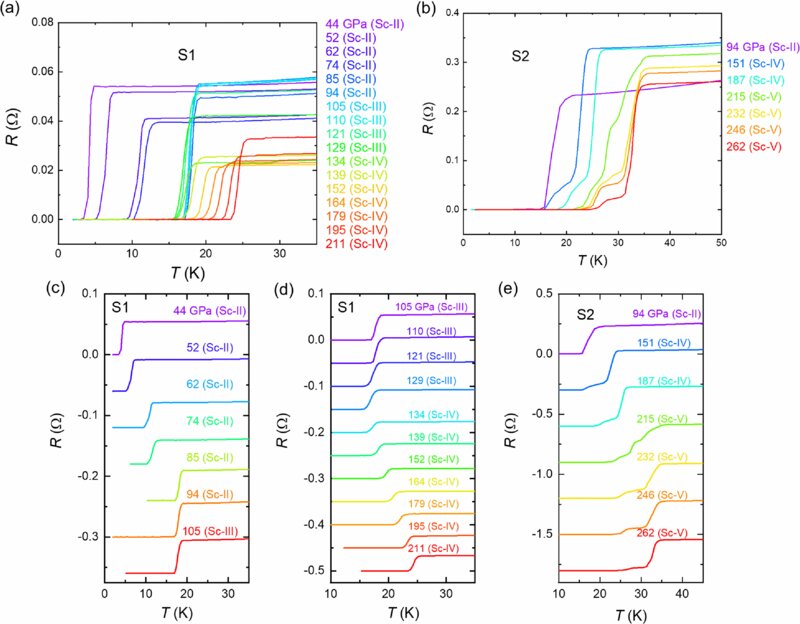
"Breakthrough: Unprecedented Superconducting Transition Temperature Achieved"

Researchers have achieved a new record for the highest elemental superconducting transition temperature by reaching 36 K in elemental scandium (Sc) under high pressure. The study provides insights into the relationship between the structure of elemental materials and their superconducting properties, opening up possibilities for discovering high-temperature superconducting materials in simple systems.