Earth's recent faster rotation has led to discussions about implementing a negative leap second to keep atomic time aligned with astronomical time, but concerns over system disruptions and international coordination make its adoption unlikely in the near future.

Earth is spinning faster, leading scientists to consider adding a negative leap second for the first time, but concerns about technical challenges and the impact of climate change on Earth's rotation make its implementation uncertain.
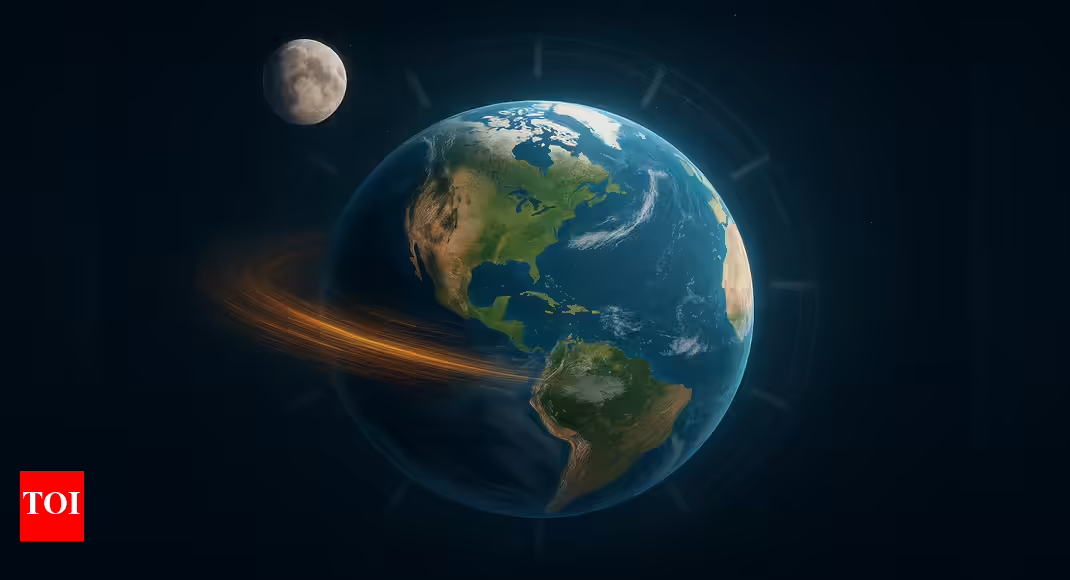
On July 9, 2025, Earth will experience one of its shortest days since 1960, finishing about 1.3 to 1.6 milliseconds early due to the planet's accelerated rotation, influenced by factors like the Moon's orbit and shifts in Earth's mass distribution. This short-term change is part of a series of days in 2025 with slightly faster spins, prompting scientists to monitor future data for potential negative leap seconds to keep atomic time aligned with Earth's rotation. The phenomenon is scientifically significant but poses no practical risk to daily life, aiding in climate modeling and satellite navigation research.
Climate change is affecting the Earth's rotation, potentially delaying the need for a "negative leap second" until 2029, according to a new study. Leap seconds, added to reconcile traditional time with atomic clocks, have caused disruptions in interconnected systems. The Earth's rotation, influenced by factors including climate change, is now gradually getting faster, complicating timekeeping. The potential for a negative leap second poses unprecedented challenges for timekeepers and technology systems, prompting discussions on potential solutions.