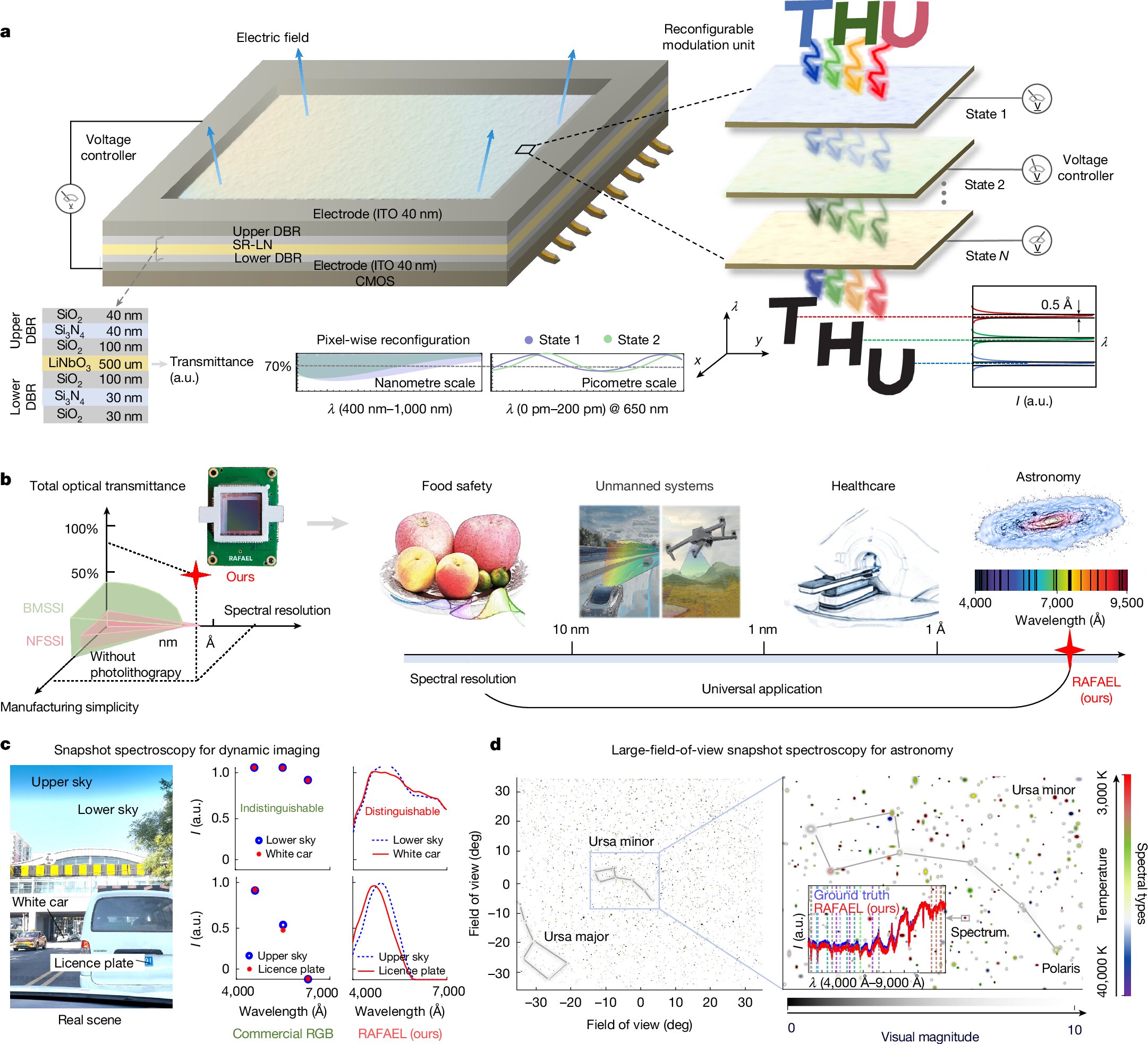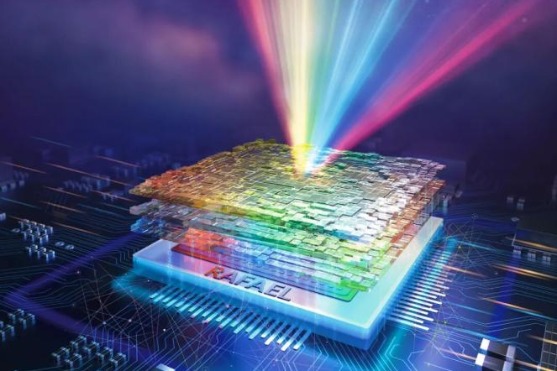
Researchers at Tsinghua University have developed RAFAEL, a tiny, high-efficiency spectroscopic chip that can capture detailed images of space and analyze materials more quickly and accurately than current methods, though it is still in the prototype stage.
A Chinese research team from Tsinghua University has developed RAFAEL, a revolutionary spectroscopic imaging chip that overcomes traditional limitations by providing high-resolution, high-throughput snapshot spectroscopy, enabling more efficient observation of celestial phenomena such as dark matter and black holes.
Researchers at Tsinghua University in China have created a groundbreaking AI chip called "Taichi" that utilizes light instead of electricity for data processing, making it over 1,000 times more energy-efficient than Nvidia's H100 GPU chip and particularly significant in light of export restrictions to China.
Scientists at Tsinghua University have developed Taichi, a light-based artificial intelligence chip that is over 1,000 times more energy efficient than traditional electronic chips and outperforms the high-performance Nvidia H100 GPU. The chip, using photonic integrated circuits, shows promise in artificial general intelligence tasks such as image recognition training and content generation. The research team believes Taichi could pave the way for large-scale photonic computing and advanced artificial general intelligence applications, potentially revolutionizing AI computing with its energy efficiency and high-speed data processing capabilities.
Astronomers have discovered a unique binary star system, TMTS J0526, where a white dwarf orbits a hot subdwarf star, compressing 72 Earth years into a single day. The system, located 2,760 light-years away, features a white dwarf rich in carbon and oxygen and a tiny subdwarf star completing an orbit every 20.5 minutes. This finding may shed light on the formation of such minuscule subdwarf stars and the process of white dwarf formation from sun-sized stars.
A China-led research team has discovered the smallest star ever detected, a hot subdwarf just seven times the size of Earth, along with its larger white dwarf companion, using the Tsinghua University-Ma Huateng Telescope for Survey. The star, TMTS J0526B, and its invisible companion, J0526A, orbit each other every 20 minutes, and their existence supports a theory proposed by Chinese astronomers two decades ago. The finding offers the first direct observational evidence of such a unique binary system, and the researchers expect that the next generation of space-based gravitational wave detectors could detect the system's gravitational waves.
Chinese scientists from Tsinghua University have developed a brain-computer interface (BCI) called SpiralE that can connect to the brain via the inner ear. Unlike other BCIs, SpiralE does not require surgery and can be easily inserted and removed without blocking the wearer's hearing. The technology has the potential to enable applications such as thought-to-text translation, thought-controlled digital objects, and human memory augmentation. However, ethical concerns regarding privacy and human rights need to be addressed before widespread adoption.