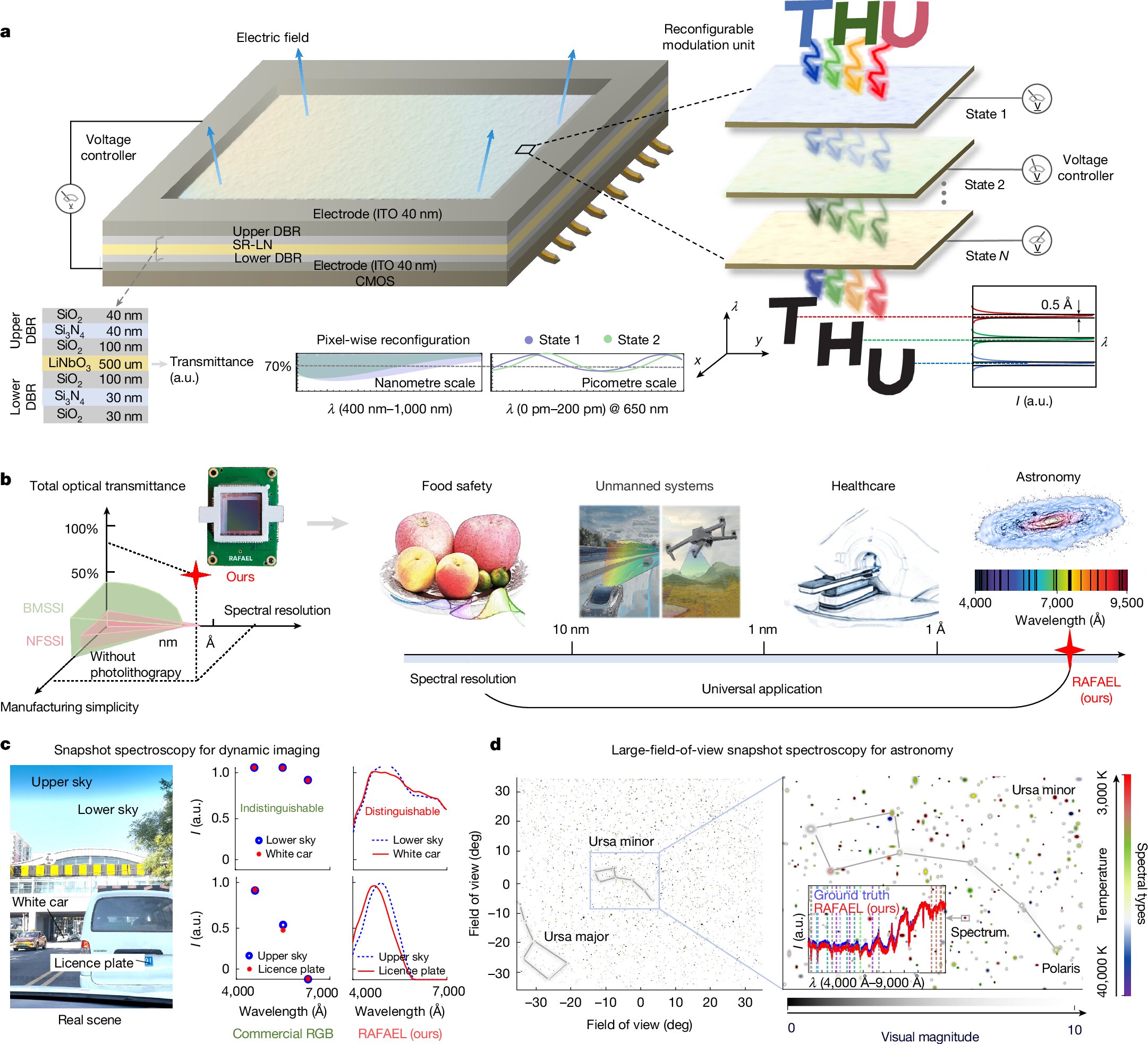
Researchers at Tsinghua University have developed RAFAEL, a tiny, high-efficiency spectroscopic chip that can capture detailed images of space and analyze materials more quickly and accurately than current methods, though it is still in the prototype stage.
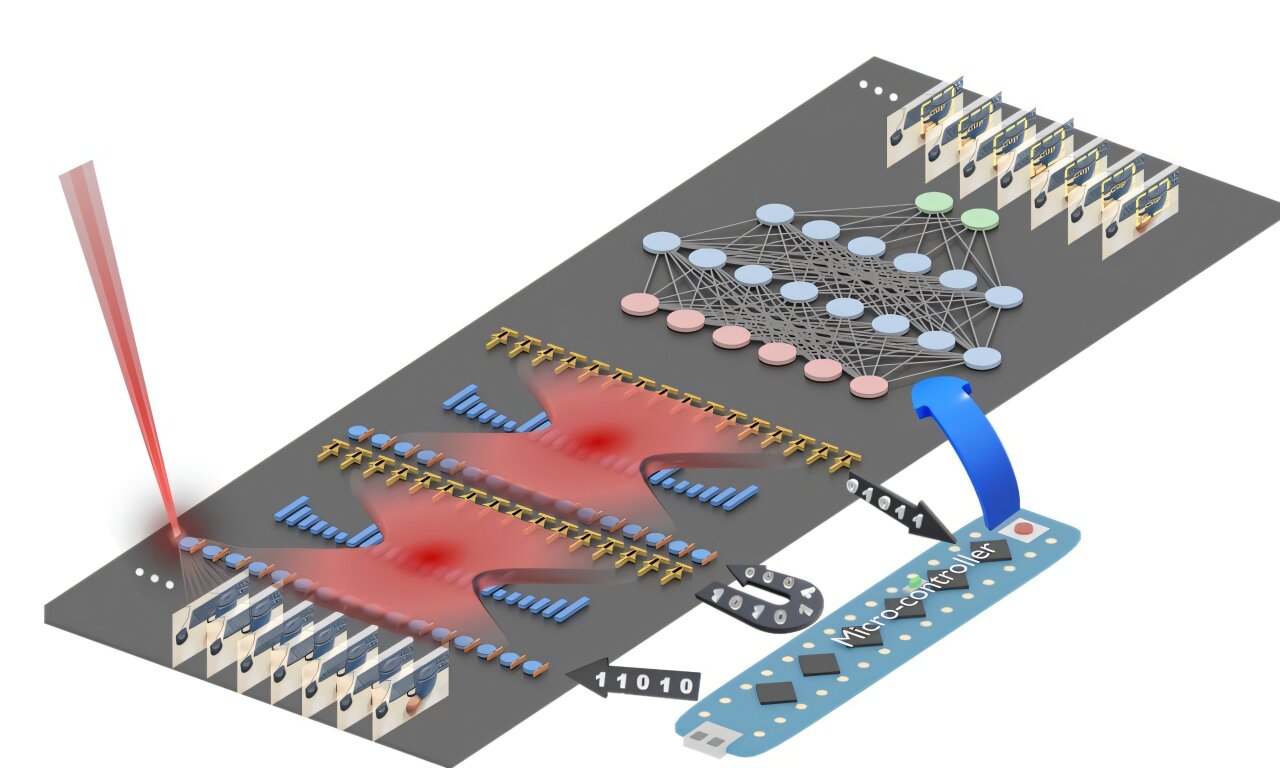
A new light-based AI chip significantly boosts efficiency—by 10 to 100 times—by using integrated lasers and tiny lenses for optical calculations, matching traditional performance while drastically reducing energy consumption, potentially transforming future AI hardware.
Researchers at the University of Florida have developed a silicon photonic chip that uses light to perform AI convolution tasks, achieving up to 100 times greater power efficiency than traditional electronic chips, which could significantly reduce energy consumption in AI systems.
MIT researchers have developed a photonic chip capable of performing deep neural network computations with high energy efficiency and speed, achieving 96% accuracy in training and 92% in inference. This chip, which integrates nonlinear optical function units, represents a significant advancement in AI hardware by maintaining operations in the optical domain, thus reducing energy consumption and latency. The technology, still in its early stages, promises scalable solutions for energy-efficient AI applications.
Columbia Engineering researchers have developed a tiny photonic chip that can produce high-quality, ultra-low-noise microwave signals using only a single laser, representing a significant advancement in optical frequency division. This breakthrough paves the way for compact and stable microwave sources with potential applications in high-speed communication, atomic clocks, and autonomous vehicles. The chip, which is small enough to fit on a pencil point, demonstrates the process of optical frequency division without the need for electronics, simplifying device design and offering new possibilities for future telecommunication devices.
Scientists have successfully integrated nonlinear optical phenomena, specifically "Kerr solitons," into a transmission electron microscope (TEM) using a photonic microresonator chip. These stable, localized pulses of light interacted with a beam of electrons, enabling ultrafast modulation of electron beams and demonstrating the potential for high repetition-rate ultrafast electron microscopy and particle accelerators on a small photonic chip. This breakthrough opens up new possibilities for probing nonlinear optical dynamics at the nanoscale and developing nonlinear photonic devices.
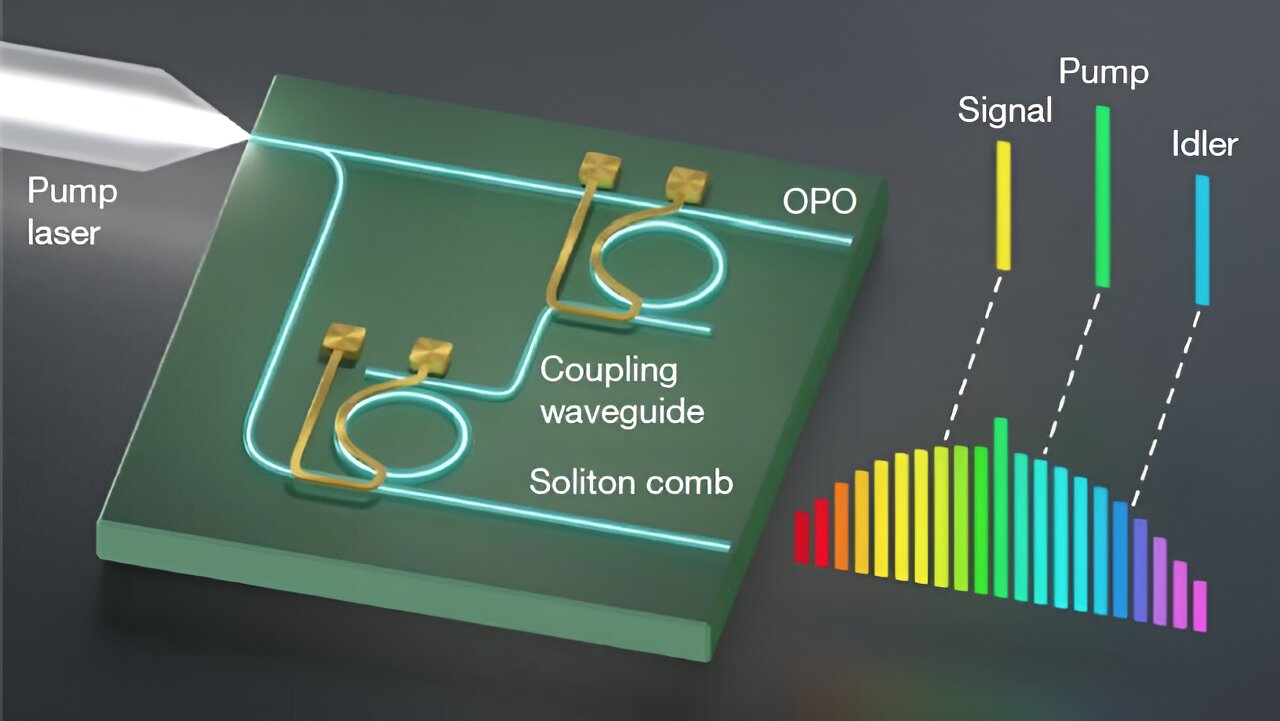
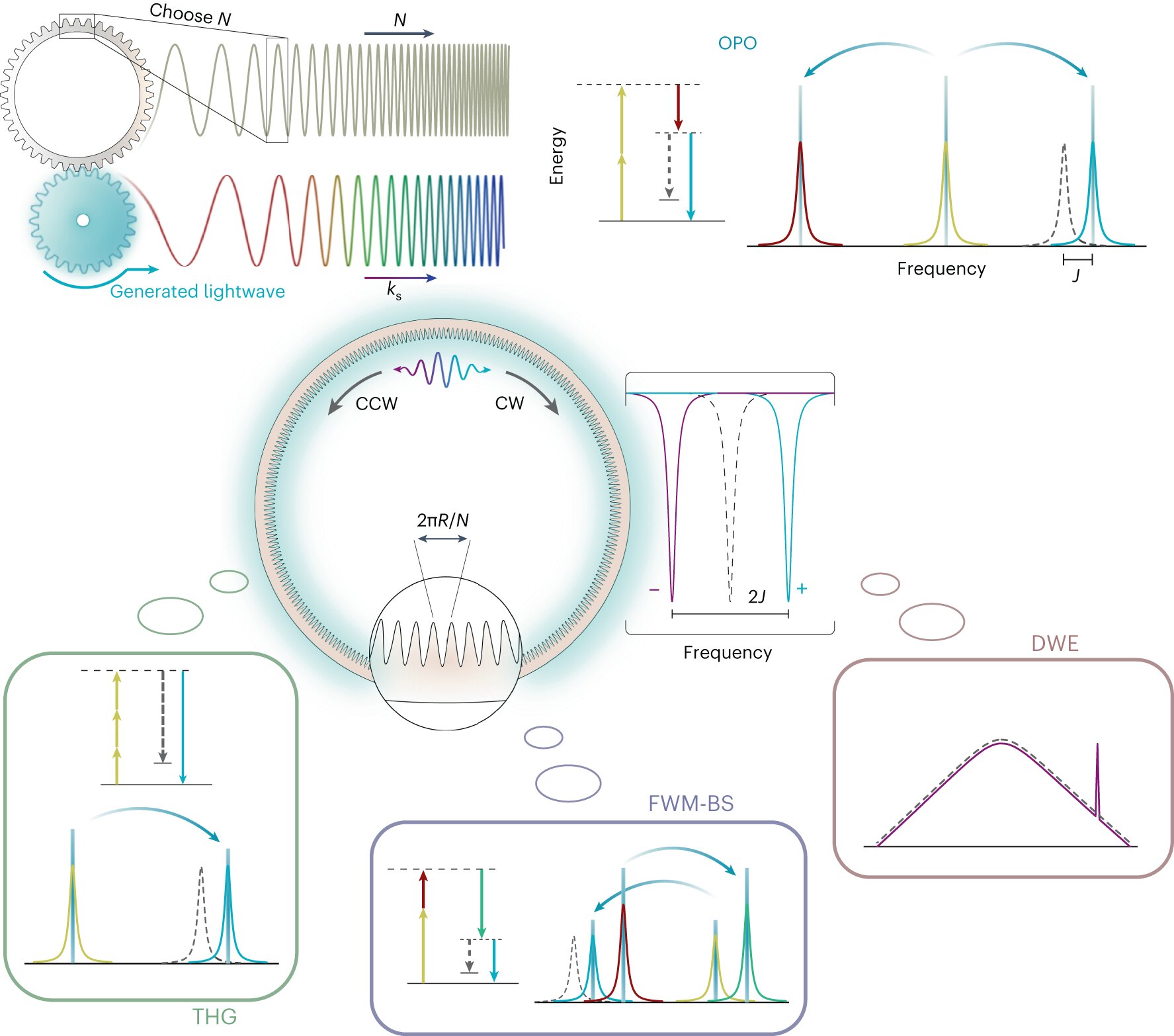
Scientists at the National Institute of Standards and Technology (NIST) and the Joint Quantum Institute (JQI) have developed a technique to convert near-infrared laser light into specific wavelengths of visible light with high accuracy and efficiency. By introducing tiny, periodic bumps along the surface of a microresonator, the researchers can select a specific output wavelength of visible light with an accuracy of 99.7%. This technique has potential applications in precision timekeeping and quantum information science, enabling the deployment of compact devices like photonic chips for quantum sensors and optical atomic clocks.
Researchers at the University of Rochester have developed a chip-scale optical quantum simulation system that allows for quantum simulations in a synthetic space, mimicking the physical world by controlling the frequency of quantum entangled photons. This approach, which differs from traditional photonics-based computing methods, has the potential to enable more complex simulations and computation tasks in the future, making scalable quantum simulations on a photonic chip feasible.