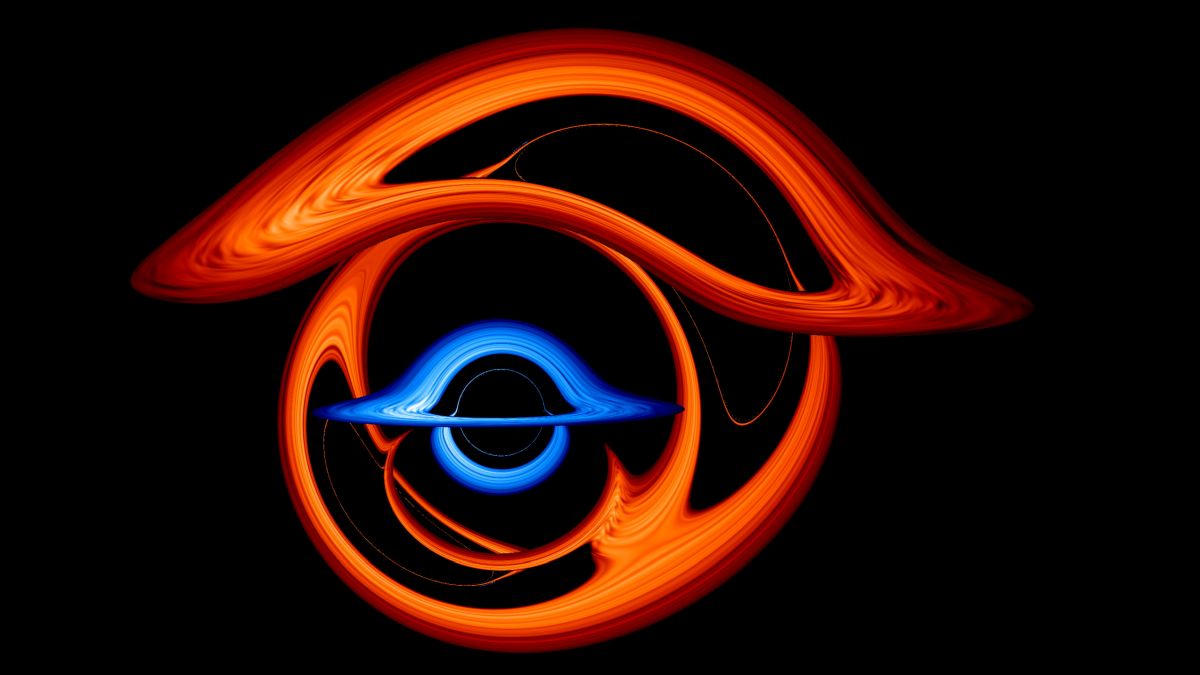
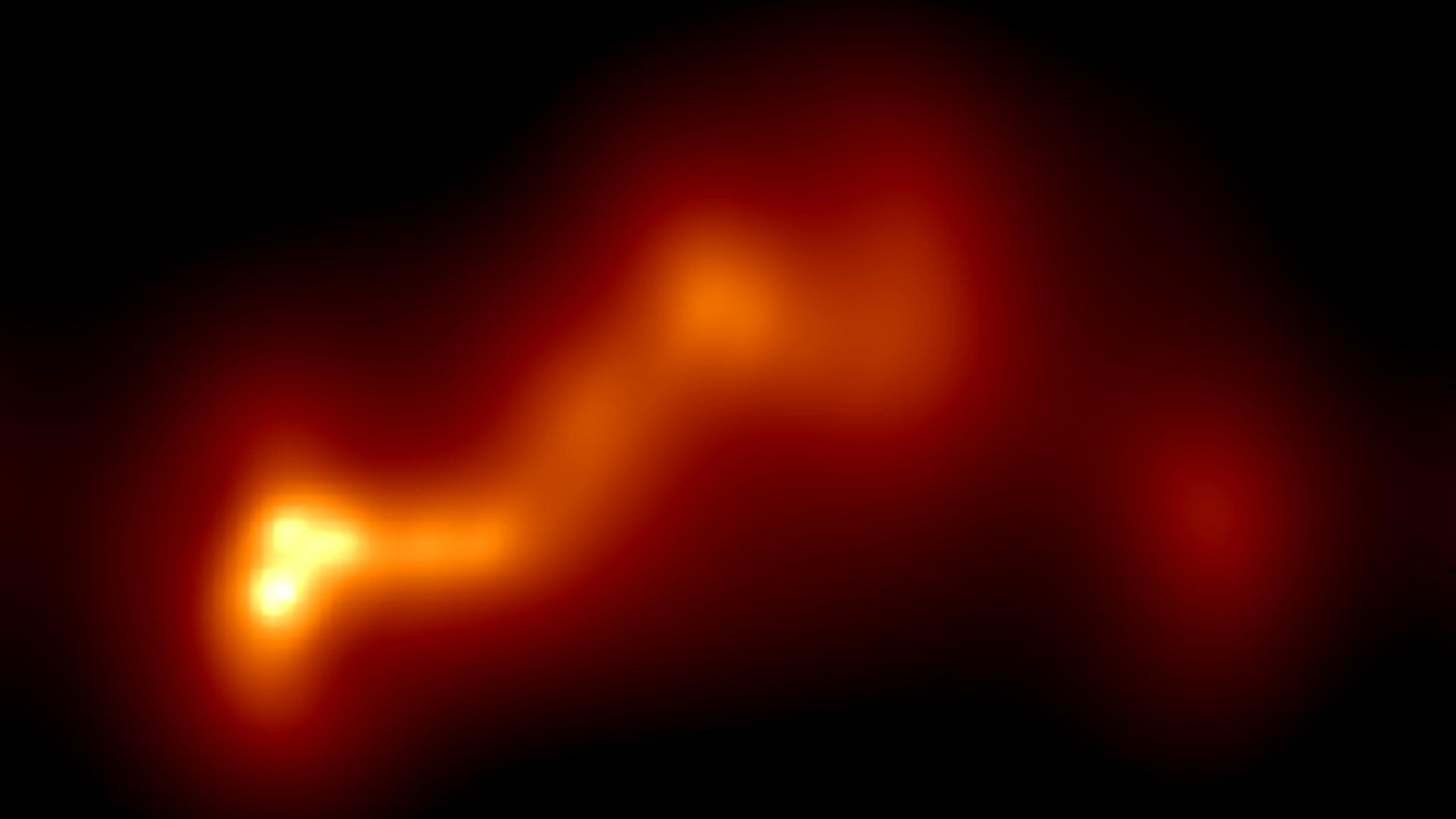
Astronomers have captured the first direct radio image of two supermassive black holes in a binary system within galaxy OJ 287, confirming models of their interaction and jet emissions, with observations suggesting the secondary black hole's jet is moving more slowly and twisting due to its orbit.
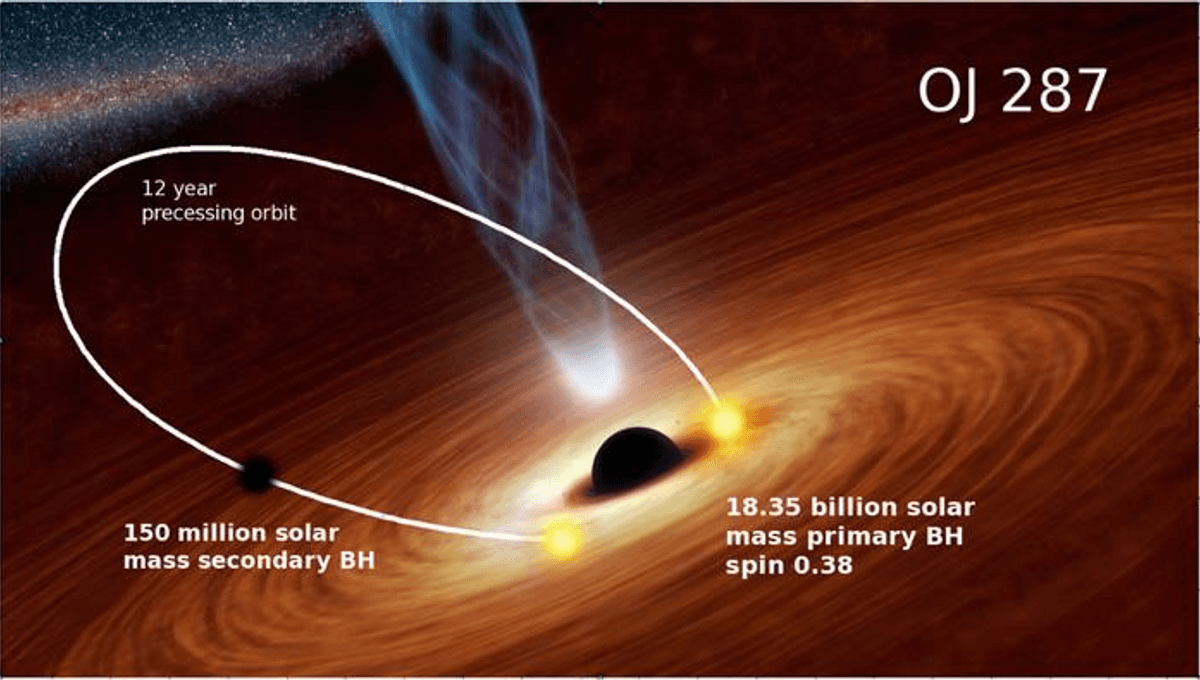
The article discusses the extreme black hole system OJ 287, which is the most massive known binary supermassive black hole system, located about 4 billion light-years away. It highlights how such systems emit gravitational waves, which are challenging to detect due to their long wavelengths, requiring advanced space-based detectors like LISA or pulsar timing arrays. The system's dynamics, including periodic flares caused by the smaller black hole crossing the larger one's accretion disk, are consistent with Einstein's general relativity. In about 10,000 years, these black holes are expected to merge, releasing an enormous amount of gravitational wave energy.
A detailed radio image of the blazar OJ 287 reveals a severely kinked jet, providing strong evidence that it hosts the most extreme binary black hole system known, with gravitational interactions causing the jet's reorientation and offering insights into merging supermassive black holes and gravitational waves.
Astronomers have detected a burst of light from the smaller of two supermassive black holes within the blazar OJ 287, marking the first time the smaller black hole's direct emissions have been observed. The smaller black hole orbits the larger one every 12 years, passing through its accretion disk twice in that period, releasing bursts of light that last about a fortnight. The system is one of the few cases where there are good prospects for detecting gravitational waves from their mutual orbits.