
Newly Discovered Secondary Supermassive Black Holes Challenge Astrophysics Theories
TL;DR Summary
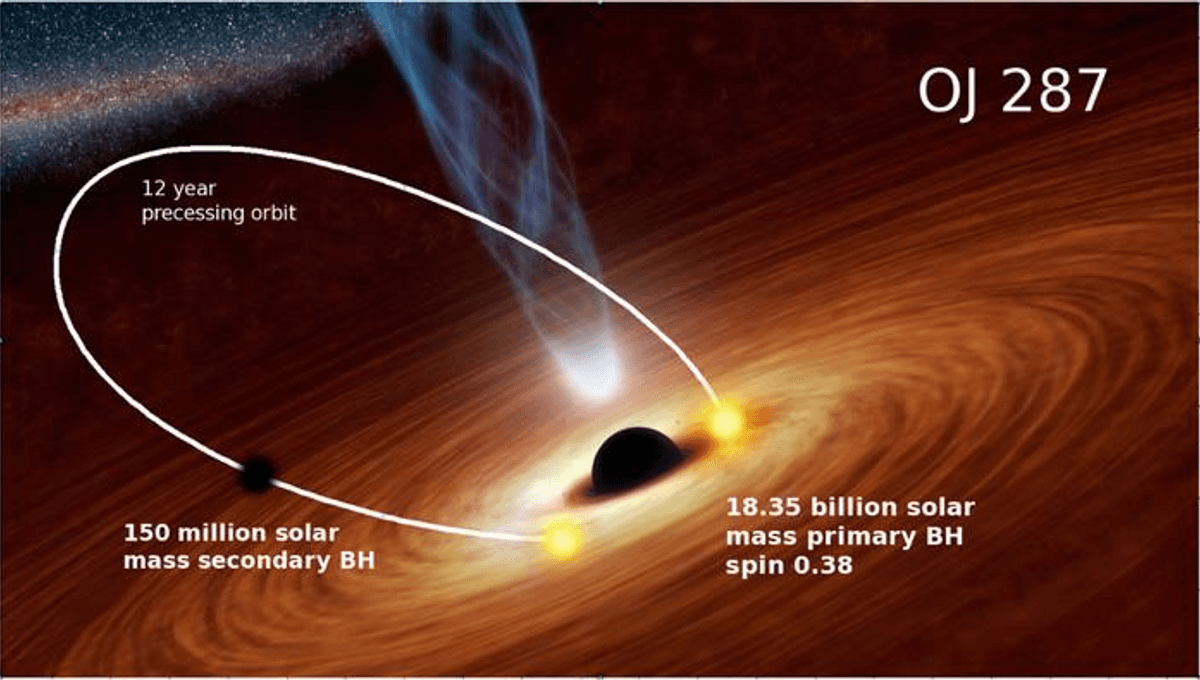
Astronomers have detected a burst of light from the smaller of two supermassive black holes within the blazar OJ 287, marking the first time the smaller black hole's direct emissions have been observed. The smaller black hole orbits the larger one every 12 years, passing through its accretion disk twice in that period, releasing bursts of light that last about a fortnight. The system is one of the few cases where there are good prospects for detecting gravitational waves from their mutual orbits.
Reading Insights
Total Reads
0
Unique Readers
1
Time Saved
3 min
vs 4 min read
Condensed
89%
729 → 83 words
Want the full story? Read the original article
Read on IFLScience