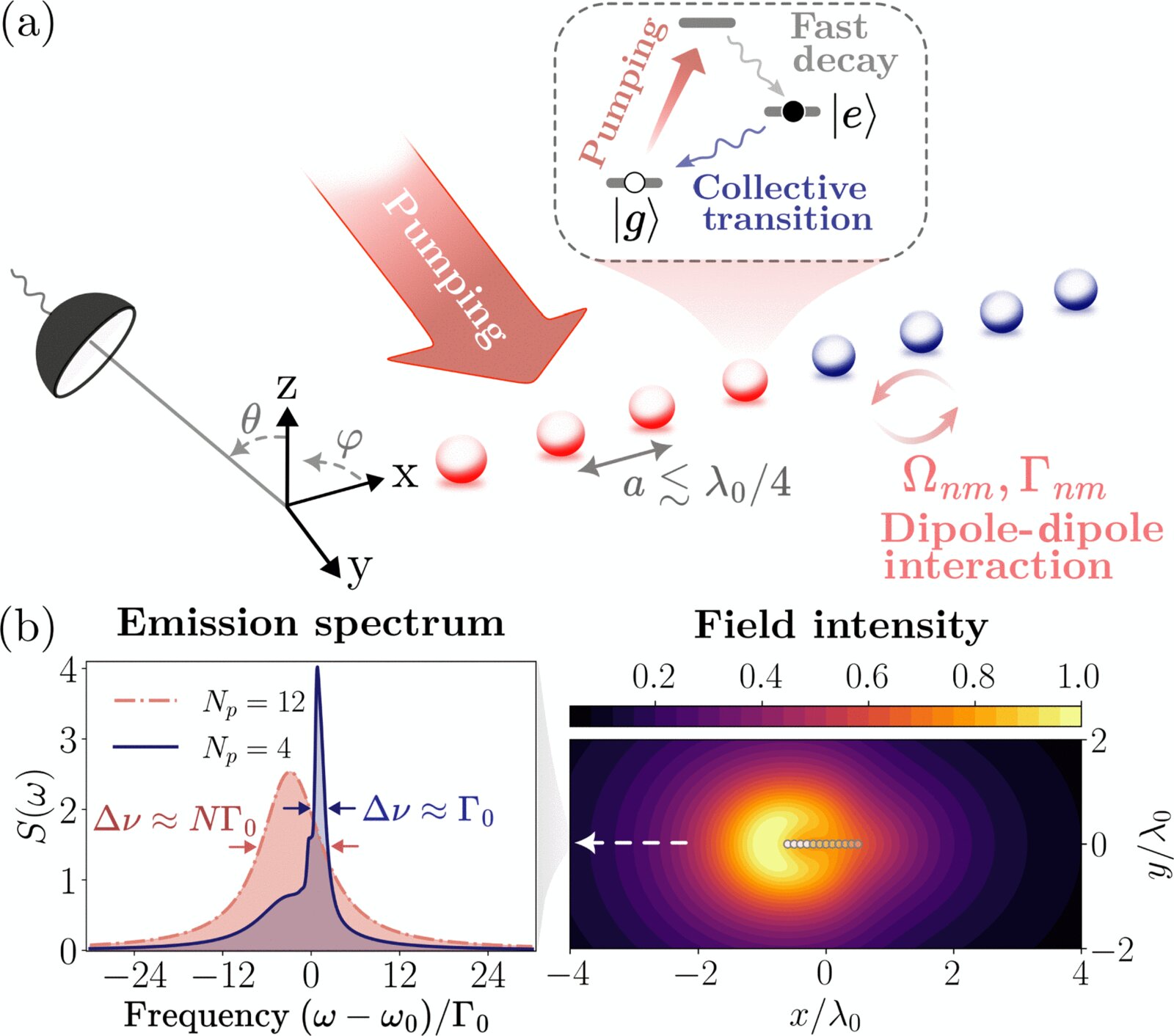
Physicists have proposed a new type of laser that operates without mirrors, using synchronized quantum emitters to produce a narrow, directional light beam, potentially revolutionizing ultra-compact light sources for nanophotonics and quantum sensing.
Scientists at the University of Birmingham have visualized the shape of a photon emitted from a nanoparticle using a novel theoretical model, revealing that a photon's form is shaped by its environment, which could impact future technologies like quantum computing and energy systems.
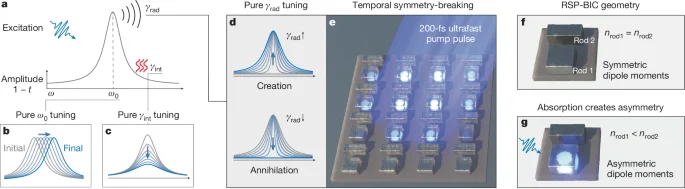
The article reports an experimental demonstration of ultrafast optical control of resonances in symmetry-broken metasurfaces by tuning the radiative loss parameter γrad through selective optical pumping, leveraging restored symmetry-protected bound states in the continuum (RSP-BICs) to achieve dynamic on-off switching of high-Q resonances on subpicosecond timescales, with potential applications in active nanophotonics and ultrafast optical devices.
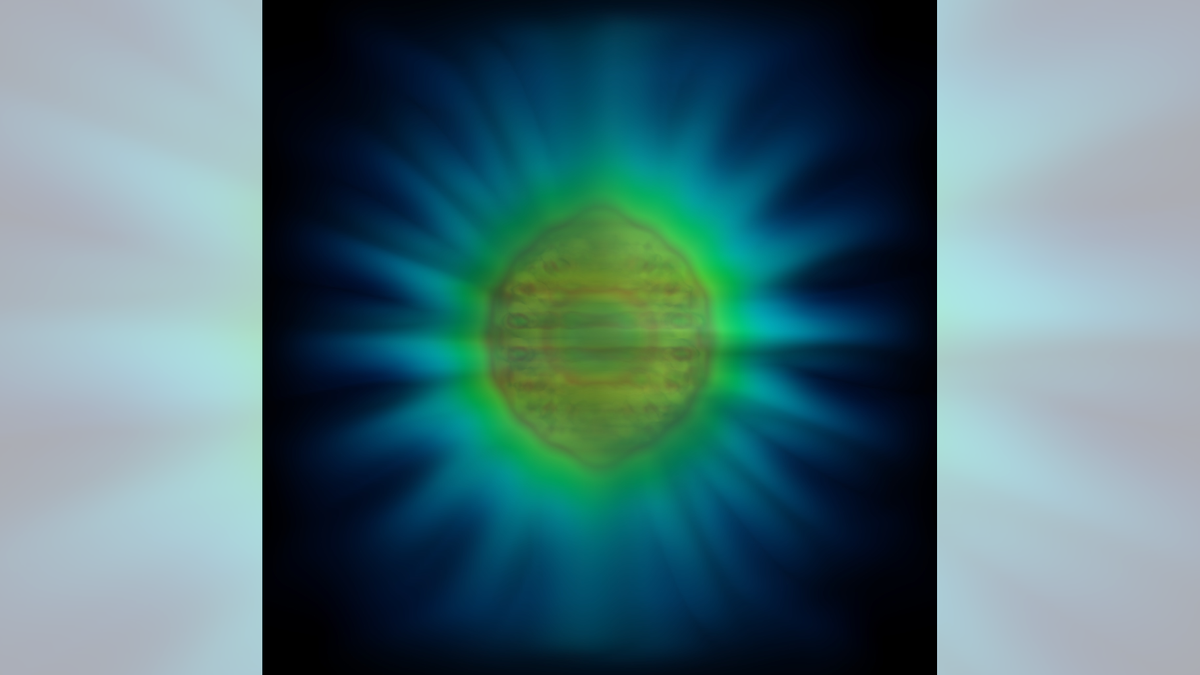
Researchers at the University of Birmingham have captured the first image of an individual photon, revealing it as a lemon-shaped particle. This breakthrough, published in Physical Review Letters, was achieved by simplifying complex equations using imaginary numbers, allowing scientists to model photon properties emitted from nanoparticles. This advancement could significantly impact fields like quantum computing, photovoltaics, and artificial photosynthesis by enhancing our understanding of light-matter interactions at the quantum level.
Researchers at the University of Birmingham have captured the first image of an individual photon, revealing it as a lemon-shaped particle. This breakthrough, published in Physical Review Letters, was achieved by simplifying complex equations using imaginary numbers, allowing scientists to model photon properties emitted from nanoparticles. This advancement could significantly impact fields like quantum computing, photovoltaics, and artificial photosynthesis by enhancing our understanding of light's quantum behavior and its interaction with matter.
Researchers at the University of Birmingham have developed a new quantum theory that defines the precise shape of a single photon for the first time, revealing its interactions with atoms and its environment. This breakthrough, published in Physical Review Letters, could revolutionize nanophotonic technologies, enhancing secure communication, pathogen detection, and molecular control in chemical reactions. The study provides a model for understanding photon behavior and energy exchange, paving the way for advancements in quantum computing and improved sensors.
Researchers at the University of Birmingham have developed a model to define the precise shape of a single photon, revealing how photons are emitted and shaped by their environment. This breakthrough allows for a better understanding of light-matter interactions, opening new possibilities for nanophotonic technologies and applications in secure communication, pathogen detection, and molecular-level chemical control. The study, published in Physical Review Letters, provides a foundation for future advancements in quantum computing and energy technologies.
Researchers at the University of Birmingham have developed a new theory that defines the precise shape of a single photon by exploring its interactions with matter at the quantum level. This breakthrough, published in Physical Review Letters, allows scientists to model these complex interactions and visualize photons, opening new research avenues in quantum physics and material science. The findings could lead to advancements in nanophotonic technologies, impacting secure communication, pathogen detection, and molecular-level chemical reactions.
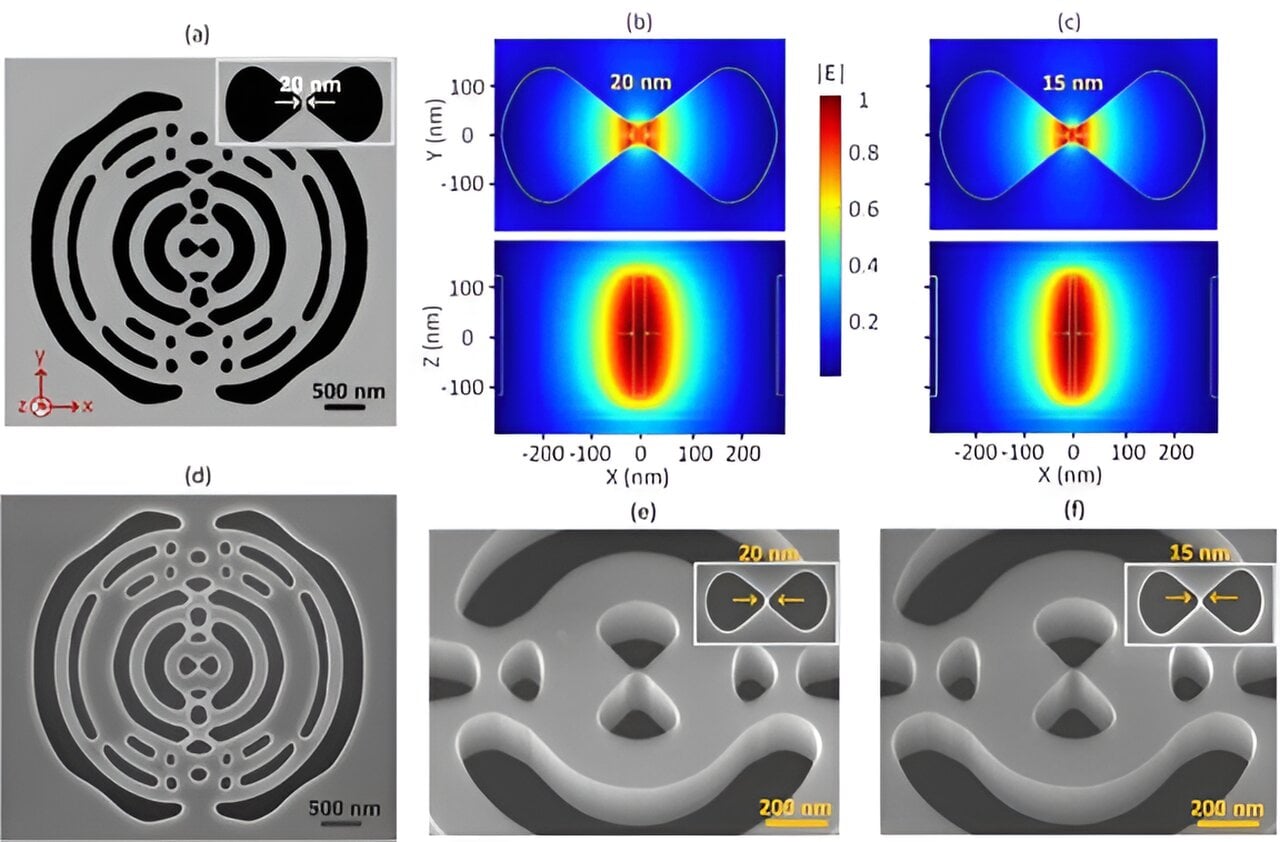
Researchers at the Technical University of Denmark have developed a new III-V semiconductor nanocavity that can confine light at levels below the diffraction limit, demonstrating extreme dielectric confinement (EDC). This achievement could lead to advancements in photonic devices, quantum communication, and sensing, as well as improved energy efficiency in data centers and computers. The nanocavity, fabricated in indium phosphide, exhibits a mode volume an order of magnitude smaller than previously demonstrated in III-V materials, enhancing light-matter interaction and enabling potential applications in various fields, including advanced imaging and environmental monitoring.
Scientists have developed a nanophotonic chip that houses ultrafast mode-locked lasers, which are typically large and expensive. These lasers generate extremely short pulses of light and have various applications in scientific, industrial, and medical fields. The miniaturized version of these lasers can fit on the tip of a fingertip, making them more practical for everyday use.
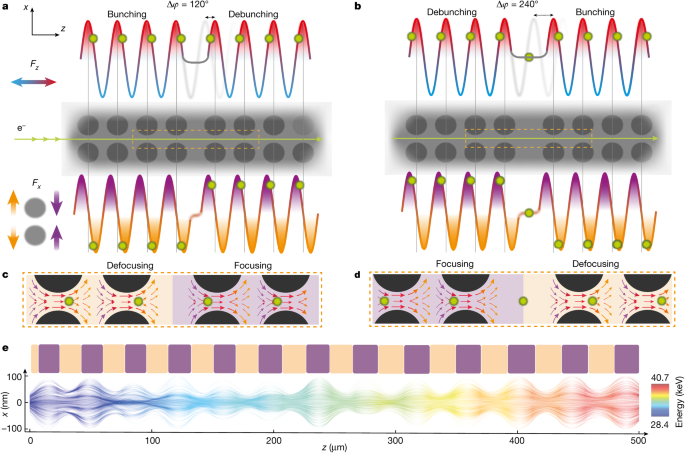
Scientists have successfully fired up the world's smallest particle accelerator, known as a nanophotonic electron accelerator (NEA), which is the size of a small coin. The NEA consists of a microchip with a vacuum tube made up of thousands of pillars, where electrons are accelerated by mini laser beams. In a recent study, researchers from the Friedrich-Alexander University of Erlangen-Nuremberg (FAU) in Germany increased the energy of electrons by 43%. This achievement, along with a similar one by colleagues at Stanford University, paves the way for the development of particle accelerators on microchips, opening up a range of potential applications.
Researchers have developed a nanophotonic electron accelerator that combines particle acceleration and transverse beam confinement, enabling the acceleration and guidance of electrons over a distance of 500 μm in a 225-nm-wide channel. The accelerator achieved a maximum coherent energy gain of 12.3 keV, representing a 43% increase in energy. This breakthrough paves the way for the development of nanophotonic accelerators that offer high acceleration gradients and minimal size requirements, with potential applications in medicine, industry, materials research, and science.
Researchers from Zhejiang University have developed a novel waveguiding scheme that can confine light to subnanometer scales, opening up possibilities for advancements in light-matter interactions and super-resolution nanoscopy. This innovative approach allows for the generation of a confined optical field as small as 0.3 nm with an efficiency of up to 95 percent. The breakthrough extends the boundaries of nano-exploration and has potential applications in areas such as atom/molecule manipulation, ultrasensitive detection, and more.
Researchers from Zhejiang University have developed a waveguiding scheme that enables the confinement of light to subnanometer scales, bringing us closer to the dream of shrinking light down to the size of a water molecule. This novel approach utilizes a coupled-nanowire-pair (CNP) to generate a confined optical field as tiny as 0.3 nm with high efficiency and a high peak-to-background ratio. The scheme extends into the mid-infrared spectral range, offering even more opportunities for exploration and discovery. The potential applications of this breakthrough include advancements in light-matter interactions, super-resolution nanoscopy, atom/molecule manipulation, and ultrasensitive detection.
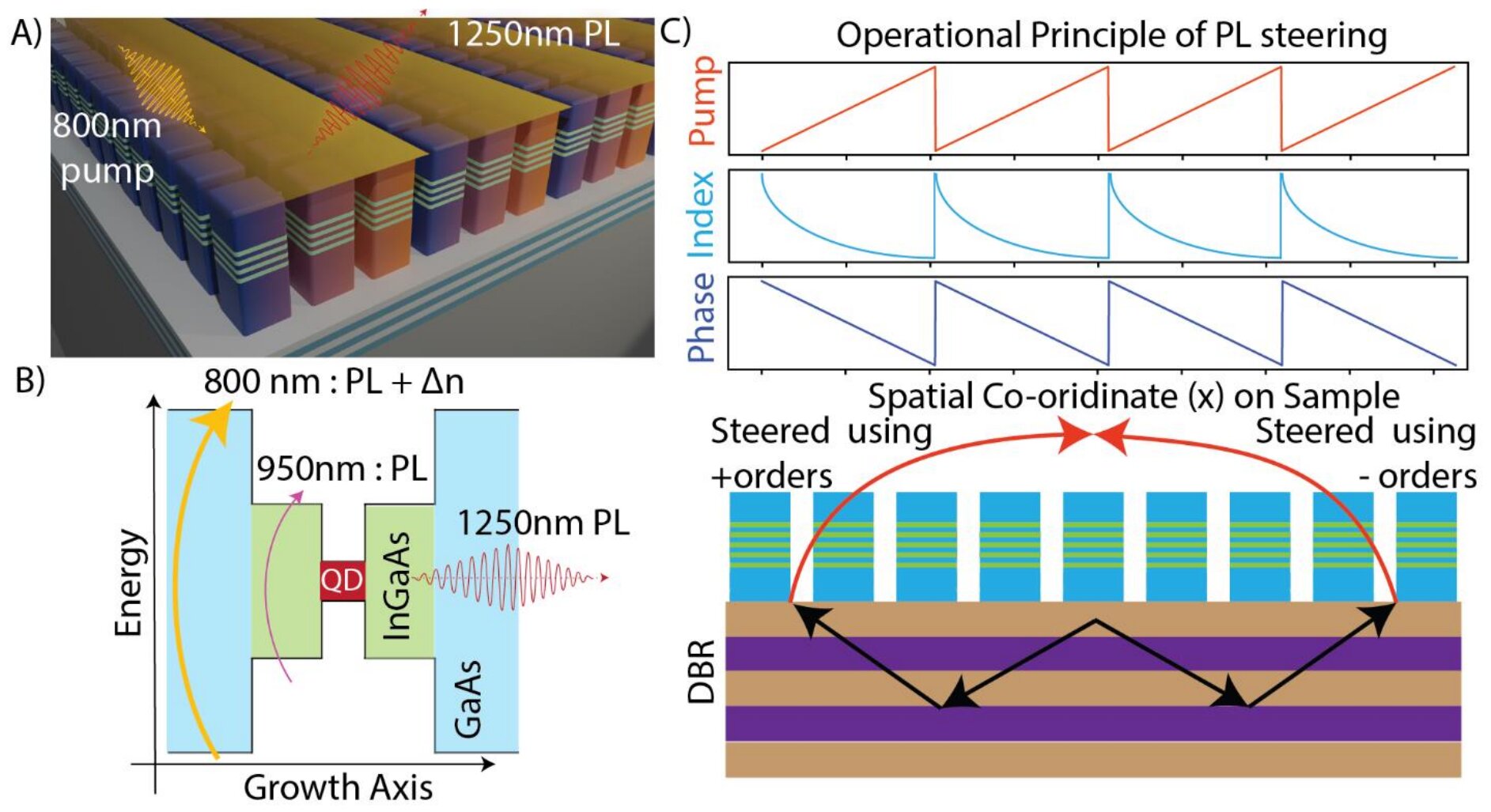
Researchers at Sandia National Laboratories have demonstrated the ability to dynamically steer light pulses from incoherent light sources using artificially structured materials called metasurfaces, made from tiny building blocks of semiconductors called meta-atoms that can be designed to reflect light very efficiently. This breakthrough could allow low-power, relatively inexpensive sources like LEDs or flashlight bulbs to replace more powerful laser beams in new technologies such as holograms, remote sensing, self-driving cars, and high-speed communication.