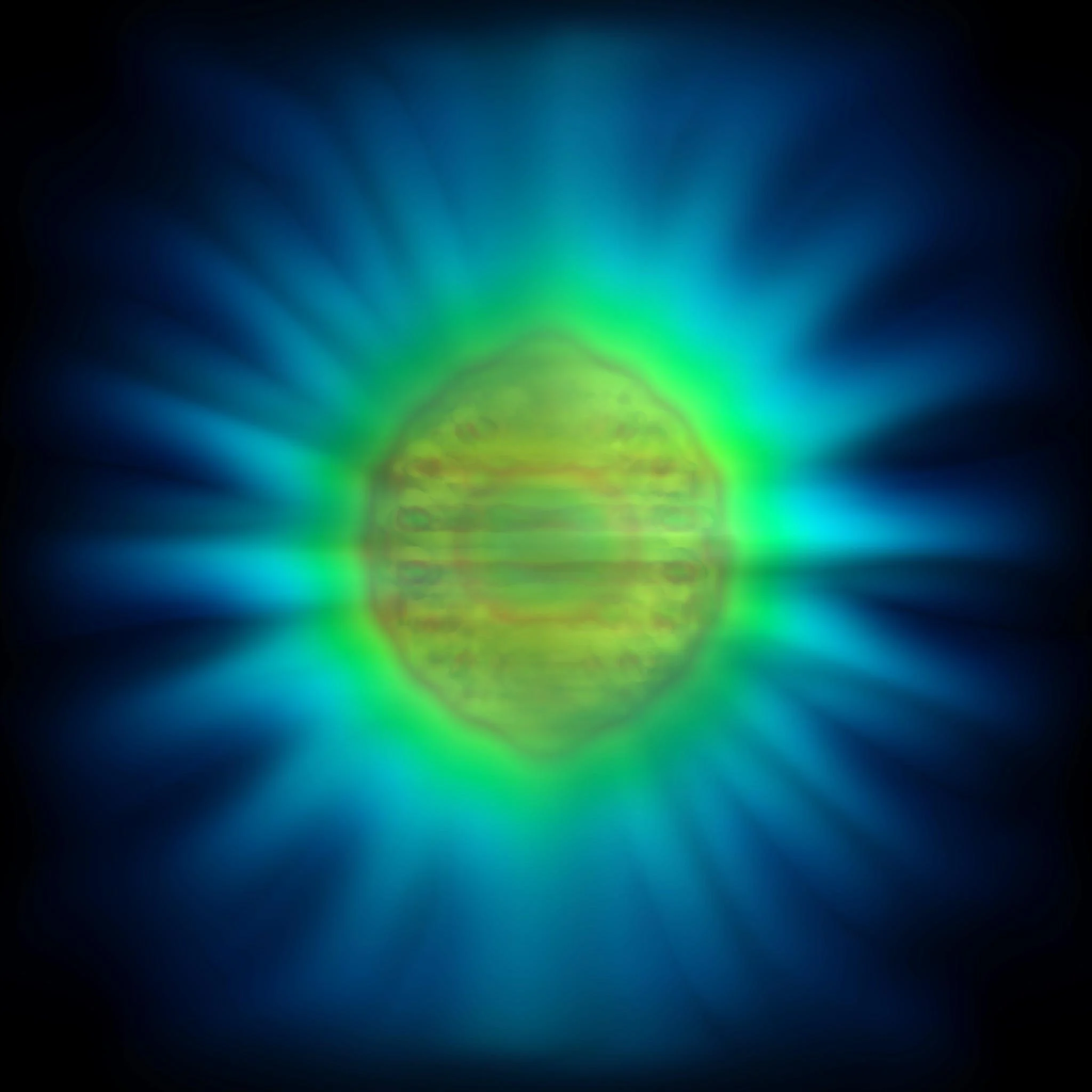
Physicists in the UK have developed a new model that provides a detailed quantum description of the interaction between light and matter, inadvertently revealing the shape of a photon. This breakthrough, published in Physical Review Letters, offers unprecedented insights into the photon's dual nature and its non-Markovian dynamics, which could enhance future technologies like sensors, photovoltaic cells, and quantum computing.

Researchers led by Dr. Benjamin Yuen at the University of Birmingham have defined the precise shape of a single photon for the first time, marking a significant advancement in quantum physics. Published in Physical Review Letters, the study provides a visual representation of a photon and enhances understanding of photon emission and interaction with the environment. This breakthrough could revolutionize nanophotonic technologies, impacting fields like secure communication, pathogen detection, and quantum computing by enabling engineered light-matter interactions.
Scientists have developed a method to predict the shape of individual photons, the smallest units of light, by modeling their interactions with atoms and their environment. This breakthrough, published in Physical Review Letters, uses classical mechanics to simplify the complex wave-particle duality of photons, allowing for a better understanding of how light behaves in both near and far electromagnetic fields. This advancement could significantly impact the development of nano-optic technology, quantum computing, and photovoltaic energy cells.
Researchers at the University of Birmingham have developed a new quantum theory that defines the precise shape of a single photon for the first time, revealing its interactions with atoms and its environment. This breakthrough, published in Physical Review Letters, could revolutionize nanophotonic technologies, enhancing secure communication, pathogen detection, and molecular control in chemical reactions. The study provides a model for understanding photon behavior and energy exchange, paving the way for advancements in quantum computing and improved sensors.