
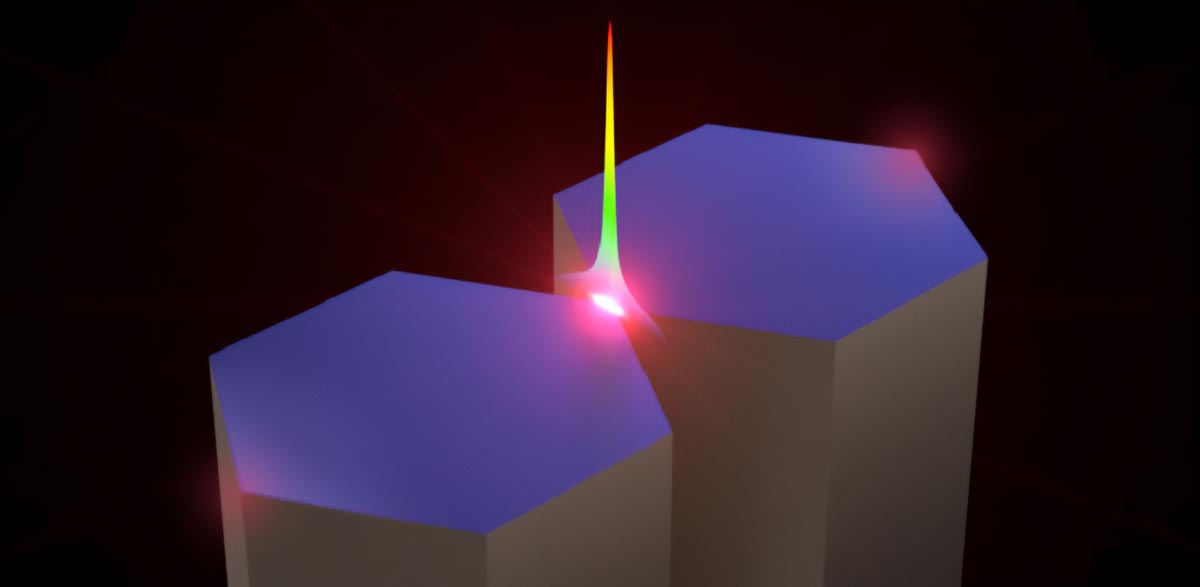
Researchers from Zhejiang University have developed a novel waveguiding scheme that can confine light to subnanometer scales, opening up possibilities for advancements in light-matter interactions and super-resolution nanoscopy. This innovative approach allows for the generation of a confined optical field as small as 0.3 nm with an efficiency of up to 95 percent. The breakthrough extends the boundaries of nano-exploration and has potential applications in areas such as atom/molecule manipulation, ultrasensitive detection, and more.
Researchers from Zhejiang University have developed a waveguiding scheme that enables the confinement of light to subnanometer scales, bringing us closer to the dream of shrinking light down to the size of a water molecule. This novel approach utilizes a coupled-nanowire-pair (CNP) to generate a confined optical field as tiny as 0.3 nm with high efficiency and a high peak-to-background ratio. The scheme extends into the mid-infrared spectral range, offering even more opportunities for exploration and discovery. The potential applications of this breakthrough include advancements in light-matter interactions, super-resolution nanoscopy, atom/molecule manipulation, and ultrasensitive detection.