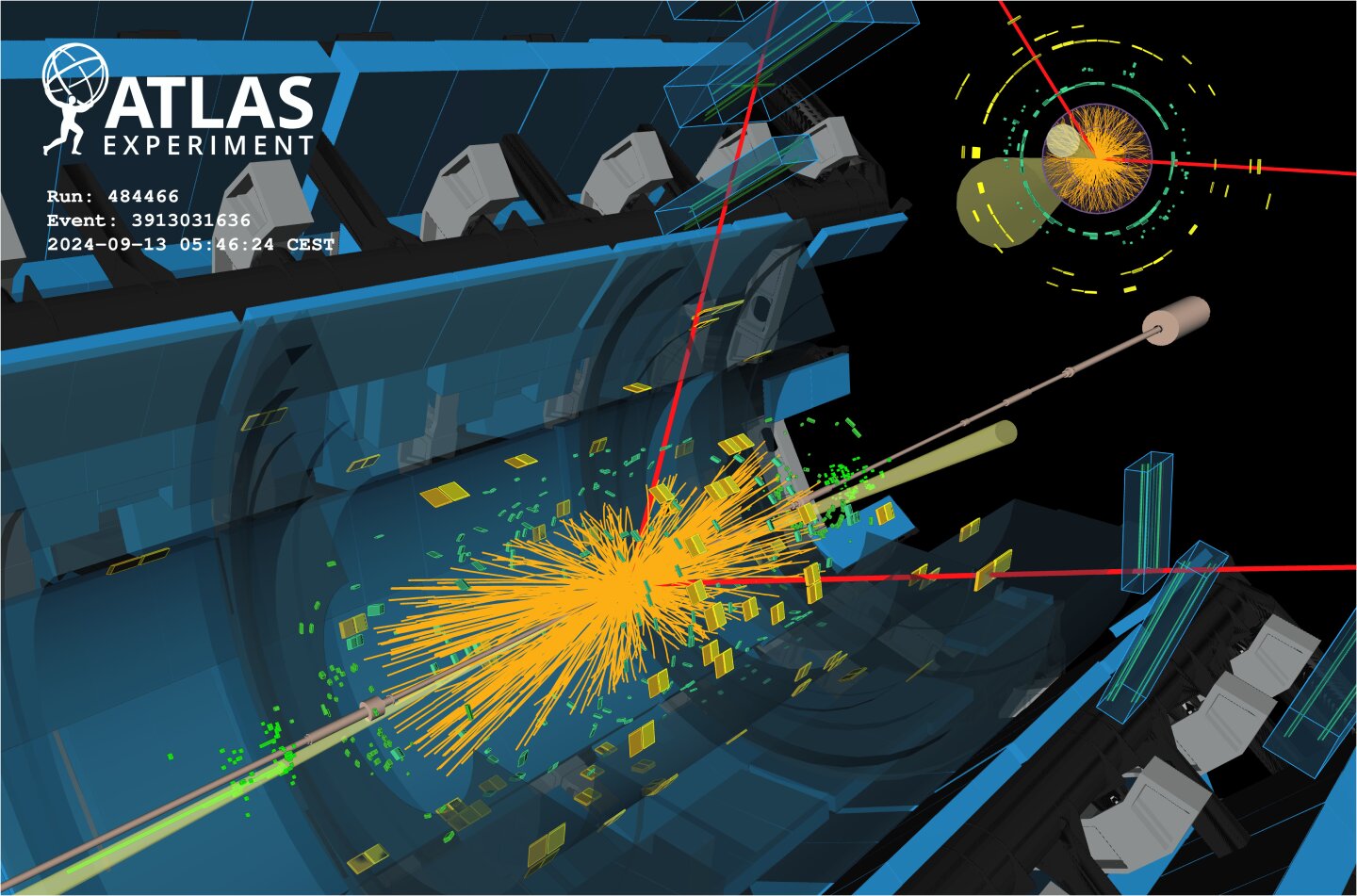
The ATLAS collaboration has found evidence of rare Higgs boson decays into muons and Z boson plus photon, enhancing understanding of Higgs interactions and potential new physics beyond the Standard Model, through combined data analysis from LHC Run 2 and 3.
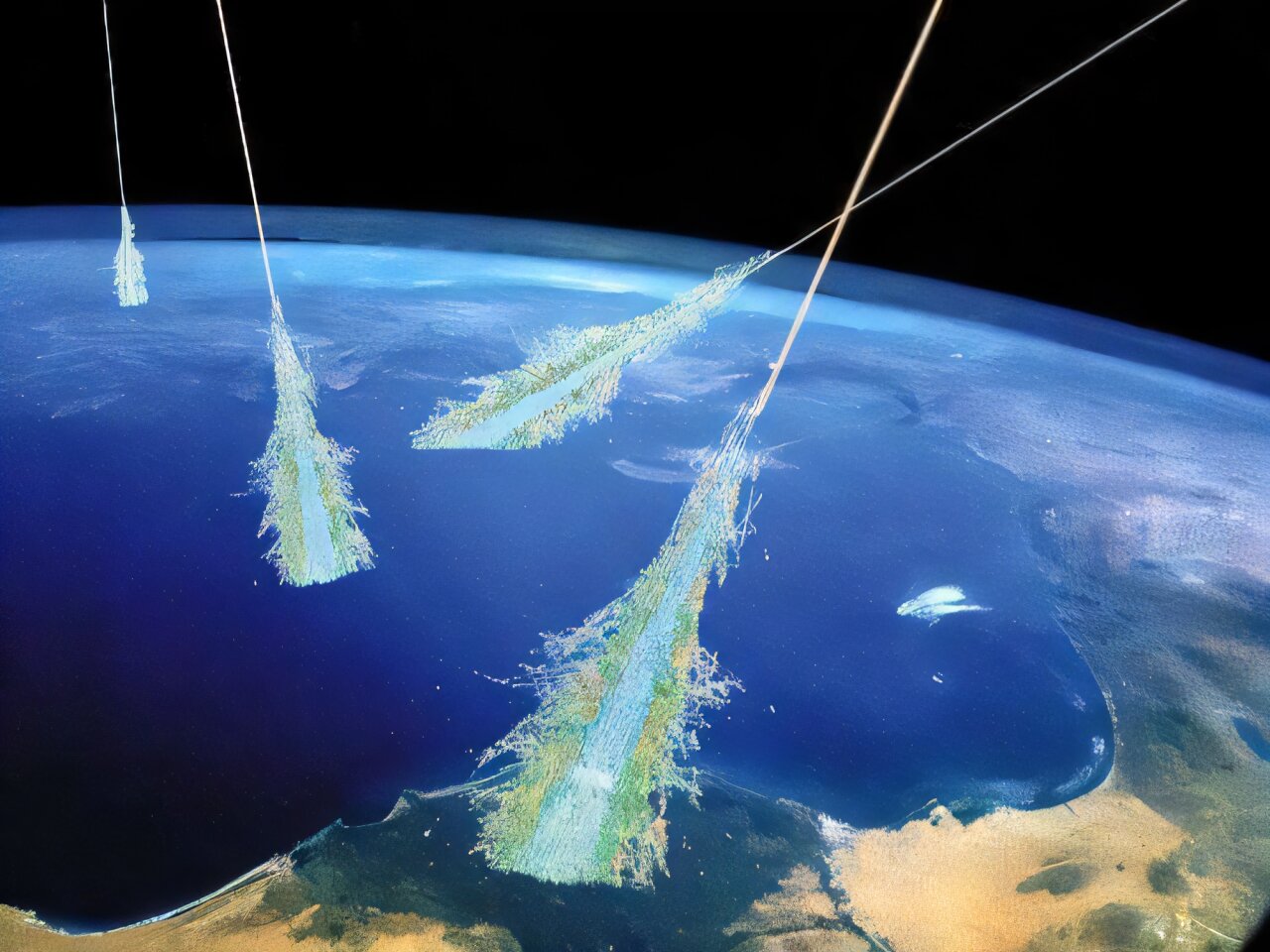
Researchers have proposed that gluon condensation during the initial collision of cosmic rays with atmospheric nuclei could explain the excess muons observed at Earth's surface. This theory suggests that gluon condensates enhance the production of strange quarks, leading to more muons than predicted by standard physics models. The findings, published in The Astrophysical Journal, offer a potential solution to the longstanding muon puzzle in cosmic ray physics.
Researchers at the Fermi National Accelerator Lab have measured the magnetic wobble of muons with unprecedented precision, potentially challenging the Standard Model of particle physics and suggesting the existence of a new dimension or a fifth force of nature. The results could indicate the presence of a new exotic particle or support the theory of supersymmetry. Further experiments and data analysis are needed to confirm these findings and determine the implications for our understanding of the universe.
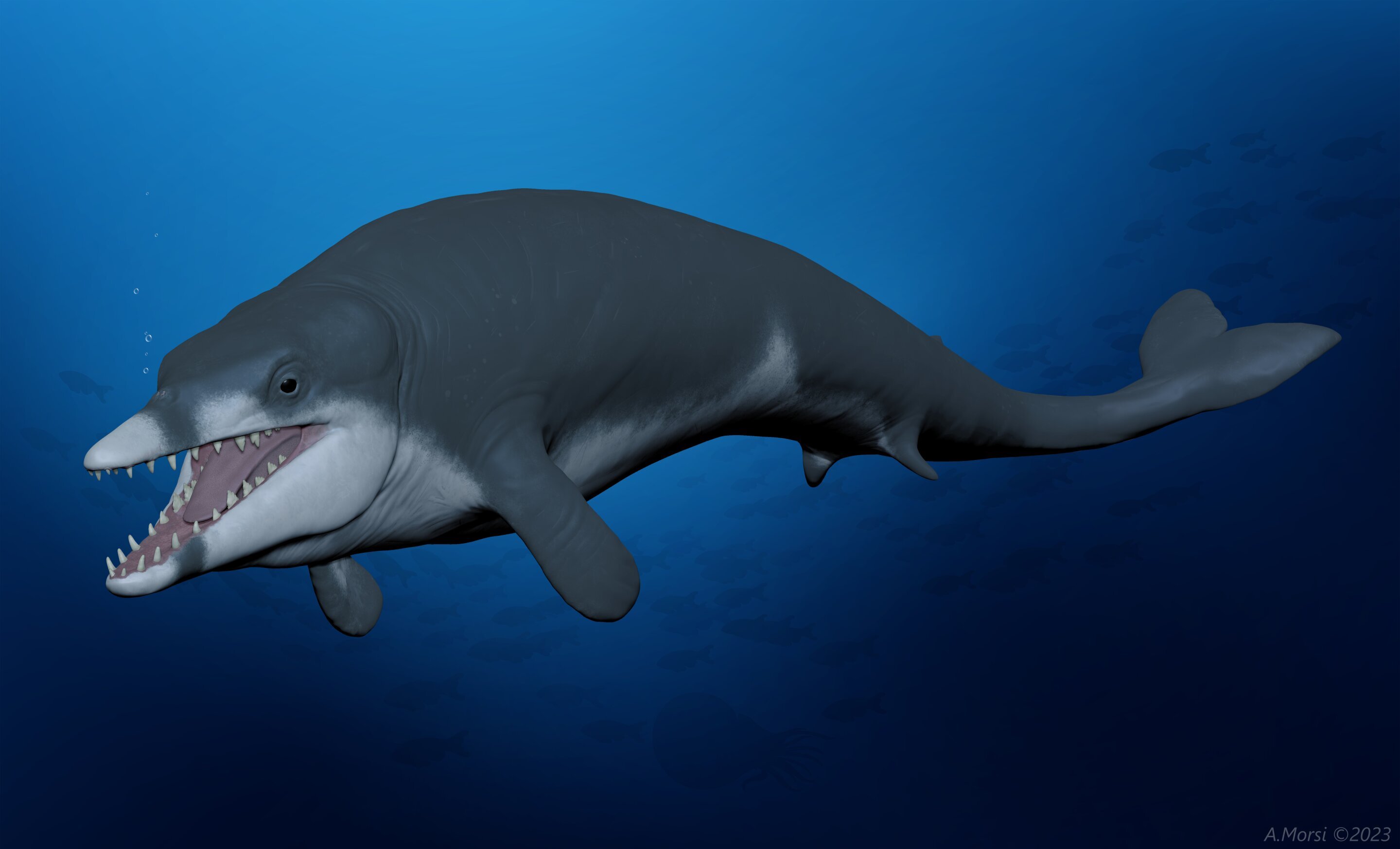
Physicists have conducted precision measurements of the muon anomalous magnetic moment, contributing to the ongoing search for particles beyond the standard model. A new species of extinct whale, Tutcetus ratanesis, has been discovered in the ancient Tethys Ocean, shedding light on early whale evolution. Researchers have refuted claims of an apocalypse caused by an exploding comet that destroyed the Indigenous Hopewell culture 1,500 years ago, citing a lack of evidence. A study suggests that a massive North Atlantic cooling event coincided with the presence of Homo erectus in western Europe, making the region inhospitable for human habitation. Scientists have identified titanic waves of plasma as the cause of extreme brightness swings in a heartbeat binary star system.
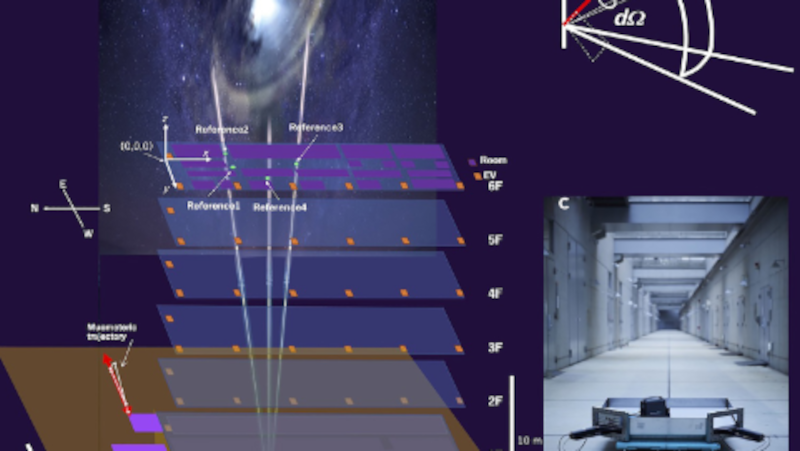
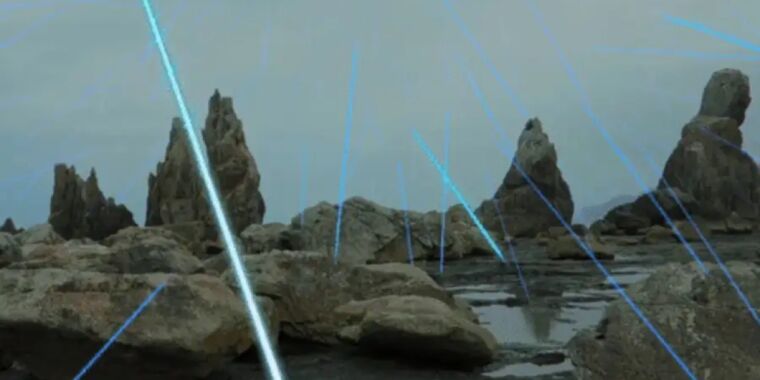
Japanese researchers are developing a new navigation system called MUWNS that uses cosmic ray muons to create high-precision navigation systems that can penetrate buildings. The reference points detect cosmic rays and relay information to receivers, allowing for very precise navigation. Muons penetrate deeper than other particles due to their greater mass, and even a Raspberry Pi can detect them.
Scientists at the University of Tokyo have developed a new kind of GPS called the muometric positioning system (muPS) that uses muons, sub-atomic particles created by cosmic ray collisions, to navigate underground, indoors, and underwater. The muPS works by using muon-detecting sensors as reference points instead of satellites in low-Earth orbit. The current accuracy of the muPS is between 2 meters and 25 meters, with a range of up to 100 meters, but researchers hope to improve accuracy through the use of chip-scale atomic clocks.
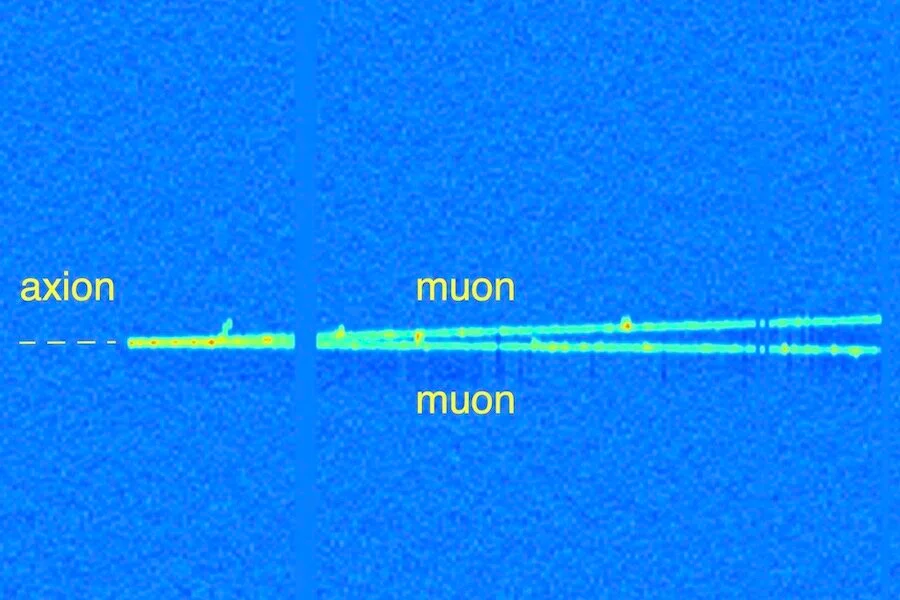
Theoretical physicists from the University of Minnesota have proposed a new method to detect axions, hypothetical particles that could solve the “Strong CP Problem” in physics. The strategy involves tracing the decay of axions into two muons, opening new possibilities in particle collider experiments. The researchers believe they have a chance to locate the axion and prove its existence by measuring the “decay” product of the hypothetical axion into two muons.
Japanese researchers have developed a wireless navigation system that relies on cosmic rays, or muons, instead of radio waves, which could be used to guide underwater robots or underground autonomous vehicles. The Muographic positioning system (muPS) works underground, indoors, and underwater, and relies on four muon-detecting reference stations above ground serving as coordinates for the muon-detecting receivers, which are deployed either underground or underwater. The system has been successfully tested, but further development is needed to improve accuracy and time synchronization.
Scientists have developed a new kind of GPS called the muometric positioning system (muPS) that works underground, indoors, and underwater. The system uses cosmic ray muons to calculate an individual's position in a building's basement, where satellite global positioning systems don't work. Muons are subatomic particles created when cosmic rays from sources like distant supernovae or the Sun collide with particles in Earth's atmosphere, and they can penetrate deep underground. The muPS system has been wired, but the team has now taken the system wireless. The current accuracy of the muometric wireless navigation system (MuWNS) is between 2 meters and 25 meters, with a range of up to 100 meters, depending on the depth and speed of the person walking.
University of Minnesota researchers have developed a new method to search for axions, hypothetical particles that could help solve the Strong CP Problem in physics. The method involves measuring the decay of the axion into two muons, which has not been used before in neutrino or collider experiments. The researchers believe that by working backward from the muon tracks in the detector to reconstruct such decays, they have a chance to locate the axion and prove its existence. The discovery of axions could be a significant advance in our fundamental understanding of the structure of nature.
A group of programmers create a simulated universe with increasingly complex physics packages, leading to the creation of intelligent life and the discovery of relativity. However, the addition of more particles and symmetry slows down the simulation, causing the programmers to draw the line and refuse to add any more complexity. The story explores the idea of the simulation hypothesis and the role of physics in a simulated universe.