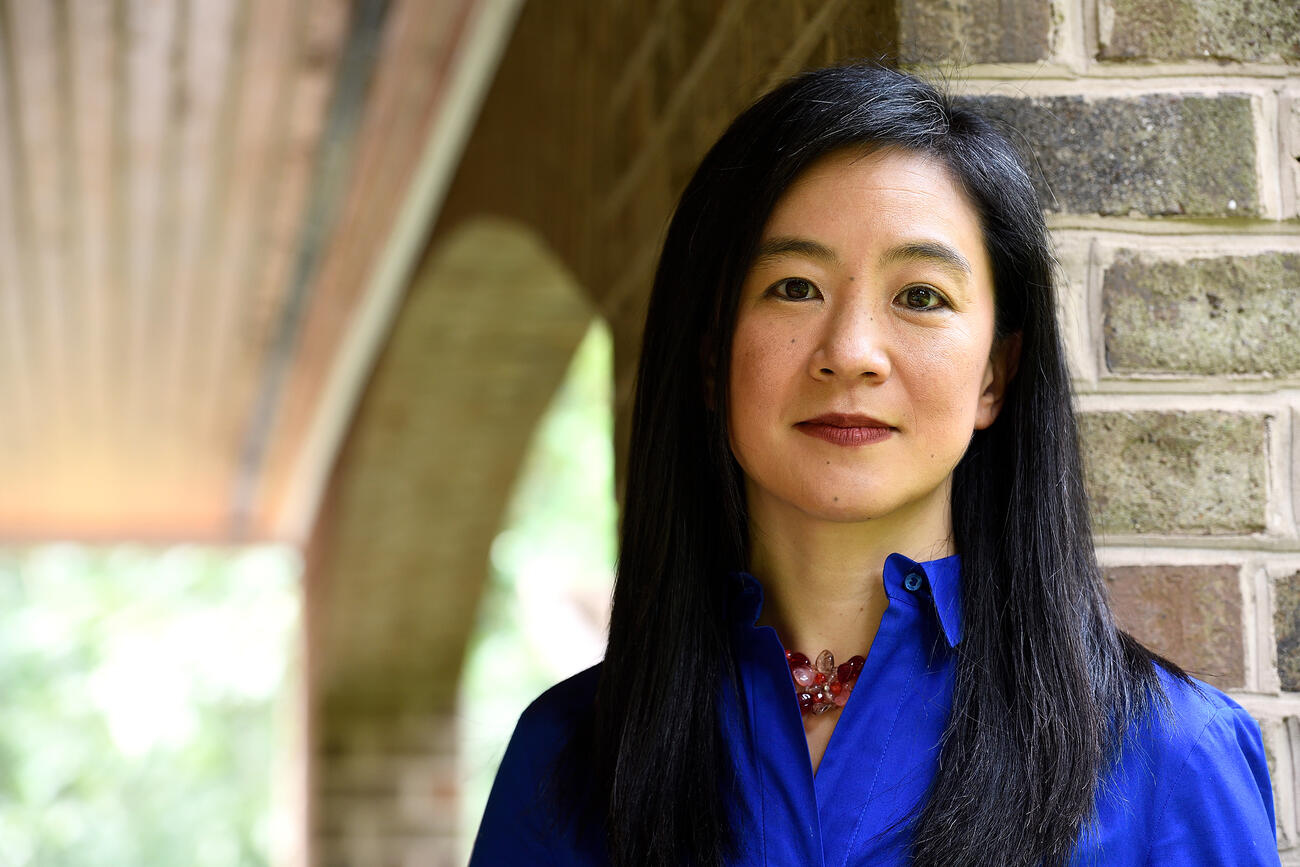
Hahrie Han, a Johns Hopkins political scientist and director of the SNF Agora Institute, received the prestigious 2025 MacArthur Genius Grant for her work on political organizing and democracy, marking her as the first Hopkins faculty member to earn this honor since 2008.
A study by Johns Hopkins University researchers reveals that people struggle to judge the strength of knots, highlighting a potential "blind spot" in our physical reasoning. Despite knots being a common part of daily life, participants in the study failed to accurately assess knot strength, even with visual aids. The research suggests that understanding soft objects like string or rope may be more challenging than solid ones, and that expertise in knot-tying, such as that of sailors or mountaineers, might improve judgment.
A study by Johns Hopkins University reveals that people struggle to visually assess the strength of knots, despite their familiarity with them. Participants consistently failed to identify the strongest knot among similar ones, even when shown videos or diagrams. This suggests a blind spot in our intuitive physical reasoning, as we cannot easily discern the internal structure of non-rigid objects like knots. The research highlights the complexity of understanding knot strength and suggests that expertise, such as that of sailors, might improve performance.
A study by Johns Hopkins University reveals that despite our familiarity with knots, most people struggle to visually determine the strength of different knots. Participants consistently failed to identify the strongest knot, even when shown videos or diagrams. This suggests a blind spot in our physical reasoning, as we cannot intuitively assess the internal structure of non-rigid objects like knots. The research highlights the complexity of intuitive physics and our limitations in understanding the physical properties of certain objects.
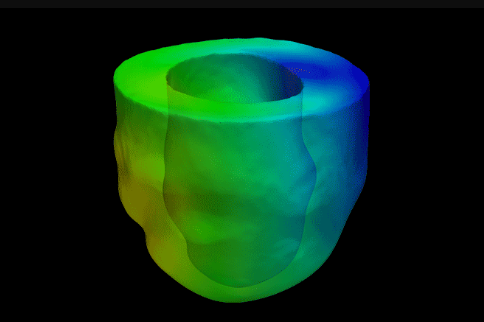
Researchers at Johns Hopkins University have developed a new AI framework called DIMON that can solve complex engineering problems, such as modeling car crashes or predicting heart arrhythmias, much faster than traditional methods. This AI can handle partial differential equations across various shapes without recalculating grids, significantly speeding up simulations and optimizing designs. The technology promises to revolutionize fields like engineering and medicine by enabling personal computers to perform tasks that typically require supercomputers.
Roland Griffiths, a renowned psychedelics researcher at Johns Hopkins University, conducted rigorous studies on the potential therapeutic effects of psilocybin, found in magic mushrooms, for treating anxiety, depression, addiction, and the fear of death. While known for his analytical approach and agnostic beliefs, Griffiths also saw psychedelics as crucial for humanity's survival and admitted to using them himself. However, a former colleague has criticized his research methods, likening them to a "new-age retreat center," raising questions about the influence of psychedelic advocates on the field and the potential mistakes made in focusing on the mystical aspects of psychedelics.
A Johns Hopkins University-led team has found that the sound waves previously thought to be from a 2014 meteor fireball near Papua New Guinea were likely vibrations from a passing truck, casting doubt on the belief that materials recovered from the ocean last year were of alien origin. The team's research suggests that the materials are ordinary meteorites or particles produced from other meteorites hitting Earth's surface mixed with terrestrial contamination, and they identified a more likely location for the meteor more than 100 miles from the initially investigated area.
Scientists at Johns Hopkins University have used the Cosmology Large Angular Scale Surveyor (CLASS) telescopes to map 75% of the sky over Earth and study the polarization of the cosmic microwave background (CMB), a remnant light from the universe's early history. By filtering out interference from the Milky Way, the team aims to understand the universe's initial conditions and the evolution of matter, including the formation of stars and galaxies. Their research, published in The Astrophysical Journal, provides essential insights into the universe's history and sets a new standard for ground-based polarization measurements.
Dr. Sabra Lewsey, a cardiologist at Johns Hopkins University, outlined key steps for women to prevent heart disease, the leading cause of death for women in the U.S. She emphasized the importance of knowing and monitoring key health numbers, paying attention to heart rhythm, understanding family history, and collaborating with healthcare providers. By staying proactive about health measurements, leading a healthy lifestyle, and ensuring doctors communicate about heart health, women can significantly reduce their risk of developing serious heart diseases.
Johns Hopkins University, like many other colleges, is navigating a war of narratives surrounding the Israel-Palestine conflict on its campus. After issuing a response to the Hamas attack, the university faced demands from its graduate student workers union to call for a ceasefire in Gaza. The conflict has sparked competing acts of protest, with accusations of Islamophobia and antisemitism. Colleges are struggling to play the roles of nonpartisans and moderators, attempting to acknowledge multiple perspectives while ensuring the safety and inclusivity of their communities. The university has held public discussions and virtual classes to encourage discourse, but the challenge lies in finding a balance between supporting students and avoiding performative statements.
Researchers at Johns Hopkins University have developed a data science method to match astronomical objects across different surveys, allowing for a deeper understanding of the cosmos. By assigning a "score" to pairs of observations from different surveys, the researchers were able to quickly and effectively match objects between 100 different catalogs. This method helps scientists extract more knowledge from the vast amount of data collected by telescopes, contributing to the building of theories about the universe. The team's code is publicly available, and their research was published in The Astronomical Journal.
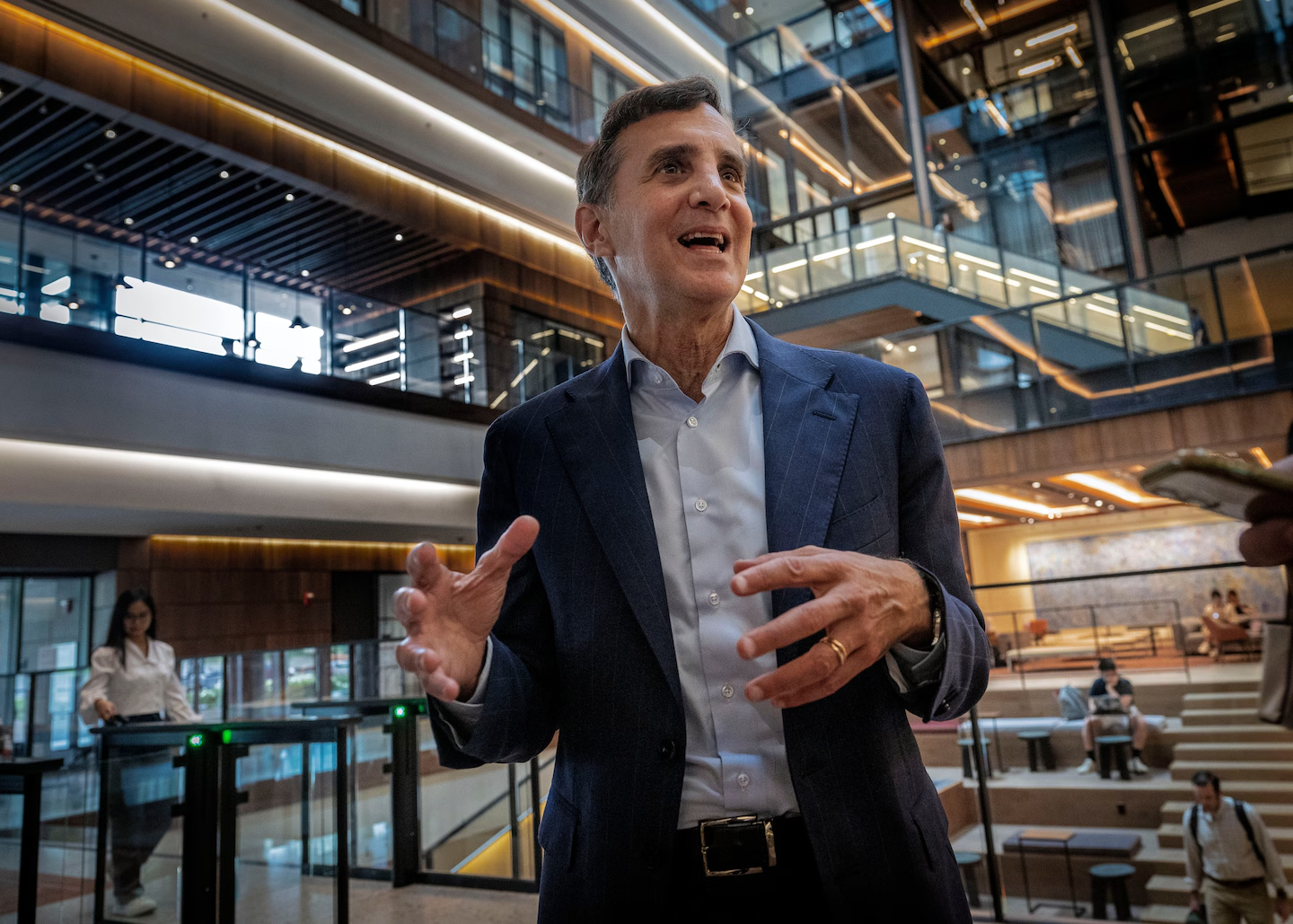
Johns Hopkins University has opened a new academic center in Washington D.C. after a $275 million renovation of the former Newseum building. The university plans to launch a School of Government and Policy within the next few years, alongside its School of Advanced International Studies. The center will provide a prime location for Hopkins to expand its presence in the nation's capital and offer programs focused on climate, sustainability, technology policy, economics, and finance. The move follows a trend of out-of-town universities establishing campuses in Washington D.C. to engage with government and related topics.
Johns Hopkins University will establish a School of Government and Policy in Washington, D.C., as its 10th academic division. The school will leverage the university's expertise in research and discovery to develop data-driven solutions for contemporary policy challenges and effective government. It will emphasize the integration of science, data, and technology in its curriculum, as well as cross-functional skills and capabilities. The School of Government and Policy will be co-located with the School of Advanced International Studies (SAIS) at the Hopkins Bloomberg Center, fostering collaboration and interdisciplinary approaches to address national and global issues. The school is projected to serve 200-250 graduate students and will begin accepting students in the fall of 2026.
A study conducted by Johns Hopkins University found that there were approximately 9,800 additional births in Texas between April and December 2022 following the implementation of SB8, a six-week abortion ban. While the study does not attribute all the additional births to the ban, it suggests that many pregnant individuals in Texas were unable to access abortion services and were forced to continue unwanted or unsafe pregnancies. The research highlights the negative consequences of being denied an abortion, including impacts on physical and mental health, increased likelihood of living in poverty, and struggles faced by families. The study also raises concerns about the potential larger impacts of recent abortion bans, such as the one in Dobbs v. Jackson Women's Health Organization, on the number of live births in states that have restricted or banned abortion.
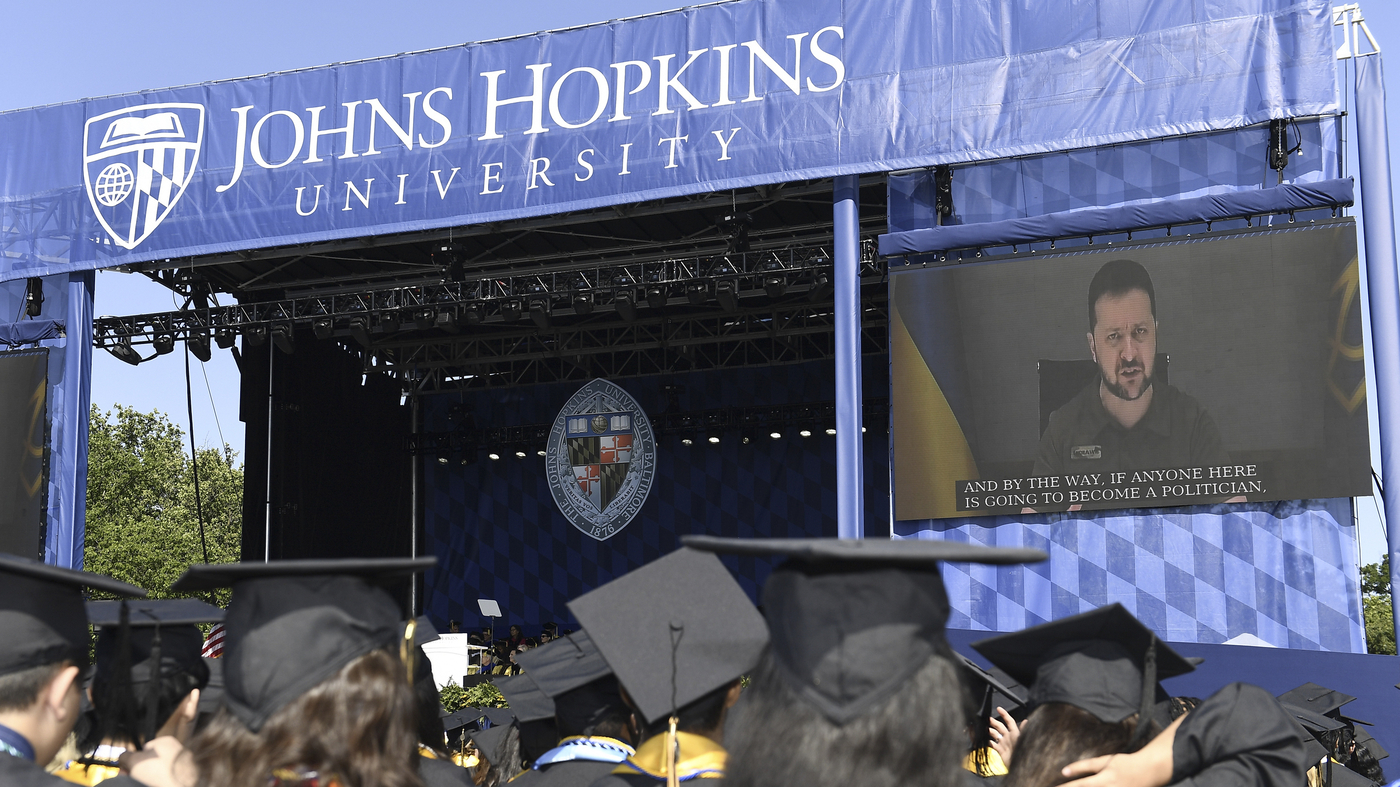
Ukrainian President Volodymyr Zelenskyy surprised the class of 2023 at Johns Hopkins University by delivering a 10-minute commencement speech via live video stream from Ukraine. Zelenskyy spoke about the importance of time and the ideals of freedom, self-determination, and democracy. He also thanked the United States and the Biden administration for their support in Ukraine's defense against Russian aggression. Zelenskyy was presented with an honorary Doctor of Humane Letters degree by Johns Hopkins University President Ron Daniels.