Tag

Astronomical Objects

All articles tagged with #astronomical objects

"Discovery of a Monstrous Protostar in a Distant Nebula"

Originally Published 2 years ago — by Ars Technica

Featured image for "Discovery of a Monstrous Protostar in a Distant Nebula"
Source: Ars Technica

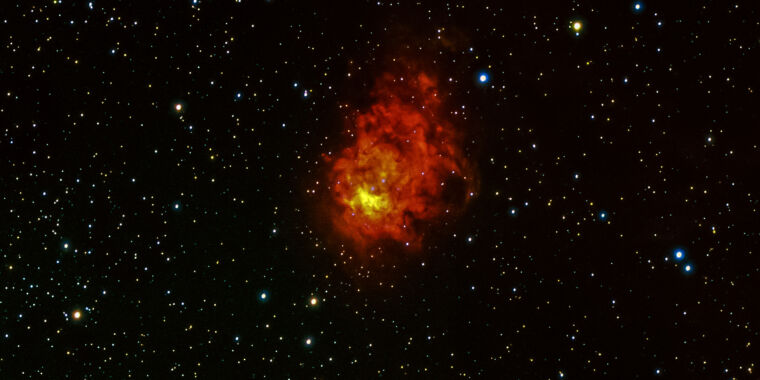
Astronomers have discovered a massive protostar within the NGC 7538 nebula, located 9,000 light-years from Earth in the constellation Cepheus. Estimated to be 300 times larger than our Solar System and with a mass of 2,000 Suns, this gargantuan protostar is a region of active star formation, producing a large amount of hydrogen. The image was captured by Paul Buckley using a Celestron 9.25-inch Edge HD telescope from his backyard in New York.
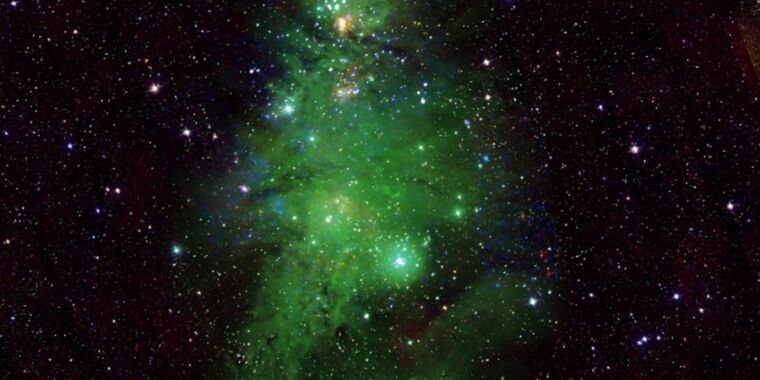
Glowing Green: Telescopes Illuminate Christmas Tree Cluster in Space

Originally Published 2 years ago — by Ars Technica

Featured image for Glowing Green: Telescopes Illuminate Christmas Tree Cluster in Space
Source: Ars Technica

NASA has released a composite image of NGC 2264, also known as the "Christmas Tree Cluster," which showcases the Cone Nebula and the cluster. Located about 2,300 light-years from Earth, these popular astronomical objects are often observed in the night sky. The image combines observations from NASA's Chandra X-ray observatory and ground-based telescopes, and has been rotated to make the "Christmas tree" appear standing.

"Breaking Barriers: The Remarkable Woman Immortalized in Astronomy"

Originally Published 2 years ago — by Ars Technica

Featured image for "Breaking Barriers: The Remarkable Woman Immortalized in Astronomy"
Source: Ars Technica

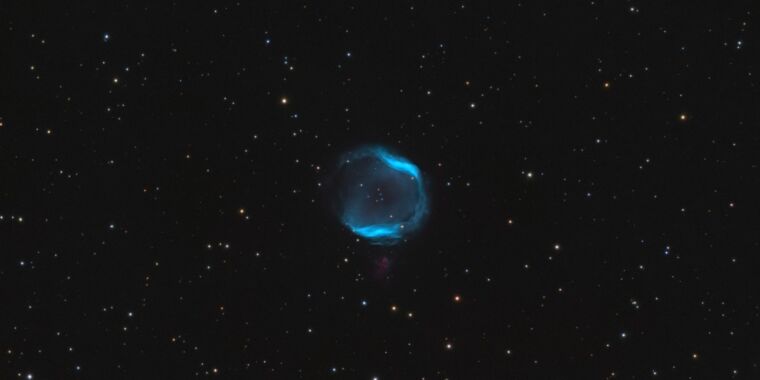
The Jones 1 nebula, a faint nebula located about 2,300 light-years away from Earth, was discovered in 1941 by American astronomer Rebecca "Becky" Jones. Named after her, the Jones 1 nebula is one of the few astronomical objects named after a woman. Jones worked as an assistant to notable astronomers of her time and had a career at prestigious observatories. Despite her relative obscurity, the planetary nebula serves as a reminder of the vastness of the universe and the fleeting nature of human existence.

"Unveiling the Secrets of the Universe: Data Science Revolutionizes Space Exploration"

Originally Published 2 years ago — by Space.com

Featured image for "Unveiling the Secrets of the Universe: Data Science Revolutionizes Space Exploration"
Source: Space.com

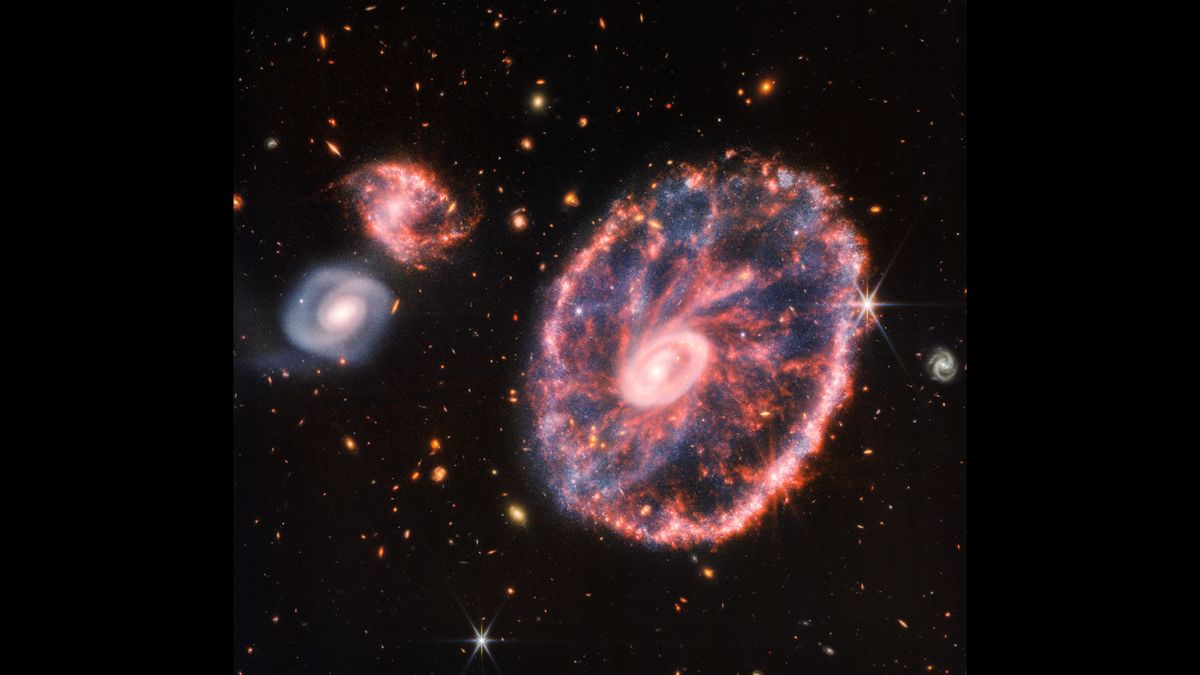
Researchers at Johns Hopkins University have developed a data science method to match astronomical objects across different surveys, allowing for a deeper understanding of the cosmos. By assigning a "score" to pairs of observations from different surveys, the researchers were able to quickly and effectively match objects between 100 different catalogs. This method helps scientists extract more knowledge from the vast amount of data collected by telescopes, contributing to the building of theories about the universe. The team's code is publicly available, and their research was published in The Astronomical Journal.

"Astronomers Call for Removal of 'Violent Colonialist' Magellan from Night Sky"

Originally Published 2 years ago — by The Guardian

Featured image for "Astronomers Call for Removal of 'Violent Colonialist' Magellan from Night Sky"
Source: The Guardian

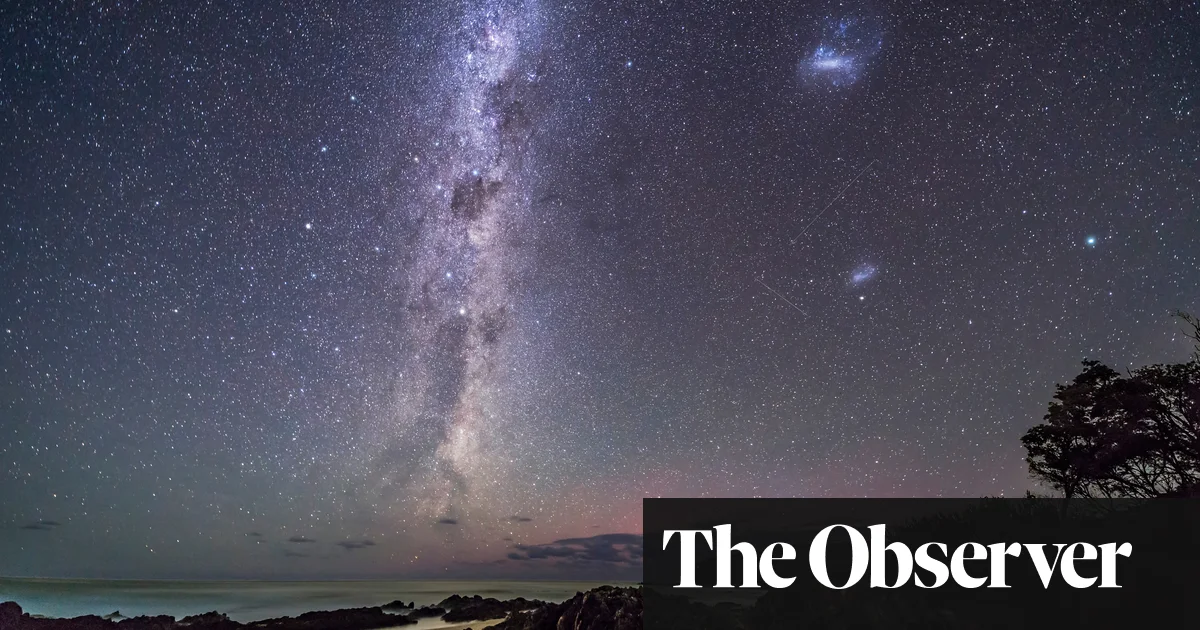
Astronomers are calling for the renaming of the Large and Small Magellanic Clouds, two satellite galaxies of the Milky Way, due to the violent colonialist legacy of Ferdinand Magellan, the 16th-century explorer they are currently named after. Magellan's actions, including murder and enslavement, have led astronomers to argue that his name should no longer be associated with these celestial objects. Indigenous peoples had their own names for the clouds, and it was not until the late 19th century that they were named after Magellan. This call for change reflects a broader movement to rename scientific objects and species with objectionable names.

Astronomers Call for Renaming Magellanic Clouds to Address Colonialist Legacy

Originally Published 2 years ago — by New York Post

Featured image for Astronomers Call for Renaming Magellanic Clouds to Address Colonialist Legacy
Source: New York Post

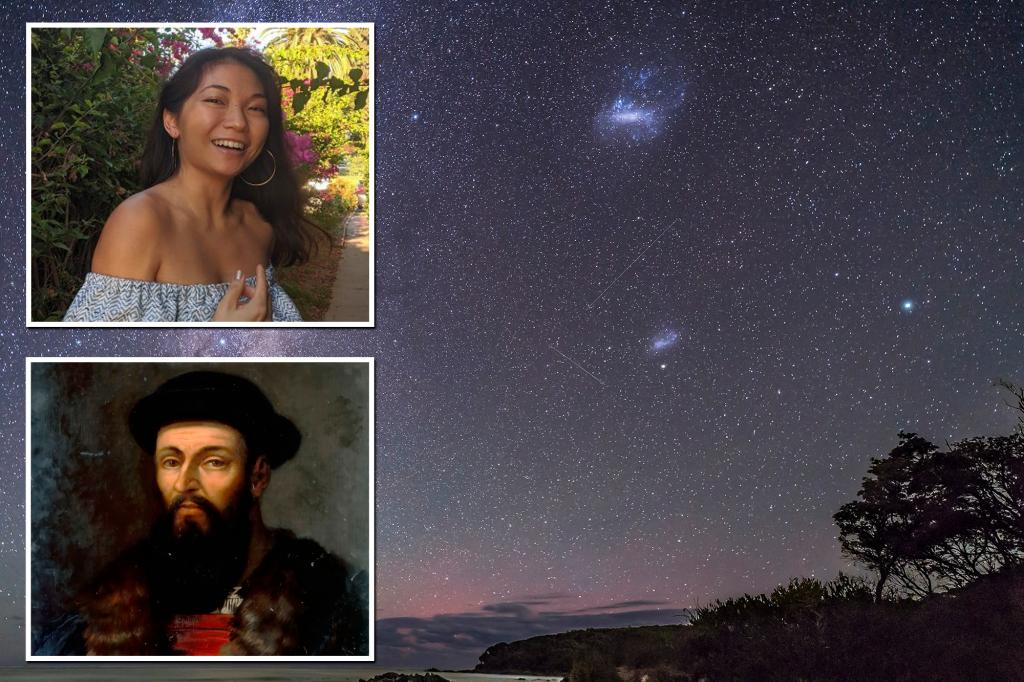
Astronomers are advocating for the renaming of the Large Magellanic Cloud and Small Magellanic Cloud, arguing that the Portuguese explorer Ferdinand Magellan, after whom they are named, had a violent colonialist legacy and no connection to their discovery. The push for a name change is led by Dr. Mia de los Reyes, who argues that indigenous peoples had names for these galaxies that predate Magellan. Many astronomers support the renaming, as Magellan did not discover the galaxies. The proposal will be brought before the International Astronomical Union for a vote.

Unraveling the Mysteries of Distant Astronomical Objects: How Astronomers Study the Unreachable Universe

Originally Published 2 years ago — by The Conversation

Featured image for Unraveling the Mysteries of Distant Astronomical Objects: How Astronomers Study the Unreachable Universe
Source: The Conversation

Astronomers studying distant solar systems rely on remote observations since they can't send spacecraft to gather samples. By measuring apparent properties such as brightness, color, and position, astronomers can indirectly determine essential physical properties of protoplanetary disks, like luminosity and temperature. The recent arrival of the Bennu sample will provide valuable insights into the composition of asteroids and interstellar dust, shedding light on the formation of solar systems.

"Rebranding the Magellanic Clouds: Astronomers Seek New Names"

Originally Published 2 years ago — by Physics

Featured image for "Rebranding the Magellanic Clouds: Astronomers Seek New Names"
Source: Physics

A coalition of astronomers is calling for the renaming of the Magellanic Clouds, the two brightest satellite galaxies of the Milky Way, along with other astronomical objects and facilities that bear the name of Portuguese explorer Ferdinand Magellan. The astronomers argue that Magellan's legacy of colonialism, slavery, and violence against Indigenous peoples should not be honored in the field of astronomy, and that the names of these objects should reflect community values and ideals. They hope that the International Astronomical Union and other astronomical institutions will reconsider the use of Magellan's name.

"Caltech Professor Receives Prestigious Simons Investigator Title"

Originally Published 2 years ago — by Pasadena Now

Phil Hopkins, a professor of theoretical physics at Caltech, has been named a 2023 Simons Investigator, receiving $150,000 in research support per year for five years. Hopkins studies the formation of astronomical objects and uses computer simulations to model their interactions. His research has contributed to understanding the relationships between stars, black holes, and galaxies, and has provided insights into the movement of dust, the missing satellite galaxies in our galaxy, the growth of supermassive black holes, and other phenomena. The Simons Investigator award will support Hopkins' work in developing novel algorithms and expanding our understanding of physics processes on different astrophysical scales.