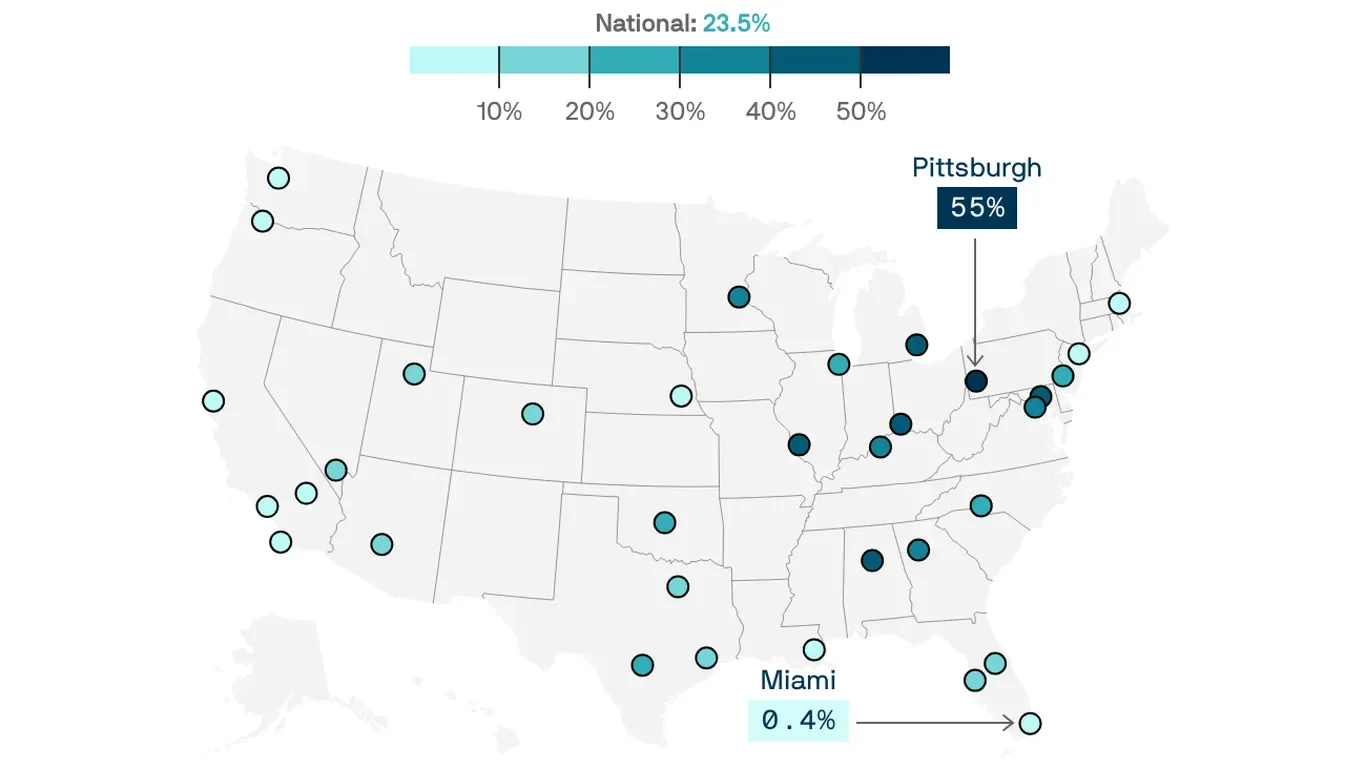
President Trump proposed banning large institutional investors from buying single-family homes to lower prices and improve affordability, but analysts believe the impact would be minimal due to the small market share of such investors and regional variations in ownership.
US household wealth reached a record $181.6 trillion in Q3 2025, driven by a booming stock market fueled by AI investments and rising home prices, despite increased household and government debt. The data was delayed due to a government shutdown.
The housing market shows signs of improvement with declining mortgage rates and slowing home price growth, leading to increased buyer activity and a potential better market for buyers in 2026. However, affordability remains a concern due to high borrowing costs, and economic uncertainties continue to influence buyer confidence and builder activity.
Home prices are stabilizing with slight declines and mortgage rates have decreased, improving affordability for buyers, but high down payment requirements remain a barrier. Increased housing supply and rising pending sales indicate a positive market trend, though the typical time to save for a down payment is still longer than pre-pandemic levels.
Next year may mark a turning point for the US housing market with expectations of increased inventory, stable home prices, and a focus on affordability reforms by the Trump administration, although significant price drops are unlikely in 2026.
Next year may mark a turning point for the US housing market with expectations of increased inventory, stable home prices, and a focus on housing reform by the Trump administration, potentially leading to a more balanced market in 2026.
Housing prices in 2026 are expected to rise, but the growth may be modest and potentially below inflation rates, depending on regional factors and market conditions. While some experts predict a 4% increase, others forecast only around 1-2%, influenced by increased housing inventory and sustained mortgage rates, which could limit price appreciation.
U.S. existing home sales increased slightly in November amid falling mortgage rates, but limited housing inventory and economic uncertainties have restrained a stronger market recovery. The median home price rose to $409,200, and sales were modestly up, though overall demand remains subdued due to labor market concerns and stretched affordability.
November home sales in the US saw a slight increase of 0.5% from October but remained 1% below November 2024, with supply declining and prices reaching record highs, driven by high mortgage rates and limited inventory, while affordability concerns persist despite wage growth.
A new era in the housing market is anticipated as affordability improves for the first time in years, driven by rising incomes and stable mortgage rates, leading to increased sales and a potential market reset by 2026, according to experts.
A new analysis predicts that in 2026, home prices will decline in 22 major U.S. cities, mainly in the Southeast and West, due to increased inventory and reduced demand, while prices in other cities are expected to rise slightly. Mortgage rates are also forecasted to decrease slightly, encouraging more homebuyers and leading to a more balanced housing market.
Home buyers in the US are benefiting from record-level price reductions, with the typical listing seeing around $25,000 in cuts in October, especially in expensive markets like Los Angeles and New York, as the housing market rebalances and homes take longer to sell.
The Boston Foundation's annual report indicates that housing prices and rents in Greater Boston continue to rise sharply, making homeownership increasingly unaffordable for middle-class residents.
High home prices, rising mortgage rates, and a shortage of available homes are making it difficult for first-time buyers, whose average age has reached 40, to enter the housing market, leading to a record low in home sales to first-time buyers and increased financial challenges for young adults.