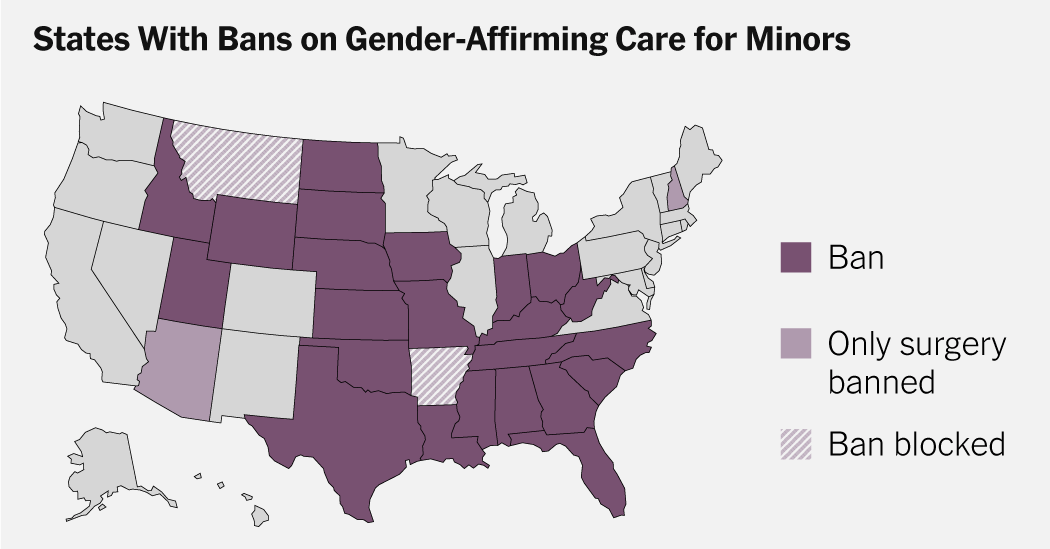
The Supreme Court upheld a Tennessee ban on gender transition treatments for minors, leaving a patchwork of state laws across the U.S. that either restrict or protect access to puberty blockers and hormone therapies for transgender youth, potentially deepening the national divide on this issue.
Wyoming's Republican governor signed a bill banning gender transition care for minors, penalizing health care professionals who provide puberty blockers, hormone therapy, and surgeries to those under 18. With this move, Wyoming joins 23 other states that have passed partial or total bans on gender-affirming care, sparking debate over government intrusion into personal affairs and the rights of parents to make decisions for their children.
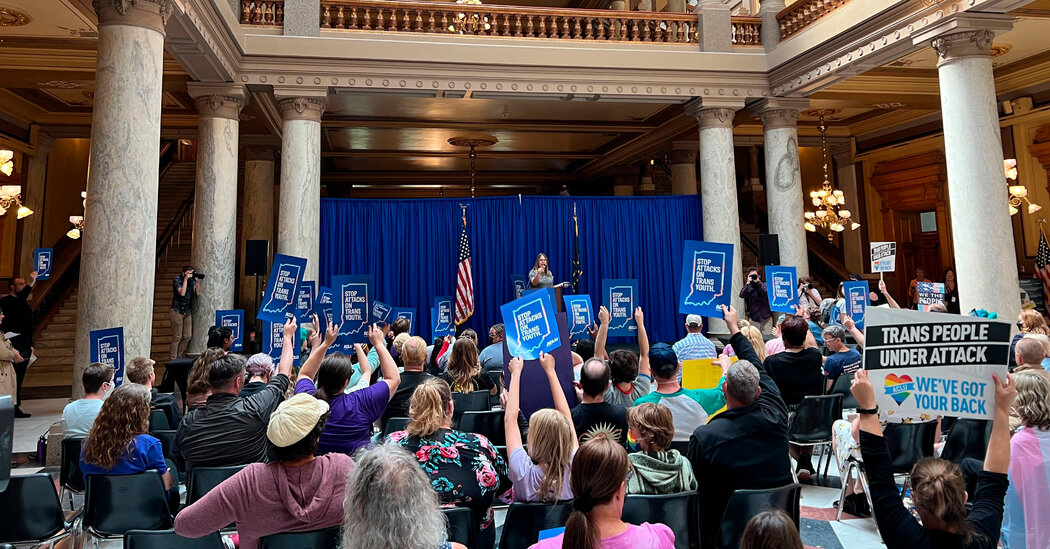
A federal appeals court has allowed Indiana's ban on hormone treatments and puberty blockers for transgender minors to take effect, overturning a lower court decision that had blocked the law. The ruling has unsettled the national legal landscape around transgender care for minors and could lead to abrupt changes in treatment for young people in Indiana, sparking disappointment from the ACLU and the A.C.L.U. of Indiana, who brought the lawsuit challenging the ban. The legality of such bans is expected to ultimately be decided by the U.S. Supreme Court.
A federal judge in Oklahoma has denied a request to temporarily block a state law banning gender transition care for minors under 18. The law, which also criminalizes medical professionals providing such care, has now gone into effect. The law prohibits all forms of gender transition medical treatment, including surgery, hormone therapy, and puberty blockers, and imposes strict penalties on medical providers. Transgender minors already receiving such care must gradually discontinue their treatments. The ruling ends an agreement between the state attorney general and the American Civil Liberties Union of Oklahoma, allowing the law's restrictions to be enforced. The lawsuit challenging the ban's constitutionality will continue to progress through the legal system, with the ACLU planning to appeal the ruling.
Federal judges in Kentucky and Tennessee have temporarily blocked laws that would ban gender-transition care for minors, extending a winning streak for transgender-rights advocates. The rulings come as part of a wave of legislation targeting transgender people that has been halted by the judiciary. The judges cited concerns over constitutionality and discrimination, noting that major health organizations consider transition care safe for teenagers. While bans on transition surgeries for minors will go into effect in both states, the rulings preserve access to puberty blockers and hormone therapy for transgender youth.
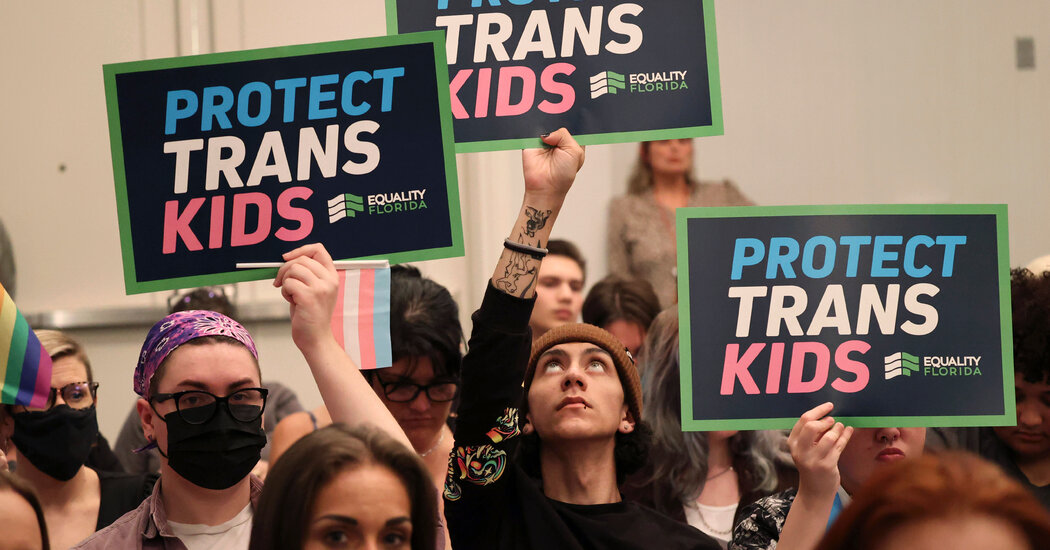
A federal judge in Florida has ruled that three transgender children can be prescribed puberty blockers, despite a new state law that prohibits gender transition care for minors and adds new hurdles for adults who seek similar care. The judge issued a preliminary injunction in response to an emergency request by three Florida families. They and others had sued the state in March over an administrative ban on gender transition care for minors, and then widened their suit to take in the new law after Gov. Ron DeSantis, a Republican, signed it on May 17.
The Florida Legislature has passed a bill that would ban gender-transition care for minors and restrict it for adults, with penalties of up to five years in prison for doctors who violate it. The bill also requires adults seeking gender-transition care to sign a consent form and prohibits such care from being prescribed via telemedicine. Gov. Ron DeSantis is expected to sign it into law. The legislation is one of several measures aimed at LGBTQ+ communities that have been passed during this year's legislative session in Florida. At least 13 states have passed similar restrictions in recent months.