Researchers suggest that dormant infections like Epstein-Barr virus and tuberculosis may contribute to long COVID symptoms, highlighting the need to explore co-infections and immune system interactions for better understanding and treatment of the condition.
Stanford Medicine researchers have linked the Epstein-Barr virus (EBV), which most people carry, to the development of lupus by showing how infected B cells can trigger autoimmune responses, potentially opening new avenues for treatment and prevention.
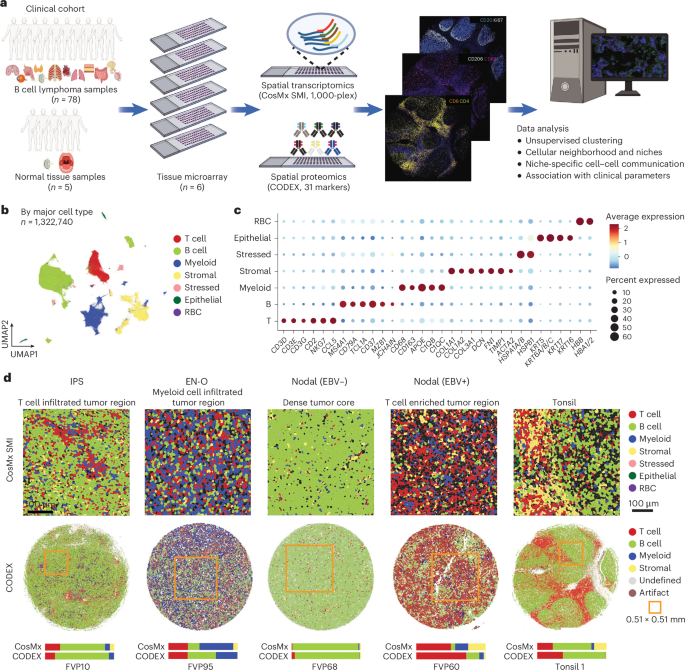
This study used spatial transcriptomics, proteomics, and genomics to analyze the tumor immune microenvironments in diffuse large B-cell lymphoma (DLBCL), identifying distinct cellular neighborhoods and communication patterns that influence immune cell function and tumor behavior, with implications for targeted immunotherapy.
A new WHO study reveals that the Epstein-Barr virus (EBV), which infects most people worldwide, significantly increases the risk of developing various cancers, especially nasopharyngeal cancer, lung cancer, liver cancer, and lymphomas, with the risk rising in proportion to antibody levels. The findings highlight the importance of understanding EBV's role in cancer development and encourage further research into its mechanisms.
Research led by NIH suggests that Epstein-Barr virus (EBV), known for causing mononucleosis, may be linked to serious conditions like cancer, multiple sclerosis, dementia, and long Covid. Efforts to develop vaccines against EBV are underway, highlighting the importance of long-term public investment in science despite political and financial challenges.
A study found that people with multiple sclerosis (MS) have high levels of T-cells in their spinal fluid that specifically target cells infected with the Epstein-Barr virus (EBV), suggesting a potential link between EBV and MS. The findings may help shed light on the processes that drive MS, as infection with EBV has been identified as one of the strongest risk factors for developing MS. The study's data suggest that these T-cells may be either causing the disease or contributing to it, and further research is ongoing to better understand the biological activity of these EBV-specific T-cells.
Research presented at the joint meeting of ECTRIMS and ACTRIMS suggests that a combination of faulty immune regulation, genetics, and specific strains of the Epstein-Barr virus (EBV) may increase the risk of developing MS. Stopping disease-modifying therapy (DMT) can lead to new disease activity, as shown in a study that had to be ended early due to participants experiencing increased disease activity. Encouraging treatment reports include the potential of foralumab to ease brain inflammation in secondary progressive MS, fenebrutinib's ability to reduce new inflammatory lesions in relapsing MS, and ongoing efforts to find ways to curb MS progression.
A new study has found that when the immune system fights off the Epstein-Barr virus (EBV), immune cells can mistakenly target a protein called CRYAB that is normally expressed by healthy myelin-making cells in the brain, which could explain the link between EBV and multiple sclerosis (MS). The study found that certain antibodies against EBV can mistakenly target the brain and spinal cord and cause damage. The researchers also found that cross-reactivity between CRYAB and EBV may play a role in MS, and patients positive for antibodies against both proteins were nine times more likely to have MS.
Viruses like herpes, HIV, Epstein-Barr, and others can cause long-term health issues, including chronic conditions like cancer and autoimmune diseases. Long COVID is the latest long-term condition caused by a virus, and researchers are studying its similarities to other post-viral fatigue ailments. While some viruses are transient and go away quickly, others like EBV can linger for years or even a lifetime. There are currently over 300 clinical trials for long COVID treatments, and prevention options like Paxlovid and metformin are showing promise. Long COVID specialty clinics are now available in every state except South Dakota and Kansas.
Researchers have found a link between the Epstein-Barr virus (EBV), which causes mono, and multiple sclerosis (MS). While most people will get EBV at some point, only a small percentage will develop MS. However, researchers believe that developing a vaccine against EBV could make MS a thing of the past. Additionally, antiviral drugs could be developed to help high-risk patients with mono get through the illness faster and safer. Moderna has an EBV vaccine in early-stage trials.