Christine Lagarde's salary is reported to be 50% higher than what the European Central Bank has officially disclosed, raising questions about transparency and disclosure practices.
Christine Lagarde warns that if President Trump undermines the independence of the US Federal Reserve, it could pose a serious danger to the global economy, emphasizing the importance of central bank independence for economic stability.
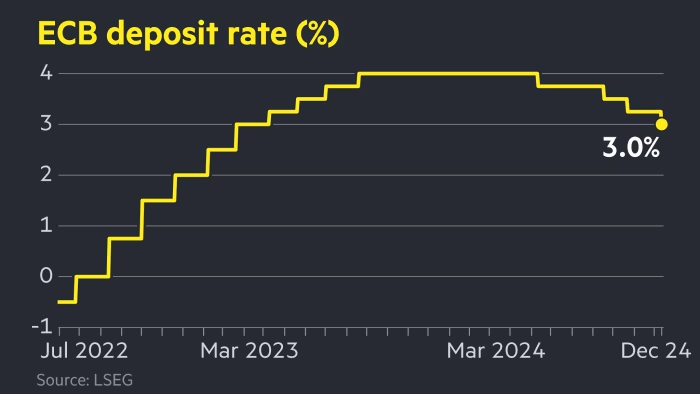
The European Central Bank (ECB) has reduced its interest rates by a quarter-point to 3%, marking its fourth rate cut since June, as it shifts to a more dovish stance amid weaker growth forecasts for the Eurozone. ECB President Christine Lagarde indicated that further rate cuts are likely, with the central bank dropping its commitment to maintain restrictive policy rates. The decision comes as the Eurozone faces economic challenges, including potential trade tensions with the US under Donald Trump's presidency. The ECB's growth forecasts for the coming years have been lowered, and investors expect more rate cuts compared to the US Federal Reserve.
Christine Lagarde, head of the European Central Bank, has urged European leaders to negotiate with President-elect Donald Trump and increase purchases of American products to avoid a trade war that could harm global economic growth. Lagarde suggests a "cheque-book strategy" to buy US goods like liquefied natural gas and defense equipment, rather than retaliating against Trump's proposed tariffs on non-Chinese imports. She emphasizes the need for Europe to transform this challenge into an opportunity to boost its economic competitiveness.
The European Central Bank is expected to hint at a potential interest-rate cut in September, with President Christine Lagarde likely to provide clues during the upcoming meeting, as policymakers take a summer break to evaluate inflation pressures.
The European Central Bank is expected to announce its first interest rate cut since 2019 at its meeting in Frankfurt, despite ongoing inflationary pressures in the euro zone. Markets have priced in a 25 basis point reduction, with further cuts anticipated later in the year. Investors are closely watching ECB President Christine Lagarde's statements and the new economic projections. This move would position the ECB ahead of the U.S. Federal Reserve in reducing rates, as other central banks like Canada, Sweden, and Switzerland have already done.
Christine Lagarde, the head of the European Central Bank, has expressed concerns about the US plan to raise debt against Russian assets, citing potential legal risks. This move could have implications for international finance and may face legal challenges.
European Central Bank President Christine Lagarde indicated that the ECB is poised to cut interest rates in the near future, contingent on no major shocks. Lagarde emphasized the bank's vigilance regarding oil prices amid concerns over potential spillover conflicts in the Middle East. The ECB's shift in language suggests a possible rate cut in June, with policymakers closely monitoring inflation and geopolitical risks. ECB policymaker Olli Rehn highlighted the impact of Iran-Israel tensions and the Russia-Ukraine war on the central bank's monetary policy, while investors have reduced expectations for Federal Reserve rate cuts.
IMF Managing Director Christine Lagarde has emphasized that China is at a critical juncture in its economic reforms, urging the country to prioritize measures that will boost domestic demand. Lagarde's comments come as China faces increasing pressure to address its economic imbalances and shift towards a more sustainable growth model.
European Central Bank President Christine Lagarde is set to hold a press conference following the bank's decision to keep interest rates unchanged for the third consecutive meeting, in response to the significant drop in euro zone inflation.
Investors are betting that the European Central Bank will start cutting interest rates, possibly as soon as April, due to slowing inflation and a weak economy in the eurozone. However, policymakers are trying to delay expectations of rate cuts, with the central bank holding rates steady at 4 percent on Thursday. President Christine Lagarde stated that rates could come down in the summer, emphasizing the need for the region to be further along in the disinflation process before being confident that inflation will stay at the target of 2 percent.
A union-run survey of European Central Bank employees has revealed widespread dissatisfaction with President Christine Lagarde's leadership, with many accusing her of fostering a negative atmosphere and focusing too much on topics unrelated to monetary policy. Over half of the nearly 1,100 respondents rated her performance as "very poor" or "poor," with concerns raised about her communication of monetary policy and her suitability for the role. Lagarde's leadership style was described as autocratic, and there were perceptions that she was using the role to further her personal image. The ECB has been battling inflation with a record run of interest rate hikes, and its latest monetary policy decision is due soon.
A survey conducted by the European Central Bank's staff union revealed that employees believe Christine Lagarde is performing poorly as president. The survey results indicate dissatisfaction with Lagarde's leadership, raising concerns about her ability to effectively lead the ECB.
ECB President Christine Lagarde emphasized the need for Europe to strengthen itself in preparation for a potential return of Donald Trump to the White House, stating that a strong Europe is the best defense. She highlighted the importance of a strong, deep market and real single market, as well as increased investment in capital markets to fund initiatives like the green transition. German Finance Minister Christian Linder also stressed the significance of market investment for Europe's self-sufficiency and fostering a stronger transatlantic relationship, particularly in the face of potential euroskeptic leadership in the U.S.
European Central Bank President Christine Lagarde stated in an interview at Davos that it is likely the ECB will cut interest rates in the summer, despite policymakers pushing back against market expectations for such a move.