The article discusses the European Central Bank's (ECB) recent actions and the increasing speculation surrounding its monetary policy decisions, highlighting concerns and market reactions.
The European Central Bank's digital euro project is approaching a critical decision point with a decisive vote expected in 2026, marking a significant step in the development of a central bank digital currency in Europe.
Christine Lagarde's salary is reported to be 50% higher than what the European Central Bank has officially disclosed, raising questions about transparency and disclosure practices.
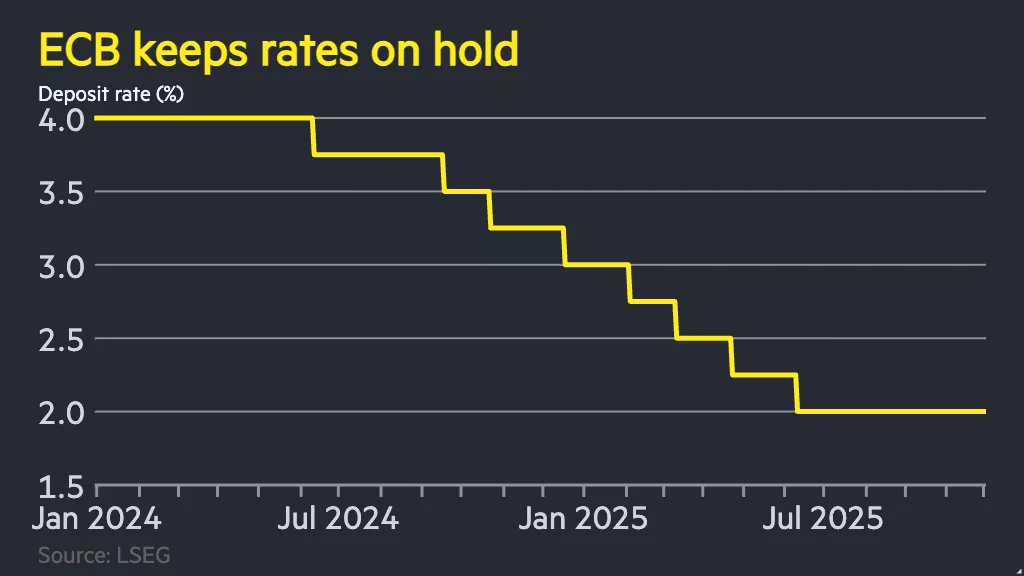
The ECB has decided to keep interest rates unchanged, reaffirming its commitment to a 2% inflation target, with projections indicating inflation will stabilize around this level by 2028 amid a resilient economy and cautious global risks.
The European Central Bank has refused to provide emergency liquidity for Ukraine's reparations loan using seized Russian assets, citing legal and independence concerns, complicating the European Commission's plan to support Ukraine financially through this unprecedented scheme.
The European Central Bank decided to keep its key interest rates unchanged, citing stable inflation near 2% and resilient economic growth despite global uncertainties. The ECB will continue to monitor economic data closely and is prepared to adjust its policies as needed to ensure inflation stabilizes at its target, with no pre-commitment to a specific rate path.
The euro zone economy grew by 0.2% in Q3, driven by France and Spain, despite stagnation in Germany and Italy, with the ECB likely to hold rates steady amid rising inflation and positive economic signals.
EU finance ministers and ECB have agreed on the next steps for the digital euro, a digital currency backed by the European Central Bank, including giving ministers a say in issuance and holding limits, as progress is made despite legislative delays and concerns over banking impacts and privacy.
The digital euro, a proposed virtual version of the euro backed by the ECB, aims to modernize payments and reduce reliance on foreign tech giants, but faces significant political and legislative hurdles in Brussels, with debates over privacy, banking industry impact, and legal framework likely delaying its implementation until at least 2028.
The European Central Bank (ECB) has decided to keep interest rates unchanged and forecasts that inflation will fall below its target next year, reflecting cautious monetary policy amid economic uncertainties.
The European Central Bank's President Lagarde is expected to face scrutiny over issues related to France, amid upcoming leadership changes at the ECB and ongoing economic uncertainties influenced by US trade disputes and political tensions.
ECB President Christine Lagarde warns that President Trump's attempts to influence the Federal Reserve threaten global economic stability, emphasizing the importance of US monetary independence and noting the legal and political challenges Trump faces in firing Fed officials. She also comments on political risks in France and the stability of the French banking system amid current uncertainties.
The European Central Bank paused its year-long interest rate cuts, holding rates at 2% amid economic uncertainty and trade tensions with the US, waiting for clarity on tariffs' impact before deciding on further policy actions.
The upcoming week in markets will focus on a busy earnings season with major companies reporting, ongoing trade negotiations between the US and its partners, the European Central Bank's policy decision, potential new US AI regulations, and key economic indicators like flash PMI figures, all amid a backdrop of economic resilience despite trade tensions.