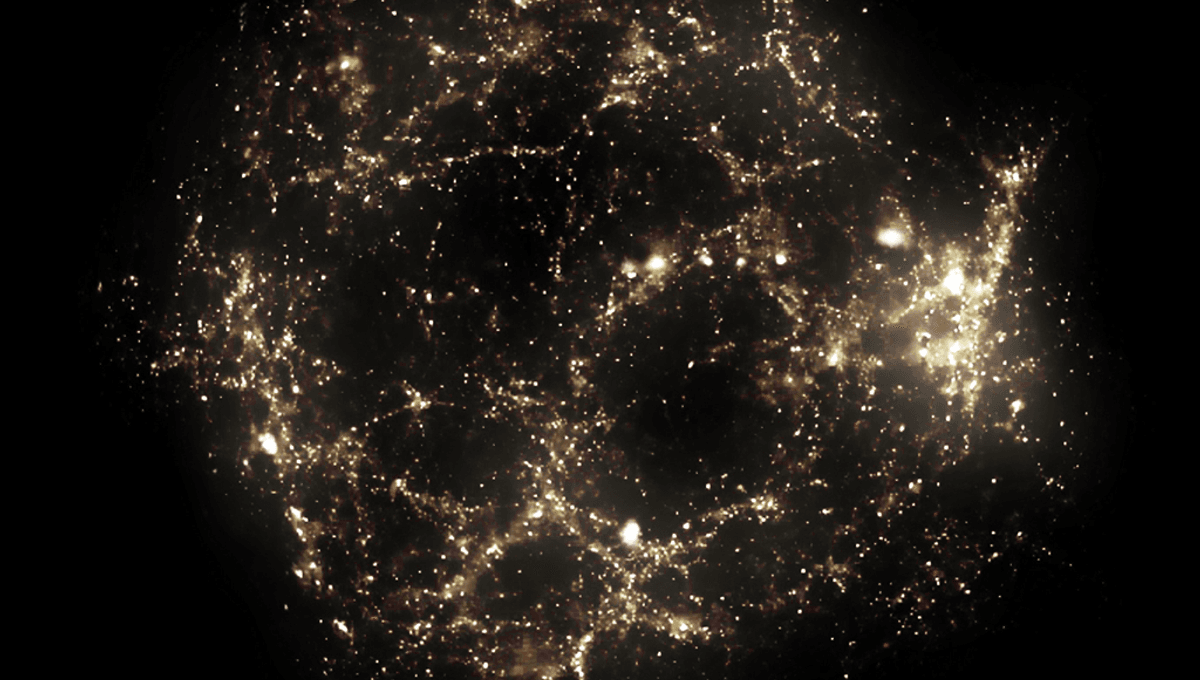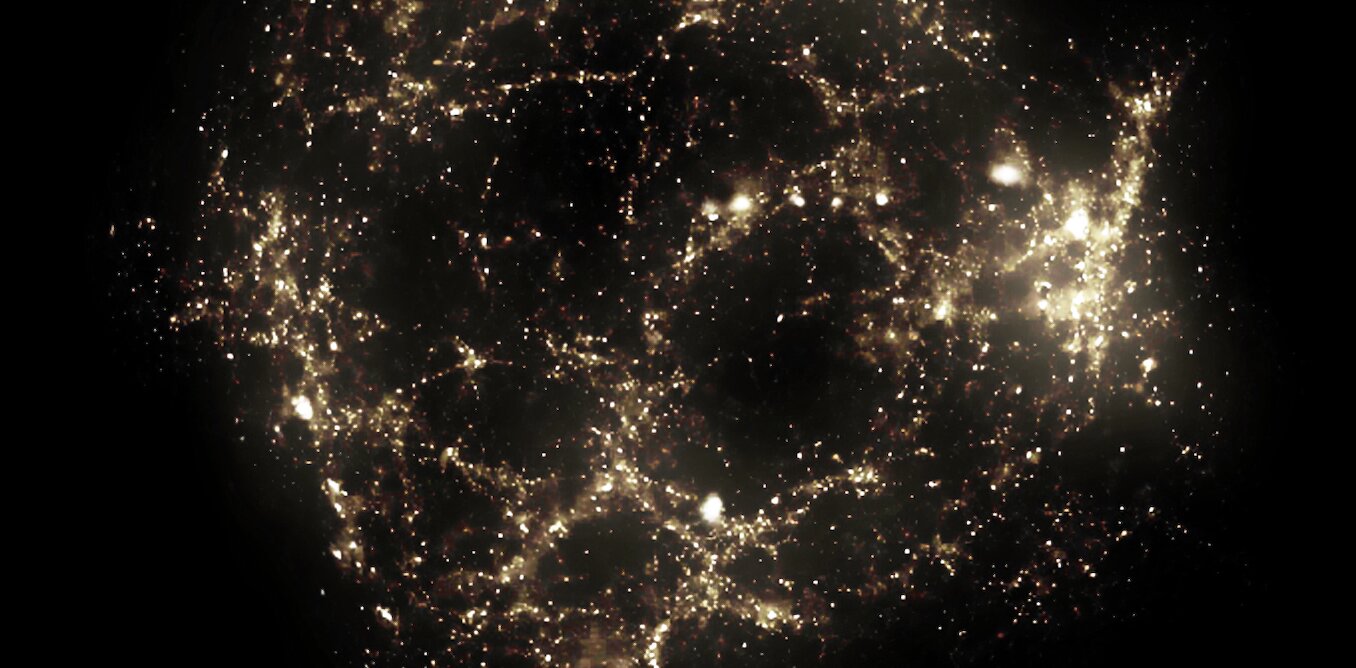
Scientists propose that Earth and the Milky Way may reside in a large, low-density void, which could explain the discrepancy in the universe's expansion rate known as the Hubble tension. Evidence from baryon acoustic oscillations supports this theory, suggesting our local universe expands faster than expected, potentially resolving key cosmological questions about the universe's age and structure.
Scientists propose a new theory suggesting that our galaxy might be surrounded by a void, referred to as a "Hubble Bubble," which could explain the acceleration of the universe's expansion. Real-world observations have not aligned with the current theory of the Hubble-Lemaitre constant, which states that the speed at which galaxies move away from each other is directly proportional to their distance. The researchers suggest that our galaxy is inside a large, empty void, creating a lower density region of space around us. This theory challenges current models and calls for a reexamination of the fundamental laws used to understand the cosmos.
Scientists from Germany, Scotland, and the Czech Republic propose that our galaxy may be situated in a region of space with relatively little matter, resembling an "air bubble in a cake." This hypothesis arises from discrepancies in the Hubble-Lemaitre constant, which measures the distance and speed at which galaxies move away from each other. The researchers suggest that a local "under-density" or void in the universe could explain these deviations, challenging the standard model of cosmology. They propose a modified theory of gravity called "modified Newtonian dynamics" (MOND) to account for the existence of such bubbles. If true, this theory would resolve the Hubble tension and potentially reshape our understanding of the universe's expansion.
Recent observations suggest that our galaxy may exist in a void, an expansive region with significantly less matter. This finding challenges the Hubble-Lemaitre constant and demands a reevaluation of the standard model of the universe. The theory supports the concept of modified Newtonian dynamics proposed by physicist Mordehai Milgrom. Further research is needed to validate this hypothesis and resolve the Hubble tension, a discrepancy in the measurement of the Hubble constant. Alternative theories of gravity and the reluctance to overhaul the Lambda-CDM model are also discussed.
Scientists propose that the "Hubble tension," the discrepancy between the predicted and observed rate of the universe's expansion, could be explained by the existence of a giant void in space. This void, with below-average density, would cause outflows of matter that inflate local measurements of the expansion rate. The researchers developed a model based on Modified Newtonian Dynamics (MOND) and found that it aligns well with observations of the bulk flow of galaxies. These findings challenge the standard model of cosmology and suggest the need to revise our understanding of gravity on larger scales.
Researchers from the University of Bonn and St Andrews propose a new theory to explain the "Hubble tension" - the discrepancy between the observed and predicted rate of the universe's expansion. They suggest that our solar system is located in a region with a lower density of matter, creating a void where galaxies move away from each other faster than expected. This finding challenges the current standard model and supports the idea of modified Newtonian dynamics, which could resolve the Hubble tension. Further scientific scrutiny is needed to validate this theory.
Scientists propose that the "Hubble tension" - the discrepancy between the predicted and observed rate of the universe's expansion - could be explained by the existence of a giant void in space. This void, with below-average density, would cause outflows of matter that inflate local measurements of the expansion rate. The researchers developed a model based on Modified Newtonian Dynamics (MOND) and found that it aligns well with observations of the bulk flow of galaxies. These findings suggest that the standard model of cosmology, Lambda-cold dark matter (ΛCDM), may need to be revised, potentially requiring changes to our understanding of gravity on larger scales.
Researchers propose that we live in a giant void in space, which could explain the discrepancy in the rate of the universe's expansion known as the Hubble tension. The void, with below-average density, would cause outflows of matter that inflate local measurements. This theory is based on an alternative model called Modified Newtonian Dynamics (MOND), which suggests that gravity behaves differently in weak gravitational fields. Recent observations of galaxy velocities support this idea, showing a quadruple speed compared to the standard model. These findings challenge the current understanding of cosmology and may require a revision of Einstein's theory of gravity.
Scientists propose that the "Hubble tension," the discrepancy between the predicted and observed rate of the universe's expansion, could be explained by the existence of a giant void in space. This void, with below-average density, would cause local measurements of the expansion rate to be inflated due to outflows of matter from the void. The researchers tested this idea using an alternative theory called Modified Newtonian Dynamics (MOND) and found that it matched various cosmological observations. The existence of a deep and extended local void, as well as the fast observed bulk flows, suggests that structure grows faster than expected in the standard model of cosmology. This may indicate the need to extend Einstein's theory of gravity on larger scales.
Astronomers are turning their attention to studying cosmic voids, regions of space that are less dense than the universe, to gain insights into the expansion of the universe and solve the Hubble tension. By using mathematical tools called Voronoi diagrams, researchers have identified about 6,000 voids and modeled how the expansion of the universe affects their characteristics. The results suggest that voids could serve as time capsules of the early universe and provide clues about the physics of that time. However, more data is needed to reach statistical significance and reconcile the discrepancies between different measurement methods.