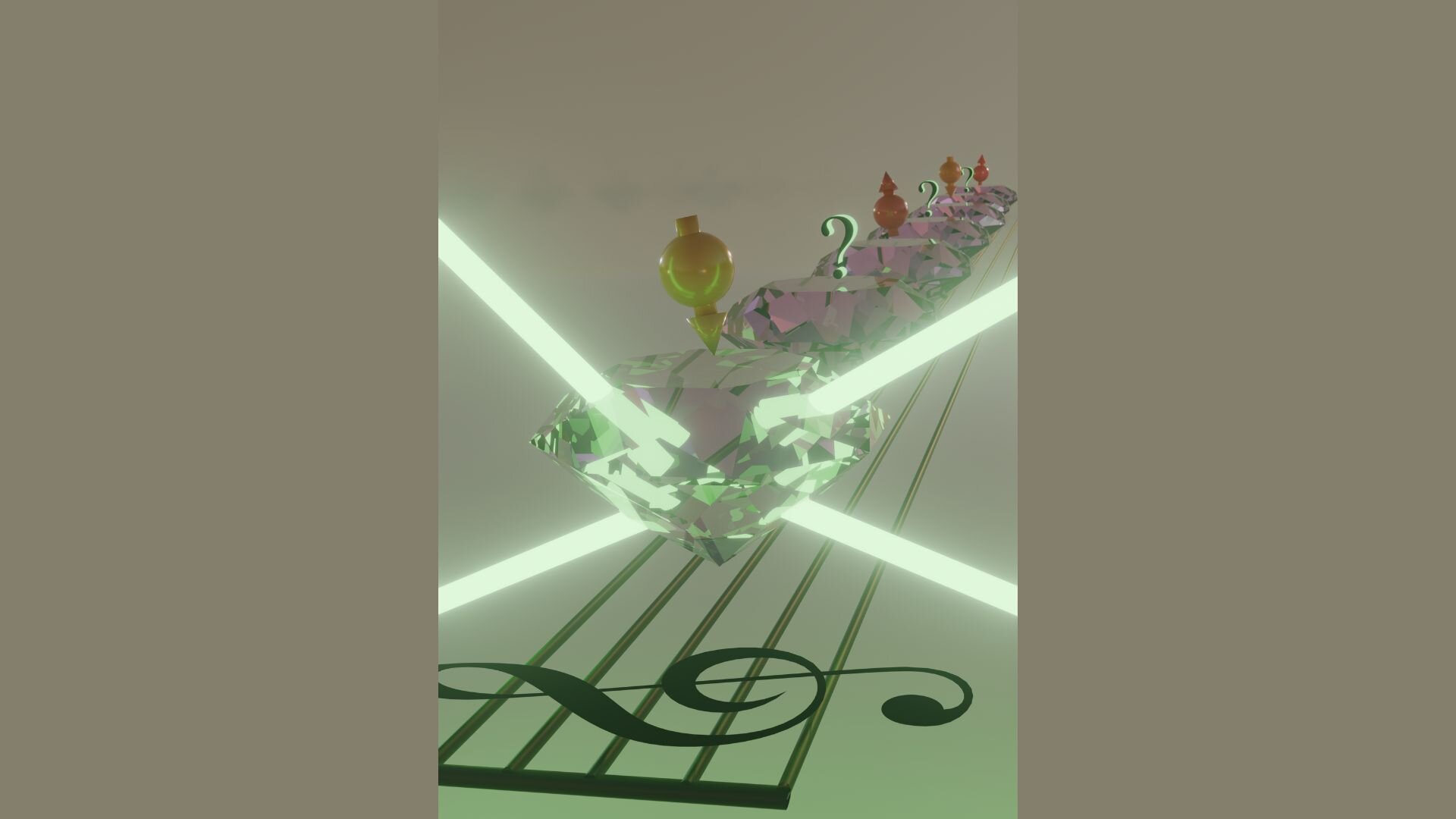
Scientists have experimentally observed a new phase called the time 'rondeau' crystal, where long-range temporal order coexists with short-term disorder in nuclear spins within diamond, demonstrating a novel form of non-equilibrium matter that combines predictable periodic behavior with controllable randomness.
Scientists at the University of Colorado Boulder have created visible, room-temperature space-time crystals using common liquid crystals, which pulse rhythmically without external energy, potentially revolutionizing secure data storage, anti-counterfeiting, and optical communication technologies.
Scientists at TU Wien have discovered that quantum correlations between particles can stabilize the formation of time crystals, where a system spontaneously develops a repeating rhythm in time without external influence, challenging previous assumptions about their formation and opening new avenues in quantum research.
Physicists at the University of Colorado Boulder have created the first visible, macroscopic time crystal using liquid crystals and light, demonstrating continuous, repeating patterns over time that could have applications in anti-counterfeit technology and deepen understanding of complex matter.
This week in science, NASA found the best evidence yet of potential past life on Mars, confirmed Stephen Hawking's black hole theory, scientists created visible time crystals, and a mysterious toxic barrel graveyard was studied off Los Angeles. Additionally, strange lights in Chile and a glowing green interstellar comet captured attention, highlighting ongoing discoveries and mysteries in space and Earth sciences.
Scientists at UC Boulder have created the first visible time crystal, a new phase of matter that repeats its pattern over time, which could have future applications in data storage and anti-counterfeiting technologies.
Scientists have created the first visible time crystals using light and liquid crystals, opening potential applications in anti-counterfeiting, data storage, and telecommunications. These crystals, which break symmetry in time and are visible under microscopes, could lead to innovative security features for currency and advanced technological uses.
Physicists have created the first visible time crystal using liquid crystals, which could lead to new technological innovations such as anti-counterfeiting, optical devices, and quantum exploration. The time crystal exhibits a repeating pattern in time, breaking time symmetry, and was observed as neon-hued stripes under a microscope. This breakthrough opens new avenues for research and practical applications in various fields.
Physicists have successfully transformed a quantum processor into a time crystal, a state of matter that could enhance the practicality of quantum computing by reducing errors. Time crystals, which exhibit periodic motion without external influence, were proposed by Frank Wilczek in 2012. This breakthrough, achieved by a team from China and the US, demonstrates the potential of using topological time crystals to maintain stability in quantum systems, even amidst environmental noise. The research, published in Nature Communications, marks a significant step towards more reliable quantum computing.
Scientists from TU Dortmund University have achieved a major breakthrough in physics by creating a time crystal that lasted for an astonishing 40 minutes, a significant improvement over previous attempts. Time crystals, which exist in a dimension beyond our typical 3D perception, could have game-changing applications in quantum computing. The crystal was created using a semiconductor crystal of indium gallium arsenide doped with silicon, and its repeating oscillations lasted far longer than any continuous time crystal before it. This achievement opens up possibilities for longer-lasting time crystals with potential applications that are yet to be fully understood.
Scientists from TU Dortmund have achieved a major breakthrough in physics by creating a time crystal that lasted for an astonishing 40 minutes, a significant improvement over previous attempts. Time crystals, which exist in a dimension beyond our typical 3D perception, could have game-changing applications in quantum computing. The crystal was created using super-cooled atoms and lasers, and its potential uses are still largely unknown, but the achievement opens up new possibilities for the future of this fascinating field of study.
Scientists from TU Dortmund University have achieved a major breakthrough in physics by creating a time crystal that lasted for an astonishing 40 minutes, a significant improvement over previous attempts. Time crystals, which exist in a dimension beyond our typical 3D perception, could have game-changing applications in quantum computing. The crystal was created using a semiconductor crystal of indium gallium arsenide doped with silicon, and its oscillations lasted far longer than any continuous time crystal before it. This achievement opens up possibilities for longer-lasting time crystals with potential applications that are yet to be fully understood.
Scientists at TU Dortmund University have successfully created an ultra-robust time crystal within a semiconductor material, demonstrating its ability to maintain periodic oscillations for roughly 40 minutes, a significant improvement over previous attempts. This breakthrough has potential applications in quantum computing, where time crystals could stabilize qubits, and in timekeeping devices, where their intrinsic temporal regularity could enhance precision. The development of a stable time crystal in a semiconductor system opens the door to further experimental investigation and real-world applications, while also challenging conventional understanding of non-equilibrium thermodynamics.
Physicists from TU Dortmund University have achieved a new record in time crystal research by creating one that lasted at least 40 minutes, which is 10 million times longer than the previous record. Time crystals are unique in that they exhibit rhythmic changes in physical properties without external influence, defying the laws of thermodynamics and remaining in perpetual motion.
Physicists have recreated the famous double-slit experiment, which showed light behaving as particles and a wave, in time rather than space. The experiment relies on materials that can change their optical properties in fractions of a second, which could be used in new technologies or to explore fundamental questions in physics. This groundbreaking experiment could lead to the development of ultrafast, parallelized optical switches and pave the way for future research in time crystals and metamaterials.